Britain urges Asia to act over surging trade in rhinoceros horn
Belief it can cure cancer has led to a huge rise in poaching of endangered animals
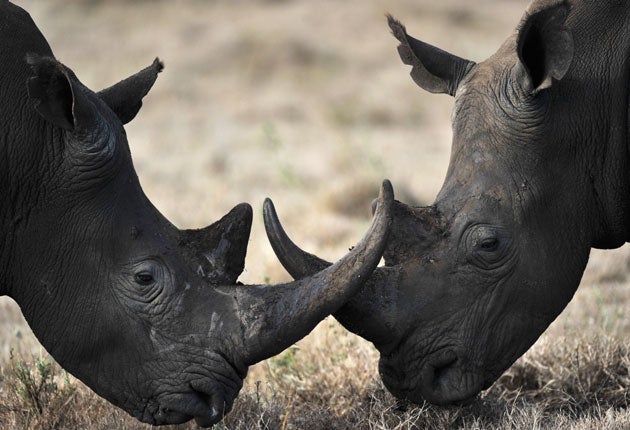
Britain is to ask China, Vietnam and other Asian countries to tell their citizens that rhino horn has no medicinal value, in an attempt to halt a wave of rhino poaching that may drive the endangered animals to extinction.
Although long known as a powdered ingredient in traditional Asian medicine, a recent belief in its power to cure cancer has seen prices for rhino horn surge to £50,000 a kilogram – more than the price of gold or cocaine.
The sky-high price has sparked a spate of museum burglaries in Britain and Europe, with mounted rhino trophy heads being targeted for the value of the horn. More significantly, it has directly produced a substantial surge in rhino poaching in southern Africa.
Between 2000 and 2007, South Africa saw about 12 rhinos poached each year, but by 2010 it had reached 333. This year, more than 200 have already been killed and conservationists are increasingly alarmed about the future of the species, with most of its populations already classified as critically endangered.
Now Britain is putting forward a request on behalf of the European Union for Asian nations to mount "appropriately targeted" awareness-raising campaigns for their citizens, highlighting the lack of evidence in support of the horn's alleged medicinal properties. British officials will speak at a week-long meeting, beginning in Geneva today, of the committee of the Convention on International Trade in Endangered Species (Cites).
"The demand for rhino horn in traditional Asian medicine is driving a new wave of poaching and the decline of rhino populations," Richard Benyon, the UK Wildlife minister, said. "The price is now very high. But rhino horn is basically keratin, which is the same stuff as our hair and fingernails, and it has no healing properties.
"The world community cannot sit back and just watch these species disappear, and we want to help debunk the myth of rhino horn's healing powers."
Mr Benyon denied the request would be seen as interfering in the internal affairs of countries such as China and Vietnam. "I don't think it is preachy – it's just asking these counties to recognise that there is a problem within their borders," he said.
The proposal, which Britain sponsored through the EU, also asks all member states of Cites to tighten up controls on the trade in rhino horn and seeks the establishment of a working group to make recommendations for the next full meeting of Cites in two years.
Commerce in the world's five species of rhino – white, black, Indian, Javan and Sumatran – is banned by Cites, except for populations of the southern white rhino in South Africa and Swaziland, whose products can legally be traded with permits. It is possible the next Cites meeting will change this.
Traditional Asian medicine has been blamed for forcing the decline of other endangered species through poaching, notably the tiger, whose body parts are prized.
The demand for rhino horn is based on what is considered a modern urban myth, widely circulating in Asia – that a senior politician in Vietnam who was allegedly dying of liver cancer was cured after taking a dose of powdered rhino horn.
Although the story is frequently repeated, no one can actually put a name to the politician, supposed to be a former Vietnamese prime minister. Yet this has not stopped it from driving the price to unprecedented levels.
Britain tightened its own regulations on the export of rhinoceros horn last year after wildlife-trade officials noticed that horn and other rhino products – such as antique trophy heads – were beginning to fetch huge sums at auction and were often being re-exported to the Far East.
Now it is virtually impossible to get a permit to export rhino horn from Britain. Earlier this year, the Government persuaded the EU to bring in a similar tightening of regulations across its 27 member states.
Yet, at the same time, a series of targeted burglaries began in museums holding rhino heads in Britain and in continental Europe. Last month burglars broke into Ipswich Museum and sawed off the 18in horn of Rosie, the head of an Indian rhino that had been there since 1907.
In February, the mounted head of a black rhino was taken from Sworders Fine Art Auctioneers in Stansted Mountfitchet, Essex. And in May a similar head was taken from the Educational Museum in Haslemere, Surrey.
In Belgium, there have been three such raids on museums in less than two months, the most recent being 10 days ago at the Africa Museum in Namur.
Rhinos at risk
There are five species of rhinoceros. All except the southern species of the white rhino are regarded as threatened.
* The white rhino (Ceratotherium simum) is split between two sub-species. The southern white is the most abundant type, with more than 17,000 known worldwide, of which the majority are in South Africa. By contrast, the northern white rhino is probably extinct in the wild; four were last seen in 2006 in the Democratic Republic of Congo but no further signs have been seen since then, despite intensive surveys. A small number of the animals survive in captivity.
* The black rhino (Diceros bicornis), which is found in southern Africa, is listed as critically endangered; about 5,000 remain.
* The great Indian rhino (Rhinoceros unicornis) is found only in India, Bhutan, Burma and Nepal and is listed as 'vulnerable'; fewer than 3,000 remain.
* The Sumatran rhino (Dicerorhinus sumatrensis) is found only in Indonesia, Malaysia, Burma, Thailand and Vietnam and is listed as critically endangered; perhaps fewer than 300 animals remain.
* The Javan rhinoceros (Rhinoceros sondaicus) is found only in Indonesia and Malaysia, is critically endangered and is perhaps the rarest large mammal on earth, with fewer than 50 of the creatures remaining.
Join our commenting forum
Join thought-provoking conversations, follow other Independent readers and see their replies
Comments