Call to ban pesticides linked to bee deaths
MPs to debate effect of chemicals blamed for weakening resistance to killer viruses
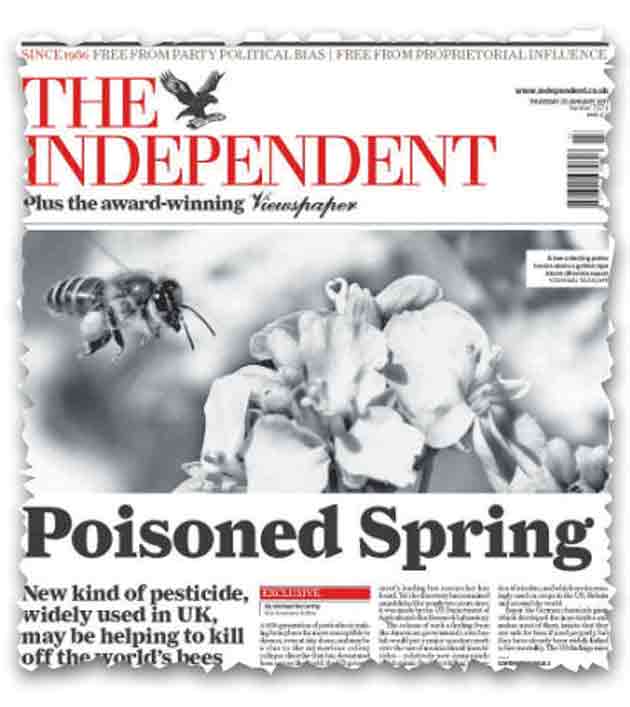
The House of Commons is to debate the impact on bees and other insects of the new generation of pesticides that has been linked to bee mortality in several countries.
The Government will be called on to suspend all neonicotinoid pesticides approved in Britain, pending more exhaustive tests of their long-term effects on bees and other invertebrates. The subject will be raised in an adjournment debate in the Commons next Tuesday on a motion tabled by Martin Caton, the Labour MP for Gower.
Although the chemicals have been banned in several countries, including France, Germany and Italy, and the Co-op has prohibited their use in farms in Britain from which it sources fruit and vegetables, the British Government has refused calls for them to be suspended as a precaution. The food and farming minister, Jim Paice, will respond for the Government.
Mr Caton, himself a former agricultural scientist, said yesterday that the evidence was growing that they were a problem, and that the testing regime for the compounds in Britain and Europe was not rigorous enough. "I think they should be suspended on the precautionary principle while we improve it," he said.
As detailed in The Independent yesterday, the compounds, which imitate the action of nicotine, the natural insecticide substance found in tobacco, are arousing increasing concern among environmentalists and beekeepers because they are "systemic" – they enter every part of a treated plant, including the pollen and nectar. There, bees and other pollinating insects can pick them up, even if they are not the "target" species for which the pesticide is intended.
A study by the US government's leading bee researcher, backed by research in France, indicates even microscopic doses of neonicotinoids may make bees more vulnerable to disease. The study by the US Department of Agriculture's Bee Research Laboratory has remained unpublished for nearly two years, but is now being prepared for publication.
Neonicotinoid pesticides, developed and mostly made by the German chemical giant Bayer, are increasingly used around the world. In Britain, the area of cropland treated with them has gone from nothing in 1993 to more than 2.5m acres in 2008, the last year for which figures are available.
A spokesman for the Department for Environment, Food and Rural Affairs said yesterday: "The UK has a robust system for assessing risks from pesticides, and all the evidence shows neonicotinoids do not pose an unacceptable risk when products are used correctly. However, we will not hesitate to act if presented with any new evidence."
Mr Caton has also put down an Early Day Motion in the Commons referring to a recent controversy in the US concerning one of Bayer's latest neonicotinoids, clothianidin. The motion says that the House is "gravely concerned by the contents of a recently leaked memo from the the US Environment Protection Agency, whose scientists warn that bees and other non-target invertebrates are at risk from a new neonicotinoid pesticide, and that tests in the US approval process are insufficient to detect the environmental damage caused."
It goes on: "[This house] acknowledges that these findings reflect the conclusions of a 2009 Buglife report that identified similar inadequacies in the European approval regime with regard to neonicotinoids; notes reports that bee populations have soared in four European countries that have banned these chemicals; and therefore calls on the Government to act urgently to suspend all existing approvals for products containing neonicotinoids... pending more exhaustive tests and the development of international methodologies for properly assessing the long-term effects of systemic pesticides on invertebrate populations."
Mr Caton said: "We're talking about a threat to our whole ecosystem, when invertebrates are being lost at the sort of rate that has happened in recent years."
Join our commenting forum
Join thought-provoking conversations, follow other Independent readers and see their replies
Comments
Bookmark popover
Removed from bookmarks