Captive chimps choose to help their neighbours
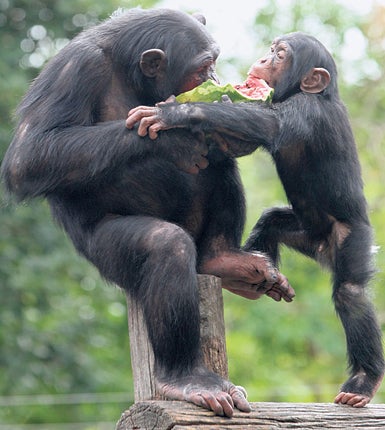
The willingness to help strangers and not expect anything in return is supposed to be a uniquely human characteristic but scientists have shown that chimps are also capable of altruism.
A study of chimpanzees kept at a primate research centre in the United States has for the first time found that, under certain circumstances, captive apes will help other individuals without appearing to expect any benefit from their generosity.
Previous studies on captive chimpanzees have seemingly failed to find any evidence of altruism in our closest living relative, although scientists observing chimp behaviour in the wild have documented instances where unrelated individuals will help others in an apparently unselfish manner.
The researchers suggest that the failure to find so-called "prosocial" traits in captivity was due to poorly designed experiments. A much simpler experiment has shown that female chimps will help a companion without necessarily wanting something in return.
"For the past decade we have lived with the curious situation – frustrating for many chimpanzee field workers and observers – that chimps are well known for spontaneous acts of altruism, yet have not shown the same tendencies in well-controlled experiments," said Professor Frans de Waal of the Yerkes National Primate Research Centre, in Atlanta, Georgia. Failure to find prosocial behaviour in chimps led scholars to suggest that altruism had evolved only in humans after the time when the two species shared a common ancestor, about six million years ago. Altruism, in other words, was uniquely human, associated with a large brain and higher intelligence.
"The negative outcome of previous experiments has led some to postulate that chimps lack prosocial tendencies altogether and that such tendencies therefore arose only in the last six million years in the human lineage, a view now popular with anthropologists, economists, and some psychologists," Professor de Waal said.
"I have always been sceptical of the previous negative findings and their overinterpretation. This study confirms the prosocial nature of chimpanzees with a different test, better adapted to the species," he said.
The evolution of altruism in the animal kingdom has posed something of a problem for "selfish-gene" evolutionists, who say it can only come about if it is done to help a close relative, or if some reciprocation is likely.
The study, published in the Proceedings of the National Academy of Sciences, involved a simple food experiment where seven female chimps could choose between keeping food parcels to themselves or ensuring that a female companion also had a banana.
"We were excited to find that female after female chose the option that gave both her and her partner food," said Victoria Horner, the Yerkes researcher who led the study.
Join our commenting forum
Join thought-provoking conversations, follow other Independent readers and see their replies
Comments
Bookmark popover
Removed from bookmarks