Chimpanzees 'launch murderous sprees to expand their territories'
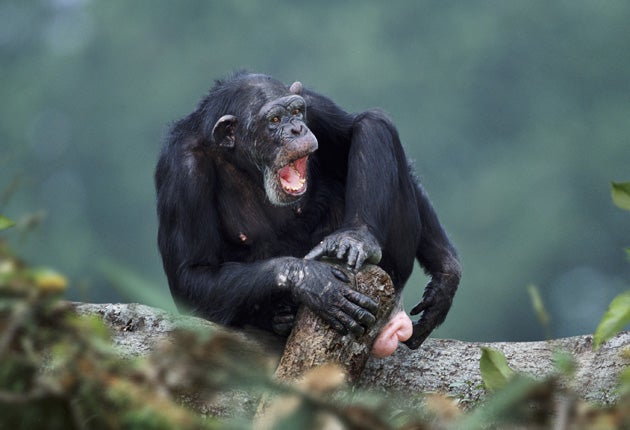
Gangs of chimpanzees kill individuals from neighbouring groups in order to expand their territory and seize new food resources, according to a new study of the animals' notoriously aggressive behaviour in the wild.
Over a 10-year period in Uganda, killing sprees by an invading group of chimps were monitored by researchers, who witnessed 18 attacks, and found signs of three others. They were perpetrated by a male-dominated community of around 150 chimpanzees at Ngogo, in Kibale National Park.
In the summer of 2009, the Ngogo chimpanzees began to occupy the conquered territory – and in doing so expanded their home boundaries by 22 per cent, travelling, socialising and feeding on their favourite fruits in the region of the animals they had killed.
It has been known for half a century that adult chimps engage in ferocious and often fatal attacks on individuals from other bands if they encounter them in the forest. It has been suspected that this is done so the attacking group can acquire more of the territory of the victims.
The new study, published in the journal Current Biology by a team led by the University of Michigan primate behavioural ecologist John Mitani, provides the first definitive evidence that this is indeed the case.
"Although some previous observations appeared to support that hypothesis, until now, we have lacked clear-cut evidence," Professor Mitani said.
"When they started to move in [to the new area], it didn't take much time to realise that they had killed a lot of other chimpanzees there," said Professor Mitani. "Our observations help to resolve long-standing questions about the function of lethal intergroup aggression in chimpanzees."
The attacks occurred when the primates were on routine, stealth "boundary patrols" into neighbouring territory. Another researcher, Sylvia Amsler, a lecturer in anthropology at the University of Arkansas, described one of the attacks she witnessed far to the north west of the Ngogo territory. She and a colleague were following 27 adult and adolescent males and one adult female.
"They had been on patrol outside of their territory for more than two hours when they surprised a small group of females from the community to the north west," Dr Amsler said. "Almost immediately upon making contact, the adult males in the patrol party began attacking the unknown females, two of whom were carrying dependent infants."
The Ngogo patrollers seized and killed one of the infants fairly quickly. They fought for 30 minutes to wrestle the other from its mother, but were unsuccessful. The Ngogo chimpanzees then rested for an hour, holding the female and her infant captive. Then they resumed their attack.
"Though they were never successful in grabbing the infant from its mother, the infant was obviously very badly injured, and we don't believe it could have survived," Dr Amsler said.
In most of the attacks in this study, chimpanzee infants were killed, and Professor Mitani believes this might be because infants are easier targets than adult chimpanzees.
Professor Mitani cautioned against drawing any connections with human warfare, and suggested instead that the findings could speak to the origins of teamwork.
"Warfare in the human sense occurs for lots of different reasons," he said. "I'm just not convinced we're talking about the same thing."
Join our commenting forum
Join thought-provoking conversations, follow other Independent readers and see their replies
Comments
Bookmark popover
Removed from bookmarks