China's presence in Africa blamed for new threat to rhino
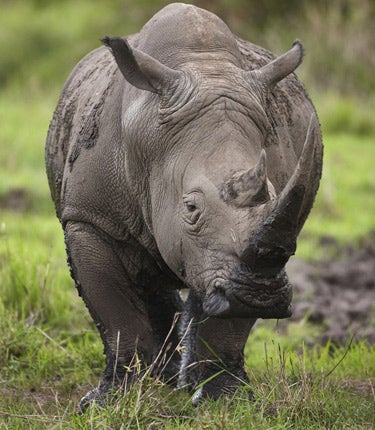
A devastating upswing in rhino poaching by criminal syndicates armed with helicopters, night vision goggles and silenced rifles is threatening to roll back more than three decades of conservation work that brought the species back from the brink of extinction.
Figures released by the charity WWF show that the number of rhinos shot dead in South Africa increased by 173 per cent last year, a trend that has seen poaching reach a 15-year high across the continent.
Although South Africa allows for limited legal hunting of white rhinos, national park officials say 333 rhinos were illegally killed last year including 10 critically endangered black rhinos. The yearly total is the highest ever in the country and nearly triple that of 2009 when 122 rhinos were killed.
Park wardens and conservationists are also battling a similar rise in poaching in Kenya, Tanzania and Zimbabwe where gangs are using increasingly sophisticated weaponry to hunt their quarry. Namibia is the only country with a significant rhino population to report no marked increase in rhino killings.
The poaching is fuelled by a demand for rhino horn in the Far East and is magnified by China's growing presence in Africa as it rushes to secure the continent's mineral wealth.
Traditionally, horns were sought for dagger handles in Yemen and as a "cure" for various fever illnesses in traditional Chinese medicine. But an effective publicity campaign and trade ban in the 1990s halted much of that demand, allowing rhinos a brief respite from the poachers. Combined with a series of successful conservation programmes, rhino populations in Africa began bouncing back.
In recent years, though, organised crime networks, primarily in Vietnam and China, have been touting powdered rhino horn as a treatment for cancer even though no medical evidence exists to support the suggestion.
The high prices paid for the horns makes poaching a lucrative business, and park rangers struggle to confront an increasingly well-armed enemy.
Initially, Vietnamese and Chinese networks used loopholes in international trade agreements to export legally acquired rhino horn using certificates governed by the Convention on International Trade in Endangered Species (Cites). A crackdown by the South African authorities on these loopholes has led to an explosion of poaching in the past three years which has been repeated across the continent. Since 2005 an estimated 900 rhinos have been poached across Africa with the last two years seeing the most dramatic increases.
Dr Morné du Plessis, chief executive of WWF South Africa, said: "The recovery of African white rhinos from less than 100 in the late 19th century to more than 20,000 today is a phenomenal conservation success story that can largely be attributed to the combined efforts of South Africa's state and private conservation authorities.
"Consumers of rhino horn across Asia, and in Vietnam in particular, are compromising this by motivating criminal groups to kill rhinos. To halt this massacre, substantial resources need to go into law enforcement."
John Sellar, a former British police officer who is chief enforcement officer at Cites, has been tracking the rhino poaching trade for more than a decade.
"In the 10 years I've worked here I can comfortably say that rhino poaching is backed by some of the most organised criminal networks in the illegal wildlife trade," he said. "There just seems to be no end in sight. In many areas rhinos are teetering on the edge of extinction but even in South Africa, which has the largest population, conservationists are starting to say that the level of poaching is becoming unsustainable."
Those at the greatest risk are black rhinos. In the 1960s they were Africa's most common species with an estimated 70,000 continent wide. By the mid-1990s their numbers had dipped as low as 2,500. They have since bounced back to just over 4,000 but remain critically endangered. White rhino numbers are estimated at 17,500. The northern white rhino, once plentiful in the Democratic Republic of the Congo, is now thought to be extinct in the wild.
Case study: 'The rangers heard gunfire but were too late to save her'
In early December park rangers from Kenya's Lewa wildlife reserve stumbled across the bloodied carcass of Melita, a 22-year-old female black rhinoceros.
The rangers had heard gunfire and rushed to the area, where they fought a gun battle with three poachers. The gang had felled the two-tonne mammal, meaning to cut off and sell her horn. The rangers got there before the horn had been cut off but it was too late to save Melita. The poachers ran off into the bush.
Lewa, a private wildlife reserve 140 miles north of Nairobi, is where Prince William proposed to Kate Middleton. It is also on the front line of a war to protect rhinos from increasingly rapacious and sophisticated poachers.
The area is home to 117 of the herbivorous mammals, 64 of which are critically endangered black rhinos. For years they were safe, and no shootings were reported. The reserve is famous for its rhino protection work and is seen as a model conservancy in wildlife protection circles. But in the past two years four black rhinos have been shot dead by poachers.
"We've never seen anything like this before," says John Pameri, head of security and chief ranger at the reserve. "The poaching is becoming a serious problem."
Mr Pameri believes the recent influx of Chinese construction workers into Kenya has helped to renew awareness among locals and crime networks that rhino horns can be sold for thousands of pounds on the black market.
"Our local intelligence suggests some of the poachers come from Somalia, but the demand is from the Chinese workers," he says.
The poachers are also using increasingly sophisticated weapons. Last Saturday three suspected poachers were arrested in northern Kenya. They were found with a stash of elephant ivory and a rhino horn weighing 5kg.
Drew McVey, Africa species programme manager for WWF, said police had also found equipment including night vision goggles and silenced high-calibre rifles. With only 600 rhinos left in the country, wildlife officials view any rhino death as a conservation disaster.
"There were 14 rhinos killed in Kenya in 2009, and it looks like last year's figure will be in the high teens. For that size of population, even one death is one too many," said Mr McVey.
Jerome Taylor
Join our commenting forum
Join thought-provoking conversations, follow other Independent readers and see their replies
Comments