Death in the Orchard of Eden
The ancient forests of Central Asia gave the world apples, apricots and walnuts. Now they are under threat
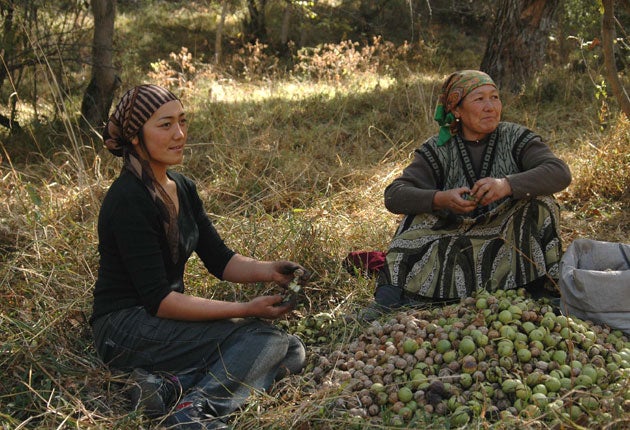
In Biblical legend, it grew in the Garden of Eden. In reality, it grew wild in Kazakhstan. And now the world's original apple tree, the progenitor of all our modern apple varieties, is threatened with extinction.
It is one of nearly 50 trees, including the original apricot and the original walnut, which have become endangered in a belt of forests in Central Asia – a region home to more than 300 wild fruit and nut species, including, plum, cherry, and many other important food trees from which domesticated varieties are thought to descend.
In the past 50 years an estimated 90 per cent of these forests have been destroyed, and a new survey has pinpointed the threat to the very existence of many of the wild tree species they contain. The Red List of Trees of Central Asia identifies 44 tree species in Kazakhstan, Kyrgyzstan, Uzbekistan, Turkmenistan and Tajikistan as threatened with extinction.
Notable among them is Kazakhstan's wild apple, Malus sieversii, which scientists from the University of Oxford have recently judged to be the genetic progenitor of all domestic apples in cultivation today. (The name of Kazakhstan's former capital city is Almaty, which means "Father of Apples".)
It is thought that as the wild apples were domesticated and bred, they gradually spread westwards down the Silk Road, the great trading highway for camel caravans which linked Asia to the Middle East and ultimately Europe, and that this process was repeated with other fruits and nuts. It happened with the wild apricot, Armeniaca vulgaris, from which all the current varieties of apricot stem – 6,000-year-old apricot seeds have been discovered during archaeological excavations in the region – and the wild walnut, Juglans regia. Both of these species are now to be found on the Red List.
According to the British conservation charity Fauna & Flora International (FFI), which has drawn up the list in collaboration with Botanic Gardens Conservation International, "these fruit and nut forests have been described as a biological Eden, and have long held an important role in human culture".
The Red List identifies over-exploitation, human development, pests and diseases, overgrazing, desertification and fires as the main threats to the trees and forests in the region, while a lack of financial resources and infrastructure since the break-up of the Soviet Union has also had a negative impact.
"Central Asia's forests are a vital storehouse for wild fruit and nut trees," said Antonia Eastwood, the Red List lead author. "If we lose the genetic diversity these forests contain, the future security of these foods could be jeopardised, especially in the face of unknown changes in global climate."
Owing to the often fragmented, mountainous geography of the landscape, the genetic diversity these plants display is exceptionally high, and could prove vital in the development of new disease-resistant or climate-tolerant fruit varieties. FFI is already working in Kyrgyzstan to save and restore one of the most highly threatened apple species identified in the report, the Niedzwetzky apple (Malus niedzwetzkyana), as part of its Global Trees Campaign. Only 111 individuals of this tree are known to survive in Kyrgyzstan and the species features on the Red List as "endangered" – the second highest category of threat.
FFI is also working with local communities and government forest services in Kyrgyzstan and Tajikistan to encourage sustainable use and more effective protection for forest resources, including providing training for community groups and grants for eco-friendly small businesses to assist local livelihoods.
To build on this work, a new collaborative project is being launched in Kyrgyzstan this year, led by Professor Adrian Newton of Bournemouth University, which will conduct research on threatened trees, provide training to Kyrgyz scientists and involve local communities in forest use planning.
Join our commenting forum
Join thought-provoking conversations, follow other Independent readers and see their replies
Comments
Bookmark popover
Removed from bookmarks