Desperate bid to save finches that changed the world
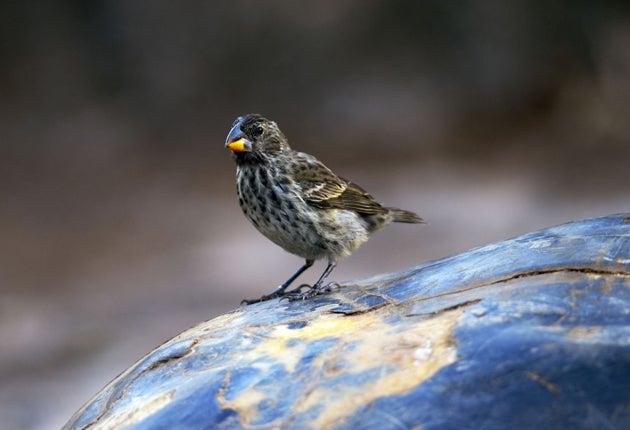
British conservationists are to launch an ambitious project to safeguard the future of a colony of Galapagos finches which inspired Charles Darwin to formulate his radical theory of evolution.
There are now only about 100 individuals left of the Galapagos mangrove finch, the rarest of the 14 closely related finch species that Darwin encountered when he visited the islands in 1835 as the naturalist on board the survey ship HMS Beagle.
All of these species evolved from a single common ancestor to fit different niches in the ecosystem, and when Darwin realised this once he was back in Britain, it helped to trigger his insight that completely new species could come into being through the process of natural selection.
The mangrove finch has shown the most extreme evolution of all: it inhabits only the narrow strips of mangrove swamp that are found in just a few parts of the Galapagos coastline.
Black rats which infested the holds of pirate ships have been identified as the chief culprits behind the destruction of the finches. The rats are thought to have arrived on Isabella, the largest of the Galapagos islands, on pirate vessels perhaps as early as the 16th century. Pirates used the archipelago, which is around 500 miles off the coast of Ecuador in the Pacific Ocean, as a hiding place before sailing off to the Spanish shipping lanes in search of boats carrying treasure.
The scarcity of its habitat means the mangrove finch has probably never been numerous. In recent times it has been rapidly heading towards extinction, and is now one of the rarest birds in the world.
However, a British-funded conservation programme has spent three years investigating its decline, and is now about to spend another three years attempting to reverse it by moving some of the birds from the western side Isabella to the eastern side where there is another small area of mangroves.
The project is being led by the Durrell Wildlife Conservation Trust, the Jersey-based charity which specialises in saving endangered species, in partnership with the Charles Darwin Foundation, the international research organisation for the Galapagos, and the Galapagos National Park, which is run by the Government of Ecuador.
Britain's Department for Environment, Food and Rural Affairs (Defra) is funding the programme under its international wildlife grants scheme, the Darwin Initiative, which has spent nearly £75m helping endangered species around the world since it was set up in 1992.
"The mangrove finch is a quite remarkable piece of evolution," said Glyn Young, the Durrell Trust scientist who is leading the effort. "It's evolved to live in this tiny habitat. It's not as though mangroves have disappeared from the Galapagos – there's just never been much there in the first place. It's a brilliant example of natural selection, filling in this tiny niche."
Dr Young and his colleagues hope to take 10 young birds a year for three years from the main colony, at Playa Tortuga Negra on the west coast of Isabella, and release them in mangroves at Bahia Cartago on the eastern side of the island, where a handful of birds is thought to be clinging on to survival.
The Galapagos mangroves are different from other mangroves around the world, Dr Young said, in that they do not grow directly at the edge of the sea but are separated from it by beaches, so piles of leaves and stalks build up underneath them – and it is in these than the mangrove finch forages. Black rats are thought to have taken a steady toll of the birds.
Starting a project to bring the birds back in 2009 was very appropriate, Dr Young insisted, as this year is a double anniversary – the 200th of Charles Darwin's birth, and the 150th anniversary of the publication of his ground-breaking revolutionary treatise, On The Origin Of Species. "I think Darwin would have been very pleased," he said.
Galapagos finches: How they made Darwin's theory take flight
*One day millions of years ago a flock of sparrow-sized birds of a single species, closely related to what is now the blue-black grassquit finch found along the Pacific coast of South America, flew out to sea and kept on flying westwards for 600 miles until they came to the Galapagos Islands. There they found a home.
But as they bred and their numbers increased, they found they could survive better by specialising. So some began to specialise in eating insects, while others began to specialise in eating seeds, or leaves, or flowers, or even in one weird case the blood of seabirds – and over time the shape of their bills changed to reflect their specialisations.
Gradually they evolved into 13 quite separate species, each exploiting a different niche in the ecosystem (with a 14th from the same common ancestor having evolved on Cocos island to the north). This process is now known as adaptive radiation.
When Charles Darwin visited the Galapagos Islands in 1835 he and colleagues collected many of the finches, but did not at first realise they were related and missed their significance. It was not until he had returned to London that the ornithologist John Gould examined them and found them to be all subtly different but closely related members of a quite new family of birds.
It was this discovery that set Darwin thinking that they may all have evolved from a single common ancestor, and thus to start to understand the mechanism of natural selection, which enabled new species to evolve.
Join our commenting forum
Join thought-provoking conversations, follow other Independent readers and see their replies
Comments
Bookmark popover
Removed from bookmarks