Electronic smog 'is disrupting nature on a massive scale'
New study blames mobile phone masts and power lines for collapse of bee colonies and decline in sparrows
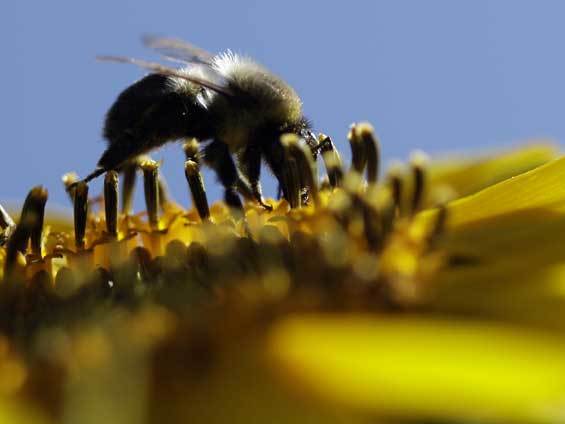
Mobile phones, Wi-Fi systems, electric power lines and similar sources of "electrosmog" are disrupting nature on a massive scale, causing birds and bees to lose their bearings, fail to reproduce and die, a conference will be told this week.
Dr Ulrich Warnke – who has been researching the effects of man-made electrical fields on wildlife for more than 30 years – will tell the conference, organised by the Radiation Research Trust at the Royal Society in London, that "an unprecedented dense mesh of artificial magnetic, electrical and electromagnetic fields" has been generated, overwhelming the "natural system of information" on which the species rely.
He believes this could be responsible for the disappearance of bees in Europe and the US in what is known as colony collapse disorder, for the decline of the house sparrow, whose numbers have fallen by half in Britain over the past 30 years, and that it could also interfere with bird migration.
Dr Warnke, a lecturer at the University of Saarland, in Germany, adds that the world's natural electrical and magnetic fields have had a "decisive hand in the evolution of species". Over millions of years they learned to use them to work out where they were, the time of day, and the approach of bad weather.
Now, he says, "man-made technology has created transmitters which have fundamentally changed the natural electromagnetic energies and forces on the earth's surface. Animals that depend on natural electrical, magnetic and electromagnetic fields for their orientation and navigation are confused by the much stronger and constantly changing artificial fields."
His research has shown that bees exposed to the kinds of electrical fields generated by power lines killed each other and their young, while ones exposed to signals in the same range as mobile phones lost much of their homing ability. Studies at the University of Koblenz-Landau, reported in The Independent on Sunday last year, have found bees failed to return to their hives when digital cordless phones were placed in them, while an Austrian survey noted that two-thirds of beekeepers with mobile phone masts within 300 metres had suffered unexplained colony collapse.
Dr Warnke also cites Spanish and Belgian studies showing that the number of sparrows near mobile phone masts fell as radiation increased. And he says that migrating birds, flying in formation, had been seen to split up when approaching the masts.
But the Mobile Operators Association, representing the UK's five mobile phone companies, says a US research group has found collapsing bee colonies in areas with no mobile phone service, and Denis Summers-Smith, a leading expert on sparrows, has described the link as "nonsense".
Join our commenting forum
Join thought-provoking conversations, follow other Independent readers and see their replies
Comments
Bookmark popover
Removed from bookmarks