Everything you ever wanted to know about wild sex...
But, be warned, a new exhibition shows what a beastly business animal reproduction can be
The Natural History Museum is to harness public curiosity about the almost infinite variety of carnal knowledge with an exhibition that lays out toe-curling truths about wild sex.
Mostly, testosterone rules, and at this point the squeamish may want to look away. Not only is a male snake's tongue forked, so is his penis – in case a reluctant female tries to evade him and he misses his aim first time, he can have another go.
There is, says Tate Greenhalgh, developer of the exhibition Sexual Nature, which opens at the museum on 11 February, "sperm competition" which involves some species being extremely well endowed – the tiny blue wren bird, for instance, has testes that account for a quarter of his body weight.
The chimpanzee, given the promiscuity of his species, has developed powerful gonads to make sure any offspring is his own. "It's not just mating, it's reproducing," she said. "They are able to produce enough sperm not only to fertilise the female's eggs, but to form a barrier that prevents any other sperm from getting through. Hedgehogs do it too."
The delightfully named banana slug will bite off its own penis and leave it in the female to prevent any other slug depositing its DNA.
In the hyena world it is the female that rules, choosing her mate, guarding territory, rearing cubs and allowing the male to stay or kicking him out as she sees fit. Her genitalia have even evolved to look like the male's.
The star of the exhibit will be Guy the Gorilla, once an idol at London Zoo, who is returning to the spotlight 33 years after his death (and a visit to the taxidermist). He is a typical alpha male, with a 73in chest and a huge neck, but don't be fooled. "Alive, he may only have had sex once or twice a year," Ms Greenhalgh said, "and his penis would only have been about three centimetres erect, because he didn't have to compete – he had his harem and nobody challenged him for it".
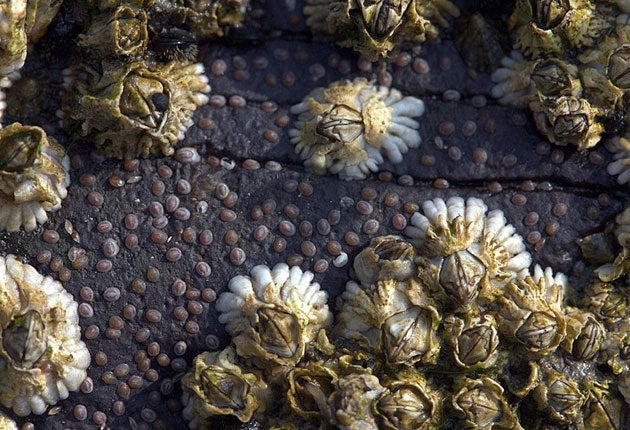
The barnacle's penis, by contrast, is 30 times its body length, and the male salmon's effort to reproduce is so great he often dies of exhaustion.
"Survival doesn't always take precedence over reproduction," Ms Greenhalgh said. "The peacock develops its glorious plumage to attract females, but it also makes him very conspicuous to predators and is often the cause of his downfall."
The museum's own most recent discovery concerns the humble water beetle, the male of which does not like to take no for an answer. As a result, he has developed suckers on his feet that allow him to get a grip on the female's carapace; in response, she has developed ridges on her back so that she can dislodge him if she doesn't find him appealing.
The impetus for Sexual Nature came from last year's exhibit on Charles Darwin, which attracted 155,000 visitors. Darwin was interested in the survival of species, but also in reproduction, an area to which the NHM's own researchers have devoted a lot of work.
Some 300 zoologists, botanists and palaeontologists are working with millions of specimens to add to our knowledge of the natural world. They are currently researching the DNA of mosquitoes so that malaria-carrying species can be more easily identified, located and eliminated.
Sharon Ament, director of public engagement, said: "Many people don't realise how much a scientific research centre this museum is, and always has been. The Darwin Centre, where you can see the scientists at work, has opened many eyes, and we hope our new approach in our exhibitions will open them still further."
Snakes
The male of the species is endowed with a forked penis to prevent the female escaping.
Guy the Gorilla
The star of the exhibit returns 33 years after his death. His penis was about three centimetres erect because he did not have to compete with other males.
Barnacles
The crustacean has a penis 30 times its body length, while the unfortunate male salmon can die from exhaustion.
Hedgehogs
Produce enough sperm to fertilise the female's eggs and to form a barrier preventing any other's sperm from getting through.
Banana slugs
Bites off its own penis to leave it in the female, preventing others from depositing more DNA.
Peacocks
The glorious plumage that attracts the female of the species is also very conspicuous to predators and can lead to the male's downfall.
Join our commenting forum
Join thought-provoking conversations, follow other Independent readers and see their replies
Comments
Bookmark popover
Removed from bookmarks