Highlanders want return of the big bad wolf
Chilling effect of top predator needed to curb grazing of Scotland's red deer
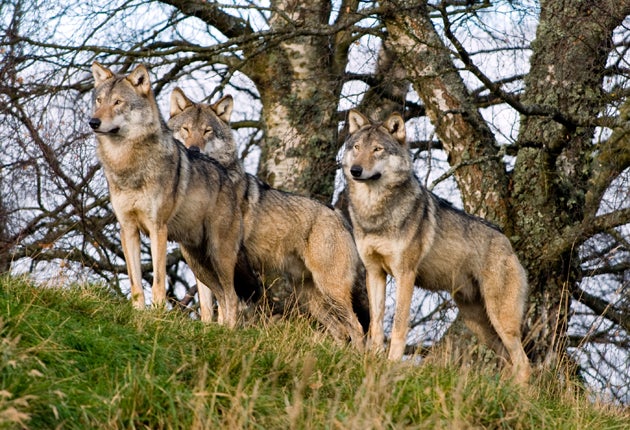
The eerie sound of howling wolves might soon be heard in the Scottish glens once more if an ambitious proposal to reintroduce the grey wolf back into the British countryside gets the backing of local landowners and the Government.
Wolves have not roamed the Scottish Highlands for more than 250 years, but scientists believe that bringing the wolf back to Britain is the only effective way of controlling the growing population of red deer which are eating their way through the highland vegetation and destroying the local habitat.
Red deer have no natural predators and hunting has only a limited impact on their numbers, and almost no effect on their grazing behaviour. Wolves, however, can hunt day and night, 365 days of the year, and the chilling effect they have on the grazing behaviour of large herbivores has been documented.
The proposal, outlined in a scientific paper to be published in the journal Biological Conservation, is the brainchild of Adrian Manning, a Scottish-educated ecologist at the Australian National University in Canberra, Iain Gordon of the Commonwealth Scientific and Industrial Research Organisation in Australia and William Ripple of Oregon State University.
They believe there is now overwhelming scientific evidence in favour of reintroducing wild wolves to Scotland, at least in the controlled setting of a large-scale field experiment on an island or fenced area, because of the astounding effects that similar wolf reintroductions have had on boosting local wildlife in other parts of the world.
As a top predator, the wolf is uniquely placed to create what the scientists call a "landscape of fear". The mere presence of a hunting pack of wolves changes the behaviour of red deer, curtailing their tendency to overgraze the Scottish moorland to the point where hardly anything can grow, they said.
This was one of the most surprising findings to emerge from the reintroduction of wolves into America's Yellowstone National Park, which began in 1995. The local elk, which had browsed freely for many decades, suddenly began to avoid certain areas of the park where they felt vulnerable to wolf attacks. The result was that the vegetation had a chance to recover.
Within a few years, tree saplings that usually would have been killed by grazing elk grew into a thick undergrowth that provided a rich habitat for insects, birds and other species. The indirect effects of changing grazing behaviour were at least as important as the direct effect of limiting elk numbers by predation, the scientists found.
"We don't propose a full wolf reintroduction, but rather a large-scale, long-term ecological restoration experiment under controlled conditions, such as an island or a fenced area. Yellowstone hints at what we might find," Dr Manning said.
"Whether we include inhabited areas of land or not is one of the things that would have to be looked at. It is not an insuperable barrier because in parts of Europe people and wolves do live in the same area without there being too much of a problem," he said.
Professor Ripple, who was involved in the reintroduction of wolves into Yellowstone, said that overgrazing by red deer in the Highlands – which have had no natural predators since the demise of the wolf – has almost certainly changed the landscape beyond recognition.
"Wolves were last found in Scotland more than 250 years ago, and as a result it's likely that very few natural areas now bear much resemblance to their native conditions," Professor Ripple said.
Paul Lister, a conservationist and owner of the Alladale Reserve near Inverness, said the proposal makes sense because the wolf has a proven track record in controlling overgrazing by herbivores. "It's what needs to happen," Mr Lister said.
"I'm in favour of it but other landowners and authorities would need to agree to it before anything can be done. It's a case of getting my neighbours on board, because this would take a lot of land," he said.
Scientists estimate the pilot experiment would require at least 800 square miles for several wolf packs to roam freely – a huge area of land for a country the size of Britain.
Eagles, kites and beavers: Three more making a comeback
*Families of beavers were reintroduced into Scotland in May after being hunted to extinction more than 400 years ago. It was the first-ever wild reintroduction of a native mammal into the UK. Their release, into the Knapdale Forest of Mid-Argyll, is for a limited period; the effect on the local habitat will be assessed after five years by independent monitors.
*Sea eagles, which disappeared after the last pair bred in 1916 on the Isle of Skye, have been successfully introduced over a period of many years, beginning on the Hebridean island of Rum in 1975. The latest batch of Norwegian white-tailed (sea) eagles were released in August last year.
*Red kites from Sweden and Germany have been successfully reintroduced into England and Scotland after they were persecuted to extinction in the 19th century.
Join our commenting forum
Join thought-provoking conversations, follow other Independent readers and see their replies
Comments
Bookmark popover
Removed from bookmarks