It's grim down South for birds as species fare better in the North
If birds are struggling to survive, that may say something about our countryside and our quality of life
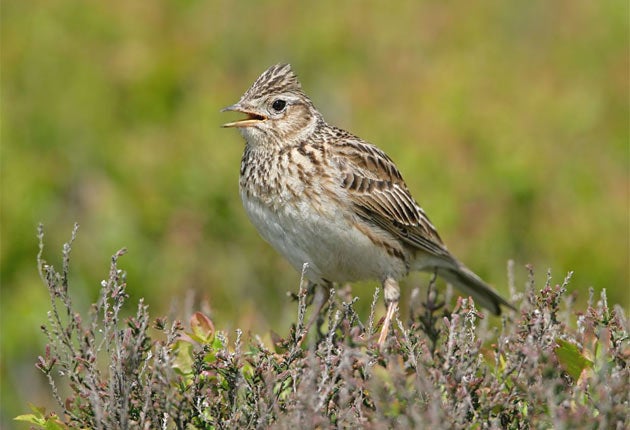
It might be "grim up North" and life might be thought more prosperous in the pampered South of England – but that doesn't hold for birds. Many British bird species are in fact doing far better in the North than in the South, according to a new analysis of national bird census figures.
The study, commissioned by the RSPB from the British Trust for Ornithology, shows that since 1994, many bird populations in the South have declined substantially, while populations in the North have generally increased, or at least performed much better.
The reasons are unknown, but theories include the greater intensification of farming that has taken place in the South, and the possibility that climate change may already be encouraging some bird species to move north. The differences are visible in all three categories of the survey: farmland birds, woodland birds and birds of other habitats – wetlands, heathlands, moorlands, coasts and urban areas. Furthermore, there appears to be an observable gradient of decline, with performance steadily worsening towards the north.
With farmland birds, such as the skylark and the linnet, the figures show declines of 28 per cent and 23 per cent respectively in the South-east and South-west, dropping to 19 per cent, 14 per cent and 14 per cent in the West Midlands, East Midlands and eastern England, then falling to 3 per cent and two per cent in the North-west and Yorkshire and Humberside, with an increase of 3 per cent in the North-east.
The same picture is shown for woodland birds, such as the willow warbler and the chiffchaff, declining in numbers since 1994 by 19 per cent and 13 per cent in the South-east and South-west. But the decline falls to 3 per cent in the West Midlands, and then the figures show an increase in every region going north, culminating in a rise in the North-west of 31 per cent. A similar picture is shown in the "other habitats" indicator.
"The divide between northern and southern England is intriguing," said Martin Harper, the RSPB's conservation director. "There could be many reasons to explain this, including different forms of land use in parts of northern England. But other factors such as development, climate change, altitude and water scarcity all vary from South to North and could all be playing part in these staggering regional differences.
"What is shocking is when you look beyond the graphs, you realise these figures are about the lives of birds and the figures chart the ability of birds to survive in our countryside; the place where we walk and grow our food. If some of these birds are struggling to survive, that may say a lot about the quality of our own countryside and our own quality of life."
The phenomenon is also observable with individual species. A typical farmland species, the linnet, declined by 48 per cent over the period in the South-east, and 32 per cent in the South-west, but in the North-west and North-east regions the decline was limited to 11 per cent. With a typical woodland species, the chiffchaff, known to be going up in numbers, there were increases of 25 and 28 per cent respectively in the South-east and South-west, but in the North-west the increase was 144 per cent.
Join our commenting forum
Join thought-provoking conversations, follow other Independent readers and see their replies
Comments
Bookmark popover
Removed from bookmarks