Koalas in danger
Eucalyptus leaves – which Australia's favourite marsupial depends on for survival – are being destroyed by abnormally high levels of greenhouse gases
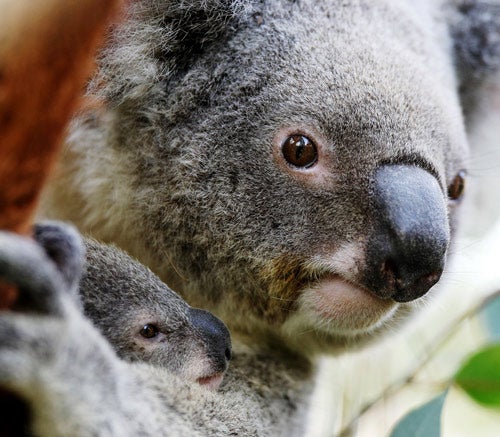
The future of the koala, perhaps Australia's best-loved animal, is under threat because greenhouse gas emissions are making eucalyptus leaves – their sole food source – inedible.
Scientists warned yesterday that increased levels of carbon dioxide in the atmosphere were reducing nutrient levels in the leaves, and also boosting their toxic tannin content. That has serious implications for koalas and other marsupials that eat only, or mainly, the leaves of gum trees. These include a number of possum and wallaby species. "What we're seeing, essentially, is that the staple diet of these animals is being turned to leather," said Bill Foley, a science professor at the Australian National University (ANU) in Canberra. "This is potentially a very significant development for the future of some marsupial populations. Life is set to become extremely difficult for these animals."
Climate change could help to explain decreases in the numbers of brushtail possums and greater gliders (a large possum) in certain parts of Queensland where none of the usual factors – disease, hunting, loss of habitat – appears to be to blame. Jane De Gabriel, a zoologist at ANU, told The Australian newspaper that brushtail possums had been found to breed more prolifically in woodland areas where the protein levels in eucalyptus leaves were high. "This suggests that in areas where nutrient levels are inadequate, animals will not be able to reproduce successfully," she said. "What follows are extinctions of wildlife populations. It's pretty scary stuff."
Despite koalas' predilection for eucalyptus, the leaves are not nutritionally rich. In fact, even in the best conditions they are so low in protein that koalas – which spend up to 20 hours a day asleep, and most of the rest of their waking hours eating – have to eat 700g (1.5lb) of them a day to survive.
Like koalas, greater gliders feed only on eucalyptus leaves. Greater gliders have disappeared from some habitats where they were abundant 20 years ago. Brushtail possums, ringtail possums and many wallabies rely on the leaves as the major component of their diet. Ivan Lawler, a researcher at Queensland's James Cook University, found that when there was more carbon dioxide in the atmosphere, the levels of nitrogen and other nutrients fell.
"With more carbon dioxide, animals need to eat more and more leaves to get their required protein levels," he told The Australian. "The balance in the leaves shifts from nutrients to non-nutritional fibre. It eventually reaches a threshold when leaves are no longer tenable as a food source. The food chain for these animals is very finely balanced, and a small change can have serious consequences." WWF Australia warned recently that rising temperatures threatened numerous Australian native species, including the tree frog, the hare kangaroo, the tiny tree kangaroo and the greater bilby.
In a report last month, it said that such creatures – already endangered as a result of wide-scale land clearing and the introduction of exotic predators – could be pushed into extinction by climate change and its knock-on effects.
A dry life: On an ecological knife edge
Koalas live in coastal regions of eastern and southern Australia. Koala is an aboriginal word that means "doesn't drink". This is because koalas get more than 90 per cent of their water from eucalyptus leaves, which are toxic to most species. The only time they drink is when they fall ill or there is not enough moisture on leaves such as during droughts. Koalas can live as long as 17 years but the average male life expectancy is about 10 due to injuries from dogs and cars. The Australian Koala Foundation estimates that there are fewer than 100,000 koalas remaining in Australia today.
Join our commenting forum
Join thought-provoking conversations, follow other Independent readers and see their replies
Comments
Bookmark popover
Removed from bookmarks