Nature Studies by Michael McCarthy: Cherish these rivers - they may soon flow no more

Sign up to the Independent Climate email for the latest advice on saving the planet
Get our free Climate email
The idea of a river dying is not a common one. If we were to categorise how people feel about rivers, in so far as they do so at all, we might suppose that feelings generally focus on power and permanence. T S Eliot, contemplating the Mississippi pounding past St Louis where he grew up, thought of it as "a strong brown God". Oscar Hammerstein portrayed it as eternal: "Ol' Man River, he jes' keeps rolling along".
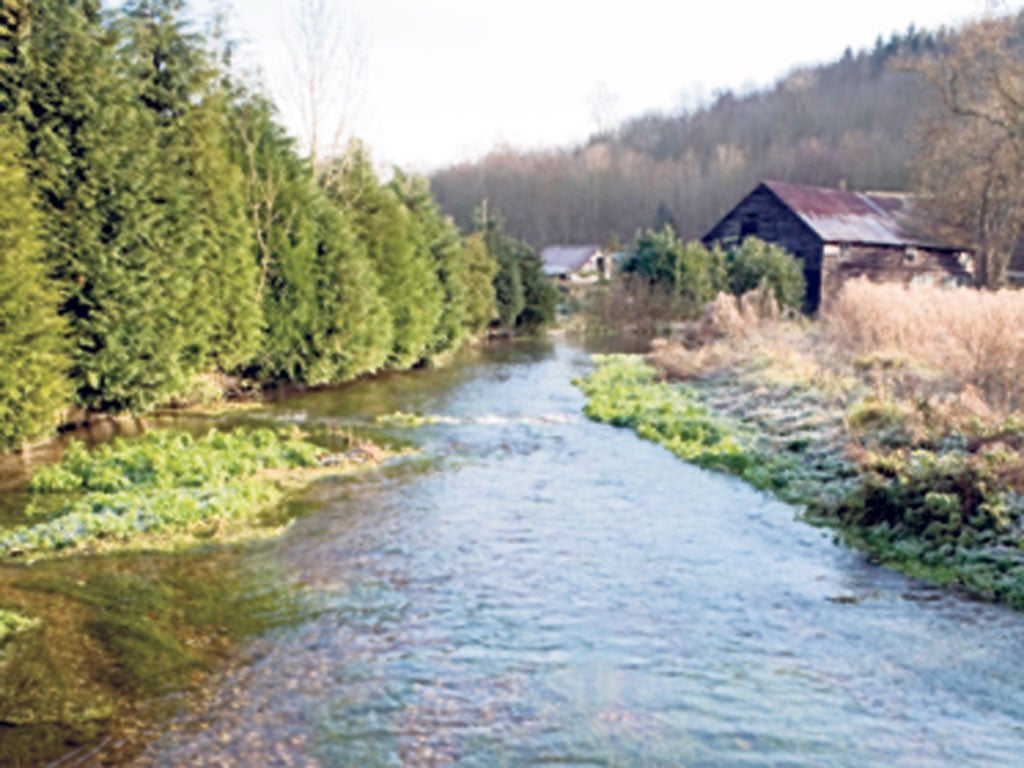
Few poems or folk songs, then, about rivers as vulnerable, as likely to wilt and die and disappear. But they can do, in somewhere like southern England, where the landscape, and hence the watercourses that bisect it, are on a much smaller scale; and a particularly vulnerable set of rivers in England are the most beautiful ones of all, the chalk streams.
The chalk streams rise on the geological band of calcium carbonate that stretches up from Dorset in the South-west, through Hampshire, Wiltshire, Berkshire and the northern Home Counties, to Norfolk, and then through Lincolnshire to finish in the Yorkshire Wolds. There are about 60 principal ones, all told, and the chalk from which they spring does several special things to them: it filters the water, making it clean and clear as gin, and gives it an alkaline quality ideal for aquatic insects and other invertebrates, so that brown trout grow fat on feeding on them, and wild flowers flourish.
Richer in life than any other rivers, and unmatched in their loveliness, especially in May and June, chalk streams are found nowhere in the world but England (except for a few in Normandy); and, for me, these watercourses, the Test and the Itchen, the Kennet and the Lambourn, the Wylye and the Nadder, constitute one of the two most sublime natural habitats in our country (the other being the bluebell wood, also found nowhere else). I feel they should be considered as national monuments like the great medieval cathedrals, so that Hampshire's River Itchen would be as formally cherished in the national consciousness as is the cathedral in Winchester past which it flows.
But one of the disadvantages of being a chalk stream is that your water is so unbelievably pure that it is keenly coveted by water companies, who do not need to go to the expense of purifying it themselves; so many chalk streams suffer from over-abstraction, which means their flows are lower than they otherwise would be and, in times of drought, when the water level in the underlying chalk aquifer drops, they can dry up.
After one of the driest winters for many decades, this is happening right now to a number of them, but nowhere more acutely than in the chalk hills of the Chilterns to the north-west of London, where water demand is very high. The main Chiltern chalk streams – the Hamble, the Wye, the Misbourne, the Chess, the Bulbourne, the Gade and the Ver – are not famous like the Test and the Itchen, and not very long (the Chess, the longest, is barely 12 miles) but they are charming, with their own riches. And all seven of them have now, in their upper reaches, run dry.
Imagine – all the rivers of a range of hills, beginning to disappear. This is only February, when their water should be sparkling. What is to happen as the year moves forward if, as many observers are beginning to fear, Britain is hit by a major drought? Will they vanish in their entirety?
Be prepared for something new; stand by to witness something different and unsettling in your experience of the natural world. For all their seeming permanence, for all their God-like strength, this summer may well show rivers to be as mortal as you and me.
Purple sheens and silver sides, the glory that is the rainbow trout
One of the special things about the Chiltern chalk streams is that two of them, the Chess and the Misbourne, are among the handful of British rivers where rainbow trout naturally breed.
Rainbows take their name from the purple sheen on their silver sides, which flashes like the wings of a purple emperor butterfly. They are not native British fish: they were introduced from North America, and their population is maintained artificially by stocking.
But in the Misbourne and the Chess there is (or there has been) a self-sustaining head of fish: wild British rainbow trout. The only other river where this phenomenon is known is the Derbyshire Wye.
The Derbyshire Wye, a splendid Peak District limestone river, is not the same as the tiny Chiltern Wye (see above, as in High Wycombe) and not to be confused with the most famous Wye, the majestic salmon river of the Welsh borders. Just thought I'd mention it.
Subscribe to Independent Premium to bookmark this article
Want to bookmark your favourite articles and stories to read or reference later? Start your Independent Premium subscription today.
Join our commenting forum
Join thought-provoking conversations, follow other Independent readers and see their replies