Nature Studies by Michael McCarthy: More badgers and fewer hedgehogs. Coincidence? I don't think so
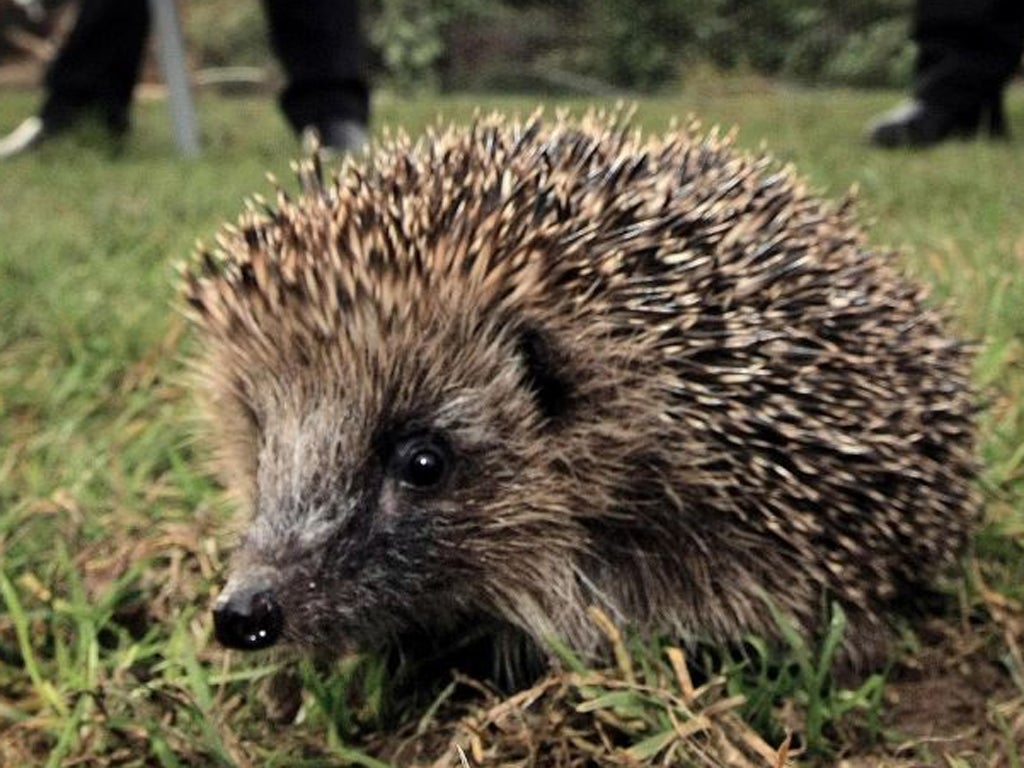
A badger's powerful front claws can uncurl the hedghog's tight ball of spines
In the wild, animal numbers naturally fluctuate. The marsh fritillary butterfly, for example, can virtually vanish from some of its colonies in certain years, only to be present two or three years later in numbers that are overwhelming (this is caused by cycles of parasite infestation, and something similar happens with red grouse).
Generally, though, animal numbers have evolved to be in balance, both with their food supply and with other species. Predators cannot eat all the prey, as they themselves would die out. So when an event comes along which disturbs this balance, it's worth examining. One such is the steep decline of one of our best-loved mammals, the hedgehog.
In the past 20 years or so, hedgehogs have disappeared from much of Britain. This has not really registered yet in the public consciousness, but it is an astounding phenomenon. There were an estimated 30 million hedgehogs in Britain in the 1950s, but by the 1990s this was thought to be down to about 1.5 million, and recently the rate of decline has grown even steeper. Last year, the first authoritative report on the problem said that "at a conservative estimate a quarter of the [remaining] population has been lost in the last 10 years".
A number of reasons are put forward. One is intensive farming, with the loss of hedgerows and the increase in pesticides, depriving hedgehogs of their prey of slugs and insects. Another is increased vehicle numbers leading to increased roadkill, and a third is urban development, with tidier gardens and better fences meaning urban populations of hedgehogs cannot move about, become fragmented and die out.
But there is a fourth potential reason: badgers. Badgers are the hedgehog's only British predator – their powerful front claws can uncurl the hedgehog's tight defensive ball of spines – and in recent decades their numbers have increased enormously, almost certainly because of the warmer winters brought about by climate change. Badgers eat hedgehogs readily, and hedgehogs are terrified of them. Yet there seems to be considerable nervousness in some circles about making the link between the former increasing, and the latter disappearing. Indeed, it is actively played down.
You can understand why. The badger is under fierce assault from farmers as the carrier of the cattle TB virus, and the Government is contemplating large-scale culls. Anything that might contribute to the further demonisation of Mr Brock (as it were) will be stoutly resisted by the badger's friends, of whom there are many.
Yet my own impression – not worth a row of beans, scientifically, of course – is that the link is obvious and direct, and I take this from my experience of my local patch, as birders would say, which happens to be the Royal Botanic Gardens, Kew (I live around the corner). Kew used to have plenty of hedgehogs in its 300 acres, snuffling across its lawns; now it has none at all – none whatsoever – although it is an absolutely ideal hedgehog site. On the other hand, it has a thriving badger population, which arrived in the mid-1980s and now numbers between 50 and 75 animals.
The man who knows Kew's grounds better than anyone, Tony Kirkham, the Head of the Arboretum, remembers the first badgers about 1985-86; and he also remembers the last time he saw a hedgehog in Kew ("about 15 years ago, it would be").
Say what you like: one animal has come, the other has gone. I can't see a way round it. In terms of our startling hedgehog disappearance, badgers seems to be The Cause That Dare Not Speak Its Name. I think we should admit it, for then we can think hard about it and think about possible ways of mitigating the problem; and I also think it is better to look the truth in the face in dealing with Nature, as with everything else.
How to help our hedgehogs
If you want to help our troubled hedgehogs, you could take part in a new study to determine whether climate change is having an impact on when they emerge from hibernation, and how this might be affecting their survival.
The People's Trust for Endangered Species (PTES) and the British Hedgehog Preservation Society (BHPS) are appealing for volunteers to join in their hedgehog hibernation survey, looking at when the animals emerge from their long winter sleep under compost heaps or piles of leaves.
The point is, that this date may have shifted in recent decades, because of warmer winters brought about by climate change, and this may be potentially harmful – for example, if the animals are emerging earlier, but are then hit by sudden cold snaps.
The two charities are asking members of the public to record their sightings of hedgehogs as they start to emerge in spring. The survey starts on 1 February, running through till August, and can be completed online. If you're interested in taking part, sign up for the survey before 1 February at www.hedgehogstreet.org.
Join our commenting forum
Join thought-provoking conversations, follow other Independent readers and see their replies
Comments
Bookmark popover
Removed from bookmarks