Nature Studies by Michael McCarthy: There is another way to appreciate turkey

Sign up to the Independent Climate email for the latest advice on saving the planet
Get our free Climate email
There are two ways of looking at turkeys, it dawned on me one day in the Yucatán peninsula in Mexico, that enormous tooth on the map, that great limestone molar, which separates the Gulf of Mexico from the Caribbean.
The first way is currently swelling in our imaginations, of course: the turkey as dinner. It fascinates because it is the biggest consumable most of us will ever take part in consuming on the family table, now that boars' heads are forgotten and swans are off the menu; a turkey can be as big as a block of cathedral stone.
When I was an eager young reporter on The Bolton Evening News, I was sent to Bolton Market in Christmas week to report on a bird so whopping that the poulterers had given it a place of honour apart from the others, and labelled it The Champ; it was the size of a dustbin, and the story made the front page. Ah, happy days.
The turkey the size of a dustbin: a great big Thing. Looking at turkeys as things, inanimate objects like Christmas puddings, is natural enough, and I have no objection to that; I am not a vegetarian and enjoy roasted meat. That's how we all see them, even though before they were objects on the table, turkeys were living creatures.
Yet I had never conceived an interest in turkeys as birds, despite the fact that the original species, the wild turkey, is one of the most notable members of the New World avifauna, and indeed was the very first plate in John James Audubon's legendary Birds of America. Why? Dunno really. I suppose that from looking at the domesticated ones I had assumed that all turkeys are boring. Then I went to Mexico.
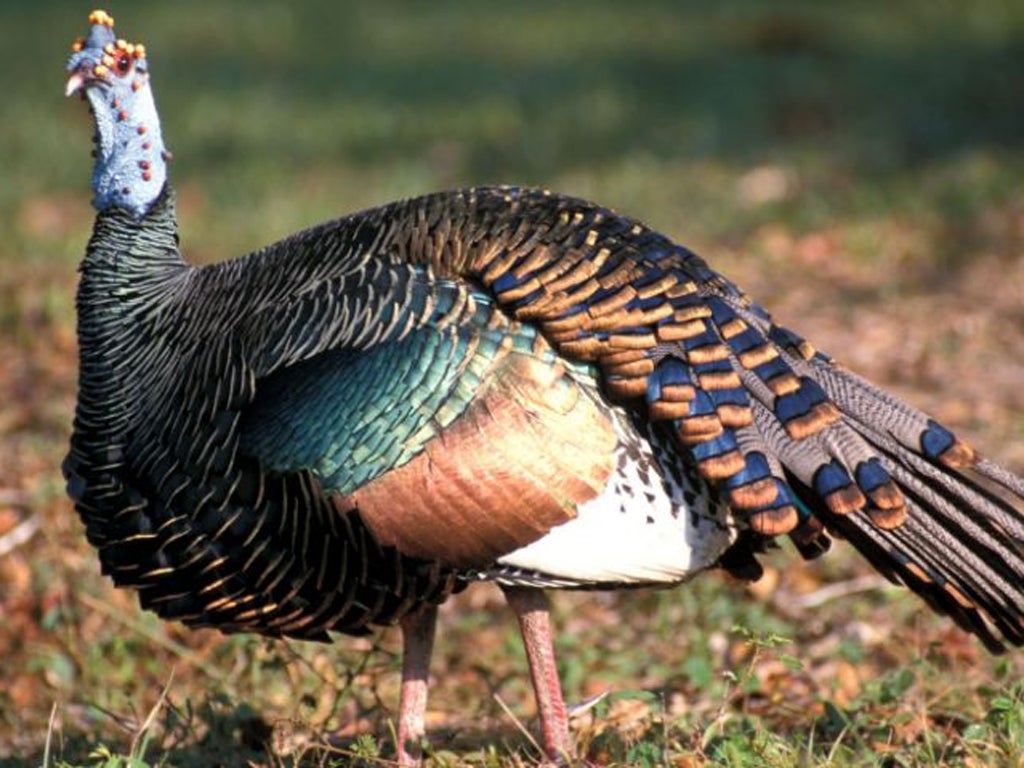
The Yucatán is a special place, a riverless limestone world with a dozen or so bird species found nowhere else, and one of them is a turkey; but not the traditional wild turkey. I came across it at the edge of a lake when the Maya guides got excited and started shouting and looking at something just inside the lake shore forest. I peered through the branches and saw a rainbow, or that's what it seems like in memory: a glowing mixture of iridescent bronze, and green, and blue, with a lustrously brilliant blue head and neck: an ocellated turkey, the second of the world's two turkey species.
It was one of those moments when the plates of your perception suddenly shift: here was the turkey as object of aesthetic admiration, not as object of appetite. And since then, I have broadened my ornithological interest to its fellow species in North America, the bird which went on to the first Thanksgiving dinner table: a creature with such a resonance in the American imagination that it was Benjamin Franklin's candidate for the US national bird, in place of the bald eagle.
I asked Mark Cocker, the naturalist and writer who is the author of the encyclopaedic Birds Britannica, about turkeys as birds, and he responded with a flood of folklore, from where the name turkey came from, to what it meant to the Aztecs. For Mark is now engaged in producing Birds and People, a close look at human relations with all the birds in the world; you'll be able to enjoy his lengthy turkey disquisition on publication, and you won't be disappointed.
In the meantime, take it from me that there is more to turkeys than the dinner table would suggest to us (not that I have anything but approval for Christmas dinner); they can reach unexpected parts of the imagination, just as in the Yucatán with me, when I suddenly realised that moist breast meat, crisp skin and stuffing were not the whole story.
Humans and birds: an extraordinary relationship
Mark Cocker's Birds and People promises to be the most ambitious mapping ever undertaken of the cultural significance of birds: a doorstep-sized 400,000-word account of how humans have interacted with every family of the 10,000 bird species found across the globe – from eagles to doves, from swallows to storks, from robins to ravens.
Those who have read Birds Britannica will know the formula: vibrant writing, deep research into folklore, and personal anecdotes from contributors of their own experiences of different bird species.
Anyone can contribute to this great undertaking – so far more than 500 people have done so, from more than 70 countries – and you can find how do so, and which bird families are left, by looking at the website www.birdsandpeople.org.
The book is not just a catalogue; it fits with Mark's own strong belief that it is the natural world which has most forcefully shaped our imaginations. With special illustrations by the wildlife photographer David Tipling, Birds and People is scheduled for publication by Jonathan Cape in 2013.
m.mccarthy@independent.co.uktwitter/@mjpmccarthy
Subscribe to Independent Premium to bookmark this article
Want to bookmark your favourite articles and stories to read or reference later? Start your Independent Premium subscription today.
Join our commenting forum
Join thought-provoking conversations, follow other Independent readers and see their replies