Nature Studies by Michael McCarthy: What this pyramid says about us and climate change
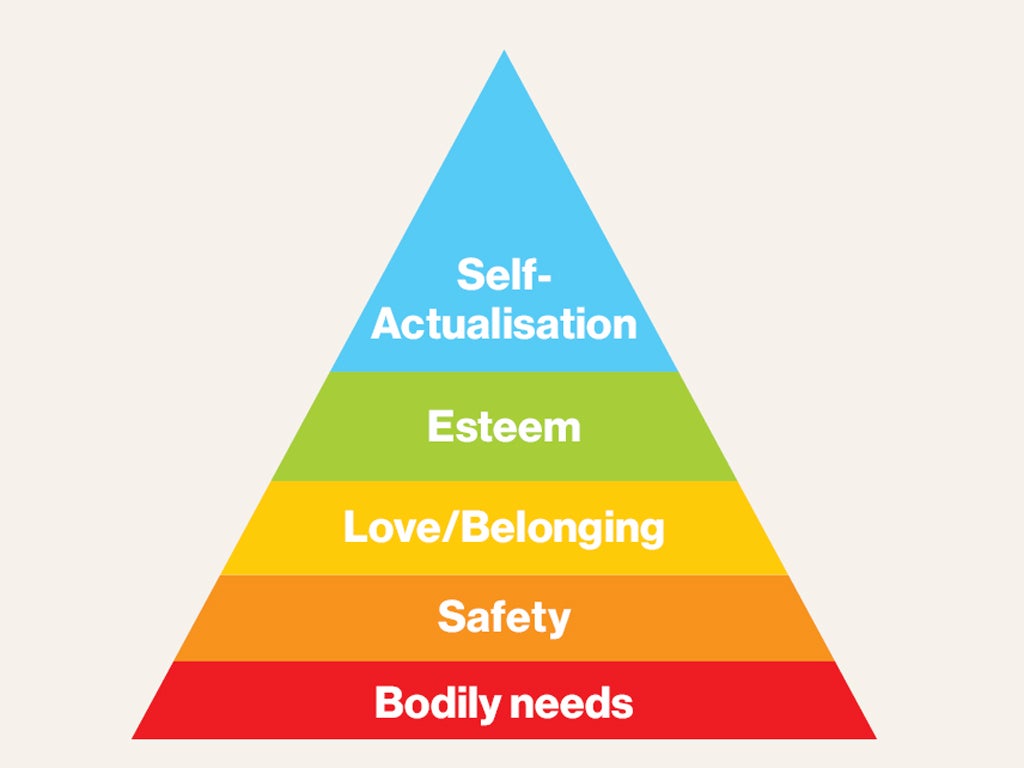
Abraham Maslow was an American psychologist of the mid-20th century, a scholar of human behaviour generally known for one particular imaginative insight into how people behave: his hierarchy of needs.
Sometimes depicted as a pyramid with several layers (pictured) and occasionally referred to as Maslow's hierarchy of values, this is a simple but convincing visualisation of human motives – from the basic, at the bottom, to the more rarefied, at the peak. And the point is, lower ones always affect us before higher ones.
Thus, at the base are the physiological needs that simply have to be satisfied before all else, such as oxygen, water, food and sleep (and, somewhat controversially, Maslow in this category included sex); while one step up from these are needs that might fit under the label of safety, and would include shelter, health, employment and the possession of resources to defend oneself and one's family.
Then the needs, the values, get less worldly, more spiritual: with the next layers up, Maslow focused on the ideas of love and belonging, of friendship and family, then on the more specifically positive idea of esteem, of self-esteem and esteem for others; at the top, he placed the need for what he termed self-actualisation, which we might interpret as how people act to bring out the best in themselves.
You could see this as creativity, perhaps, or morality; certainly, altruistic behaviour, such as concern for the environment, is up in that top bracket. And the implication, which will become increasingly clear to us as the economic downturn takes hold, is that many people have to satisfy an awful lot of other personal needs before they climb up to the top, where the environment seems important.
Let us admit it: environmental concern, in the developed world, at any rate, is largely a phenomenon of prosperity, of times when these other basic wants have been satisfied. If millions of people have no jobs, they will not give a fig for climate change or endangered species; they will want to keep their homes and feed their families, and the rest can go hang.
The great outburst of environmentalism in the late 1980s, when people flocked to join groups like Greenpeace and Friends of the Earth, and took up arms over whaling and deforestation and global warming, occurred during a colossal economic boom; and the fairly shallow recession of the 1990s was not enough to derail it. There followed 10 more years of unbroken economic growth, the Blair years, if you like, when greenery became a young person's religion, and the world was able to agree an emissions-cutting climate treaty, the Kyoto protocol.
But now prosperity has vanished, and environmentalists are going to find that the political resonance of their concern is vanishing, too. A straw in the wind was the language used by the Chancellor, George Osborne, in his Autumn Statement on Tuesday: openly contemptuous of green policies if they get in the way of growth. You may think that this was mere arrogance, and a political mistake; but you may also think he had a shrewd idea it would now strike a chord with a majority of the voters.
Environmentalists will have to face up to the fact that environmental measures will be more and more difficult to implement over the next few years of economic pain, so they will have to fight harder to bring them about. But they should remember that, even though the political resonance may be ephemeral, the problems themselves are enduring.
The threat of climate change will not diminish if ordinary people understandably discount it for a few years – just the opposite – and a cherished ecosystem that goes under concrete has gone forever, and cannot be brought back when prosperity returns. The health of the natural world is worth fighting for, whatever the state of the economy.
A charity that's made such a difference deserves saving
Another sign of all not being well on the green front; one of Britain's oldest environmental charities is to close down. It's presently called Environmental Protection UK, but, when I first ran into it more than 20 years ago, it went by the slightly more cumbersome but definitely more memorable name of The National Society for Clean Air; it is the nation's foremost lobbying body specifically concerned with air pollution.
As such, it was largely responsible for the Clean Air Act of 1956, which banned coal fires and thus put an end to London smogs, and it also had a lot to say in the campaign for lead-free petrol in the 1980s. But its origins go way back to 1898 when it began as the Coal Smoke Abatement Society.
As long as I've known it, its specialised expertise has been formidable. Now cuts in funding from local authorities mean it is heading for closure at the end of the financial year. Any bankers out there who want to give some of their bonus back, and save it?
Join our commenting forum
Join thought-provoking conversations, follow other Independent readers and see their replies
Comments
Bookmark popover
Removed from bookmarks