Nightingale numbers fall by 91 per cent in 40 years
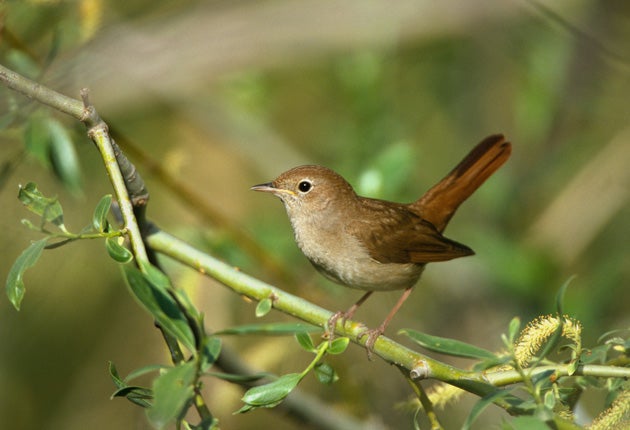
Britain's population of nightingales, the world's most celebrated songbirds, has crashed in numbers by more than 90 per cent, new research has shown.
Although there have been concerns for some time that nightingales are declining, the scale of the fall has come as a shock to researchers at the British Trust for Ornithology (BTO), who uncovered the trend.
Unpublished BTO figures, which can now be disclosed by The Independent, indicate that between 1967 and 2007 the nightingale population of Britain, which is confined to England, fell by 91 per cent.
This is the biggest fall in numbers since records began of any bird still breeding in the UK, apart from the tree sparrow, whose numbers have been decimated by intensive farming and which has dropped by 93 per cent.
"For every 10 nightingales which were singing in Britain when I was born 40 years ago, only one is doing so now," said the BTO's Dr Chris Hewson. "The rest of them have vanished. That's the scale of what we're talking about. Pretty sobering, isn't it?"
Famous for its powerful singing in the dark, and celebrated by poets since classical antiquity, the nightingale is the most versified bird in the world. In Britain it has been lauded by poets from Chaucer onwards, most notably John Keats in his much-quoted Ode to a Nightingale, inspired by a bird he heard in a garden in Hampstead, North London, in 1817.
Once familiar to everyone in southern England during the six weeks when it sings from mid-April to June, the bird has now disappeared from a huge number of locations in the countryside and as a consequence organised "nightingale walks" are attracting more and more participants.
"My parents went on one in Cambridgeshire and there were 300 cars parked there," Dr Hewson said. The bird is now almost completely restricted to the south and east of a line from the New Forest to the Wash, and is concentrated in the bottom right corner of Britain – in coastal Suffolk and Essex, and in Kent and Sussex.
Luscinia megarhynchos is one of a number of migrant bird species including the cuckoo, the turtle dove and the spotted flycatcher, which breed in Britain but winter in Africa, and which are the subject of mounting concern because of dramatic decreases in their populations.
The nightingale decline might come down to problems at both ends of its migratory range. As reported in The Independent a month ago, BTO researchers have discovered that a major cause of nightingale decline in England is the explosion in the population of deer, whose browsing is destroying the woodland undergrowth which nightingales nest in.
But there may be also problems in its African wintering grounds, as other British species which winter in the same part of West Africa, the humid tropic zone south of the Sahel, are also in trouble, including the willow warbler, the garden warbler and the cuckoo.
The real scale of the nightingale's decline had escaped attention because the BTO, which began detailed monitoring of Britain's birds in 1966 with the of the Common Bird Census (CBC), did not produce an annual trend for the nightingale as it was not picked up frequently enough. It was not until 2008 that a reliable trend was published – and this showed that the bird had declined by 60 per cent since 1994. Now BTO researchers have re-examined the data to the start of the CBC and found the long-term trend is actually a 91 per cent decline.
Had the figure been known last year, the nightingale would have been included on the Red List of Britain's most threatened birds, Dr Hewson said – as was done for the cuckoo in 2009. The Red List is updated every five years.
"People are aware of the decline of the cuckoo, but the case of the nightingale is even more dire," he said. "It is very sad. Lots of people grew up hearing nightingale song in the past and now many people will never get that opportunity."
THE FACTS
91%The estimated decline in the nightingale population in Britain between 1967 and 2007
1817 The year in which the English poet John Keats composed his famous Ode to a Nightingale
6 weeks: the window when the famous song of the nightingale can be heard, from mid-April to June
Join our commenting forum
Join thought-provoking conversations, follow other Independent readers and see their replies
Comments
Bookmark popover
Removed from bookmarks