Oil spill link suspected as dead dolphins wash ashore
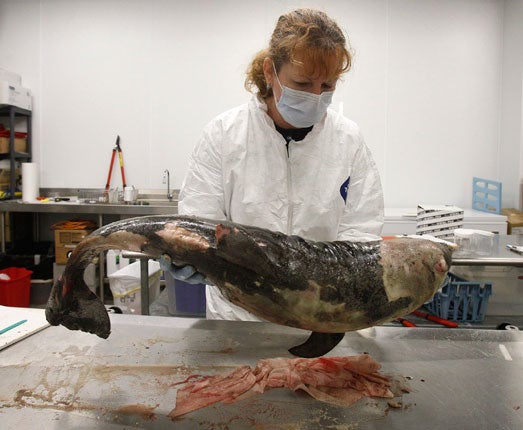
The discovery of more than 80 dead dolphins in the Gulf of Mexico is raising fresh concerns about the effect on sea life from last year's massive BP oil spill.
The dead dolphins began appearing in mid-January along the coasts of Louisiana, Mississippi and Alabama in the United States. Although none of the carcasses appeared to show outward signs of oil contamination, all were being examined as possible casualties of the petrochemicals that fouled the sea water and sea bed after BP's Deepwater Horizon drilling platform exploded last April, killing 11 men and rupturing a wellhead on the sea floor. The resulting "gusher" produced the largest marine oil spill in the history of the petroleum industry, releasing nearly five billion barrels of crude oil before it was capped in July.
The remains of 77 animals – nearly all bottlenose dolphins – have been discovered on islands, in marshes and on beaches along 200 miles of coastline. This figure is more than 10 times the number normally found washed up around this time of year, which is calving season for some 2,000 to 5,000 dolphins in the region. Another seven dead animals were reported yesterday, although the finds have not yet been confirmed by the US National Oceanic and Atmospheric Administration (NOAA).
One of the more disturbing aspects of the deaths is that nearly half – 36 animals so far – have been newborn or stillborn dolphin calves. In January 2009 and 2010, there were no reports of stranded calves, and because this is the first calving season since the BP disaster, scientists are concerned that the spill may be a cause.
"The number of baby dolphins washing ashore now is new and something we are very concerned about," NOAA spokeswoman Blair Mase said. She said that the agency had declared the alarming cluster of deaths "an unusual mortality event", adding: "Because of this declaration, many resources are expected to be allocated to investigating this."
The Institute of Marine Mammal Studies in Gulfport, Mississippi, has been tasked with examining the dead animals. "We are on high alert here," said Moby Solangi, the institute's director. "When we see something strange like this happen to a large group of dolphins, which are at the top of the food chain, it tells us the rest of the food chain is affected."
Mr Solangi said that scientists from his organisation had performed full necropsies – the animal equivalent of autopsies – on about one-third of the dead calves. "The majority of the calves were too decomposed to conduct a full necropsy, but tissue samples were collected for analysis," he said. So far the examinations have been inconclusive.
The spill was the greatest ever in the US – 20 times as big as the Exxon Valdez spill in Alaska in 1989 – and initially it was thought it would prove the worst US environmental disaster, imperiling the rich wildlife of the gulf's semi-tropical waters.
By the end of last year about 7,000 dead creatures had been collected, including more than 6,000 birds and 600 sea turtles. But this compares with the figure of perhaps 250,000 seabirds killed as a result of the March 1989 Exxon disaster.
Join our commenting forum
Join thought-provoking conversations, follow other Independent readers and see their replies
Comments
Bookmark popover
Removed from bookmarks