Panda Power! Edinburgh awaits the patter of tiny paws
With news that China is sending two of its animal ambassadors to Scotland, David Randall looks at the subtleties of panda diplomacy
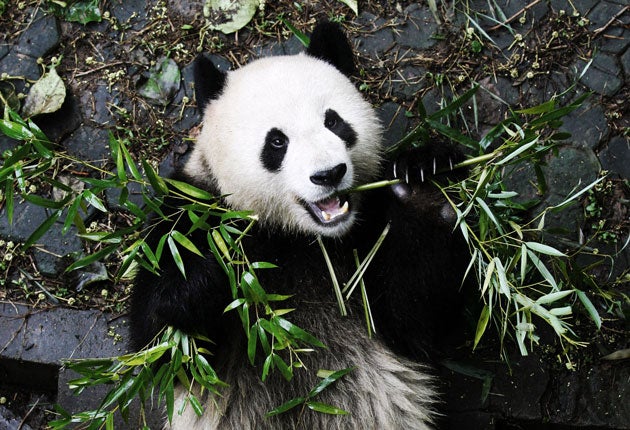
Somewhere, back in the primordial mists, evolution anticipated Walt Disney. It took a bear – an aggressive, meat-chomping carnivore of a thing – and generation by generation, nudged it in an unexpected direction. It gave it big eyes, made even larger by huge black patches of fur, steadily made its face rounder and more soulful-looking, lowered its libido and led it towards the gentle uplands of vegetarianism. By the time it had finished, the creature was a leaf-eating, real-life soft toy. Then, to finish off the transformation, humans came in and gave it the sort of name even a tongue-tied toddler can pronounce, and called it the panda.
Thus it became suitable as the emblem of conservation bodies, for cartoons, merchandising, furry pyjama cases, and diplomacy. And, as Edinburgh will discover later this year when two pandas arrive amid much fanfare from China, it is also, being the biggest celebrity in the terrestrial animal kingdom, superb at boosting attendances at zoos.
Behind this rarefied status lies quite a story. They were probably never all that numerous (they are, after all, solitary old things), and as their lowland habitat in China was deforested bit by bit they were forced on to wooded slopes in the more benign highlands. All the while, the West was oblivious; and it was not until 1869, when the famous animal and plant hunting French priest, Armand David, was given a panda pelt, that we had any idea they existed at all. In due course, trigger-happy rich American adventurers headed east to bag a panda, the first to succeed, in the 1920s, being the sons of President Theodore Roosevelt, one of whom later shot himself.
Trophy hunters were duly replaced by collectors of live specimens for zoos – which was how Britain got its first, and largest, consignment of these living teddy bears, courtesy of banker-turned-collector Floyd Tangier Smith. In 1938, he captured six and packed them off to Britain. One died on the way, another in quarantine, and three were sold to London Zoo. They did not fare well. Tang and Sung died at the age of three, while Ming, the only female, managed to live to seven. In 1945, in perhaps the first example of panda diplomacy (and which predates the Communist Revolution), the governor of Sichuan Province sent Lien Ho, an infant male, to London. He died just four years later.
In the 1950s, amid the Cold War and with China regarded as a more acceptable, if reclusive, face of international communism than the USSR, the panda began to come into its own as the ultimate goodwill gesture. By now the world recognised their rarity, and the perilous thread by which their populations hung on in remoter parts. And so it was that in 1958, a young female set off from China bound for Chicago Zoo. There she might indeed have arrived had not the US Secretary of State decided that no commie bear was setting paws on his territory. The animal's trip, which had taken in Berlin and Frankfurt, stopped in London. Our zoo bought it for £12,000, and thus it was that Chi Chi took up residence in Britain.
She became one of its most celebrated inhabitants, and undertook a further diplomatic mission in 1966 when she was dispatched to Moscow in the hope that she and that city's An An would mate. They didn't. Two years later, a return match was staged in London, with distressingly similar results. Chi Chi finally died as she had lived, a spinster, in 1972. Stuffed and mounted, she resides to this day in a glass case at the zoo. Two years after that, the Chinese government presented Edward Heath with a male, Chia Chia, and a female, Ching Ching. Again, nothing doing; and Ching Ching died, unmolested, in 1985. Her putative mate was later transferred to Mexico where he finally proved his mettle by fathering three cubs. And that – barring Ming Ming and Bao Bao, who came to London briefly in the early 1990s in what is described, in rather undignified terms, as on "breeding loan" – was that. There was much physical contact, all of it, I'm afraid, of a fisticuffs nature.
Meanwhile, China's distribution of pandas to zoos around the world in accordance with political considerations began to change. The conservation movement was now in full swing, and China itself began to take action. Breeding centres began to open, and China started the long, slow process of increasing the number of panda reserves, from 13 in the early 1980s, to more than 60 today. In latter years, there has been substantial success with the breeding programme (more than 300 pandas have been bred in captivity to date worldwide), and there have even been some reports that numbers in the wild have been underestimated and total closer to 3,000.
The export of pandas changed, too, with scientists getting more involved. China had, in recent decades, sent the animals overseas in return for an annual fee of around $1m. Since the 1980s, it has been the policy that most of this sum will be spent on panda conservation, and this is certainly the case with Edinburgh. Nothing as vulgar as a precise figure is forthcoming, but it is a "substantial annual payment", which sources there say is in line with what other zoos have paid.
Negotiations to bring two pandas to Edinburgh were instigated in 2006 by scientists from the Royal Zoological Society of Scotland. Two years later, a letter of intent was signed with Wolong National Nature Reserve and the Chinese Wildlife Conservation Association, and it was only in the latter stages that politics were involved, it being a requirement in these matters that senior politicians from China and the recipient country are the ones who close the deal. This was done last week, in the context of a major trade agreement, which may or may not tell its own story. The Edinburgh pair are due in the autumn, and will occupy a refurbished gorilla enclosure. Hopes of the patter of tiny paws (and they are tiny – the young emerge one-900th the size of an adult) are high. The female – like all her counterparts receptive only two or three days a year – has already had twins quite naturally.
It is, however, at this late stage that one should point out that pandas, in the wild at least, are not quite as cuddly as their image suggests. They have been known to kill each other, and the digestive complexities of being a vegetarian while having the interior arrangements of a meat-eater mean that they defecate about 40 times a day. Scent marking – of themselves and surrounding vegetation – is also important to them, and males have been known to perform a handstand, all the better to urinate that much higher, and more impressively, up a tree. It is not something even the most feral of youths attempt in urban Britain, and one hopes that the Edinburgh pair mind their scenting manners and remember that frequently there will be children watching. Keep the handstands to a minimum, guys, and you'll be very welcome in Scotland.
Join our commenting forum
Join thought-provoking conversations, follow other Independent readers and see their replies
Comments