Revealed: the bid to corner world's bluefin tuna market
Mitsubishi freezing fish to sell later as stock numbers plummet toward extinction
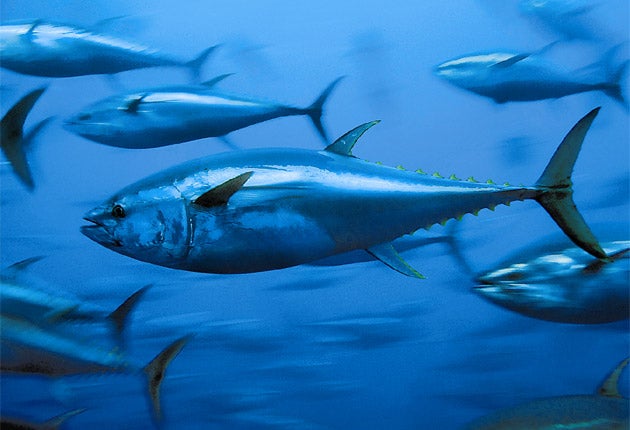
Japan's sprawling Mitsubishi conglomerate has cornered a 40 per cent share of the world market in bluefin tuna, one of the world's most endangered fish.
A corporation within the £170bn Mitsubishi empire is importing thousands of tonnes of the fish from Europe into Tokyo's premium fish markets, despite stocks plummeting towards extinction in the Mediterranean.
Bluefin tuna frozen at -60C now could be sold in several years' time for astronomical sums if Atlantic bluefin becomes commercially extinct as forecast, a result of the near free-for-all enjoyed by the tuna fleet.
In the forthcoming documentary film The End of the Line, Roberto Mielgo, a former bluefin fisherman who travels the world monitoring catches, claims that Mitsubishi buys and sells 60 per cent of the threatened fish and that it has expanded its freezer capacity to hold extra bluefin.
Mitsubishi acknowledges that it freezes bluefin, but only, it says, to even out peaks and troughs in supply.
"Mitsubishi Corporation handles between 35 per cent and 40 per cent of Atlantic and Mediterranean bluefin tuna imported to Japan," the company told The Independent.
"As we explicitly explained to the makers of the film, the fishing season for bluefin tuna in the Mediterranean is very short, making it necessary to freeze tuna to provide customers with stable supplies throughout the year."
Fish stocks across the world are in retreat because of over-fishing. One study suggests oceans will be stripped clean of all fish by 2048. Bluefin is imminently at risk of commercial extinction. The wildlife charity WWF forecasts that breeding stocks of the fish that migrate from the Atlantic to spawn will be wiped out in the Mediterranean by 2012.
Although the legal bluefin catch is set at 22,000 tonnes, conservationists suspect the actual catch is 60,000 tonnes, four times the maximum that marine scientists recommend. After studying catches and sales, Charles Clover, the environmental journalist behind the film The End of the Line, believes that businesses involved in the ransacking are deep-freezing 20,000 tonnes of bluefin a year for later use.
He hopes his film will galvanise the public about over-fishing in the same way Al Gore's An Inconvenient Truth mobilised opinion against climate change.
British retailers and chefs will not stock bluefin because it is so endangered. However, as disclosed in The Independent last week, the Japanese restaurant Nobu continues to serve it – while advising diners to choose a dish that is less environmentally damaging.
The fisheries body responsible for numbers, the International Commission for the Conservation of Atlantic Tunas (ICCAT), sanctioned a bluefin catch of 22,000 tonnes this year in defiance of its own scientists who advised no more than 8,500-15,000 tonnes.
WWF said the decision was a "disgrace". In fisheries circles, ICCAT is sometimes referred to as the International Conspiracy to Catch All Tuna. Rules forbidding the use of spotter planes to identify tuna shoals are flouted and boats are thought to have connections to organised crime in Italy.
Willie Mackenzie, a Greenpeace fish campaigner, said: "Mitsubishi are best known in the UK for making cars or electrical goods – and for most people it comes as a bit of a shock to find out they are one of the world's biggest traders in the endangered bluefin tuna. Bluefin tuna are as endangered as rhinos or tigers."
View all comments that have been posted about this article.
Offensive or abusive comments will be removed and your IP logged and may be used to prevent further submission. In submitting a comment to the site, you agree to be bound by the Independent Minds Terms of Service.
- Print Article
- Email Article
-
Click here for copyright permissions
Copyright 2009 Independent News and Media Limited


Reduce your global impact.
Comments
Unfortunate the species that attracts the attention of the Orientals, it will soon be gone. At least dogs and cats are not endangered so at least the Orientals can eat those to their hearts' content (yecchh.)
There are 70 farm registered and they too should be given a share of the Quota and a list of vessels that can land to them.
In reply to "boycott" add Spain to that list, it only offically reported two thirds of its catch.
davidcharlesboden@yahoo.com
'Oriental' refers to rugs and dolls. Carry on...
Don't mistake these hard-core, fact based opinions (like mine) for any sort of 'racist' projection. Think of this way: You know how many Europeans profess to hate the (at least) pre-Obama Bush administration US, but differentiate between 'government' and 'people'? It's like that.
I'm talking specifically about the HUGELY powerful Japanese business interests/ fishing industry lobbyists influencing- and yes since the mid 90's actually flagrantly LYING about tuna catch quotas and throwing huge amounts of money around the world to essentially due what ever they need to get as much bluefin tuna as they want, sustainability be dammed. (I mean, whose 'making up' a market to kill whales under the auspices of scientific research? How transparent is that..)
Don't get me wrong- I'm no apologist for ICCAT and the wimpy, ridiculously blind, fishing industry beholden representatives the US sends to these commissions. But hands down, the Japanese vested industry representatives aren't even interested in PRETENDING that Tuna populations are crashing. It's flagrant self-interest that is leading to extinction before our eyes.
Yes, boycott all Mitsubishi's products. (But tell them why.) But as previous posters pointed out, our efforts as consumers may not work unless we really tackle the big laws, big commissions, and others that supposedly 'monitor' the activity of the fishing industries.
God, I really hope the Bluefin survives. They are flippin' beautiful, wonderous animals.
It might be a good time to boycott all of Mitsubishi's products. Likewise it is probably time line up others who are complacent in this trade including products/services originating from Turkey, Malta, France, and Italy.
The Japanese dont export the tuna. If you stop eating tuna and fish it wont make a difference. Japan has the appetite to consume all the fish you can throw at it.
Need something like an international fisheries police (this may already exists and are not doing their job effectively) to enable the survival of struggling species of sea life.
(2) Boycott the products and services of the Japanese companies that are engaged in the Bluefin Tuna trade.
If enough people do this then said corporations will either change their ways or go out of business.
Optional part (3) support Sea Shepherd? :-)
http://www.washingtonpost.com/wp-dyn/co
Tuna is without doubt my favorite food in the world and i had noticed a lack of it at fish counters across Europe, but stupidly had never put one and one together. Now i know the situation she is off MY menu. I will never consume her again, which is a pity, but it is all we consumers can promise to do.
-ALL of us CONSUMERS of EVERY NATION-
but i doubt we will and it makes me very sad that once again we will be saying goodbye to another glorious species, further narrowing the planets diversification ,removing another colour from our landscape.
Yet another nail in our own coffin, thumped in with our own thick heads.
Its time like this when you realise that humanity is doomed.
I consider that what I am doing is sustainable, even my partner's sister, who is a rabid veggie, understands the rationale. Fish-farming is not sustainable, simply due to the amount of bait-fish taken to process into fish pellets. I refuse to eat Danish bacon products because I can taste fish from the sandeel that is caught to feed the pigs.
I've no doubt that I will be labelled as hyprocritical but I can live with what I'm doing.
Of course a legally enforced large-scale reduction in fishing would have a big impact on the millions of people employed in the industry world-wide, with big social implications. But there is a choice. If a reduction in fishing intensity happens now there is the prospect of a return to (more sustainable) fishing once fish stocks have recovered in the future, and the industry can survive. If there is no reduction in fishing intensity then the mass unemployment will still occur, just a few years later, with fish stocks irreparably reduced, and no prospect of a future for fishing.
To support our planet, and our fellow man, we as citizens need to act now to demand change, and effect changes in our consumer patterns to give the impetus to big corporations to stop their destructive activities.
Or we can just all wait to see what they can drag out of the deep marine trenches for us to eat once there's nothing left in the rest of the ocean.
More companies should be exposed so that consumers can make informed decisions when deciding who to purchase from. Consumers should also be boycotting tuna or better still it should be illegal to sell tuna as well as catch it.
LET HER RIP PEOPLE - Tell them you won't be using or buying their products. I know I won't and I'm going to stop eating tuna.
https://secure.mitsubishicorp.com/j
How can populations be culturally challenged? This is the main issue of our lifetime