Save the elephant: ivory trading is set to resume
Britain urged to oppose demands from Tanzania and Zambia to lift ban on tusk sales / Conservationists fear the move would intensify slaughter of elephants
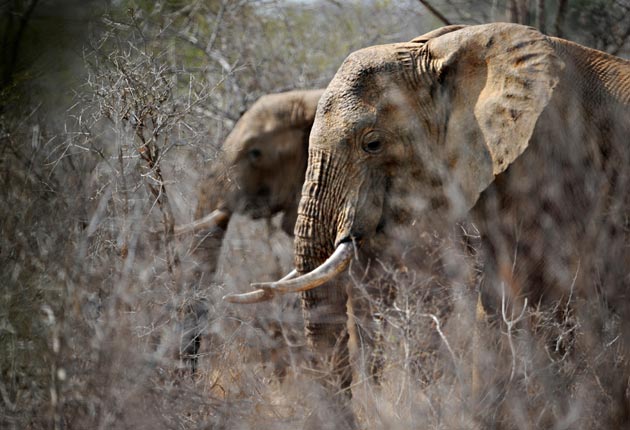
Two African countries are trying to open a new breach in the worldwide ivory trade ban, which conservationists fear could lead to more African elephants being slaughtered by poachers.
Environmental campaigners called on Britain to take a clear lead in opposing the proposals by Tanzania and Zambia to sell their ivory stocks, which will be voted on at the next meeting of the Convention on International Trade in Endangered Species (CITES) in Qatar in March.
Other African countries, led by Kenya and Mali, are strongly opposed to the idea, and are sending representatives to Brussels this week to urge the European Union not to support it. If it went ahead, the sale would be the third "one-off" auction of ivory since the world ban came into force, 20 years ago last week.
The ban was initially successful in halting the huge scale of elephant killing of the 1980s, when Africa's elephant population crashed from 1,300,000 to 625,000 in a mere decade. But following the most recent sale, in November 2008, of 100 tonnes of ivory owned by Botswana, Namibia, Zimbabwe and South Africa – bought by dealers from China and Japan – there has been a notable upsurge in worldwide seizures of illegal ivory, and of elephant poaching. It is thought that the resumption of any trading creates a market into which illegal poached ivory can be laundered, thus boosting demand for it.
In some Central and West African countries this is now pushing elephant populations to extinction. Chad is thought to have only a few hundred elephants and Senegal and Liberia may have fewer than 10; Sierra Leone's last elephants were wiped out by poachers in November.
In Kenya, whose wildlife protection measures are among the strongest in Africa, the number of elephants killed by poachers rose from 47 in 2007, to 98 in 2008, and 214 in 2009. Reports suggest that at least 15 tonnes of African ivory tusks and pieces – the equivalent of up to 1,500 elephants – were seized in, or en route to, Asia in the past year.
Yet the British Government has declined to offer unequivocal opposition to a new one-off sale. "The global ban on international trade in ivory imposed in 1989 remains firmly in place and the UK strongly supports this," said the Wildlife minister, Huw Irranca-Davies. "CITES is assessing the likely effects of another one-off sale, but rigorous enforcement of protection for the planet's endangered species must be paramount, and be the driving force behind CITES' recommendations."
Conservationists say CITES' recommendations regarding the last two sales, in 1997 as well as 2008, were that they should go ahead, and in both cases, Britain, as part of the European Union voting block within the convention, did not oppose them.
"The African elephant population is in crisis, and it's not enough for the British government to take a 'wait and see approach'," Caroline Lucas, the MEP and leader of Britain's Green Party, said last night. "Instead of hiding behind advice from officials, ministers should show leadership by giving a clear guarantee now that they will oppose a further one-off sale."
Allan Thornton, head of the Environmental Investigation Agency, the Washington and London-based pressure group which provided much of the evidence of poaching which led to the original ban, said: "The present level of poaching as a result of the illegal ivory trade is already devastating and wiping out elephant populations across Africa. If this new sale went ahead it would be throwing fuel on the fire. Britain is represented on the standing committee of CITES and should take a lead role in opposing this."
Tanzania and Zambia want to sell their stocks of legally acquired ivory (from culling, or from elephants which have died naturally) which amount to 90 tonnes and 22 tonnes respectively, worth a total of $16m. They also want their elephant populations "downlisted" from CITES' Appendix 1 (which prohibits all trade in the species) to Appendix 2 (which allows trade if it is monitored).
When CITES sanctioned the last ivory auction in 2007, it was agreed that there would be no more such one-off sales for at least nine years, and Tanzania and Zambia are seen as having reneged on this. Their move has aroused resentment and anger among other African states which have elephant populations and wish to protect them. Congo, Ghana, Kenya, Liberia, Mali, Rwanda and Sierra Leone, have tabled a counter-proposal for the March meeting, calling for a 20-year moratorium on any such sales, from the date of the last one.
And delegates from the 23-government African Elephant Coalition (AEC) are in Brussels aiming to persuade the EU Commision, the European Parliament and EU member states, to oppose the new sale, with the Kenyan Forestry and Wildlife Minister, Noah Wekesa, giving a press conference to detail recent poaching.
"This is really the last call for elephants in Africa," said Bourama Niagate, director of parks and natural reserves in Mali. "The devastating poaching of the 1980s first controlled through CITES is now so prevalent that the African elephant is all but extinct in some countries. This is because limited legal sales were allowed in the recent past providing the perfect cover for illegal trade in poached ivory.
"If we do not let elephant populations recover over the next 20 years by stopping the trade entirely, there will be no more African elephants outside a few zoological specimens in reserves in southern parts of Africa. Europe needs to do the right thing and back our stance now because it is nearly too late."
Ivory ban: A sad history
*1989: Member states of CITES agree at their meeting in Lausanne, Switzerland, to place the African elephant on CITES' Appendix One, meaning all all trade in elephant products, ivory, is banned around the world.
1990: The ban comes into force, halting the rapid crash of elephant populations caused by poaching. Poaching levels drop substantially across Africa.
1997: Led by Robert Mugabe of Zimbabwe, inset, four southern African states with substantial elephant populations – Zimbabwe, South Africa, Namibia and Botswana – get CITES to agree to a "one-off" sale of 50 tonnes of ivory. Britain goes along with it. Poaching rises.
2007-08: The same four African states get CITES to agree to another "one-off" sale, this time of 100 tonnes. Britain goes along, despite warnings that it will increase poaching. AndChina is allowed by CITES to become an official ivory buyer, in spite of harbouring the largest amount of illegal ivory. Britain goes along with it, despite warning this too will increase poaching, which soars.
2010: Tanzania and Zambia seek a third "one-off" sale. Will Britain go along with it? Time will tell.
Join our commenting forum
Join thought-provoking conversations, follow other Independent readers and see their replies
Comments
Bookmark popover
Removed from bookmarks