The Big Question: Why are honey bees disappearing, and what can be done to save them?
Why are we asking this now?
Because yesterday Britain's beekeepers, an eminently peaceful and undemonstrative group of people, felt steamed up enough about the issue to mount a lobby of Parliament, bending the ears of peers and MPs.
What are they lobbying for?
They want the Department for Environment, Food and Rural Affairs (Defra) to carry out an urgent research programme into the diseases that seem increasingly to be threatening honey bees in Britain and in other parts of the world. The beekeepers have costed the programme at £8m over five years. The Food and Farming Minister, Lord Rooker, accepts that bees are facing serious threats. In fact, he himself has warned that honey bees could be wiped out in Britain. But he says that Defra simply doesn't have the cash to fund the research.
What are these threats?
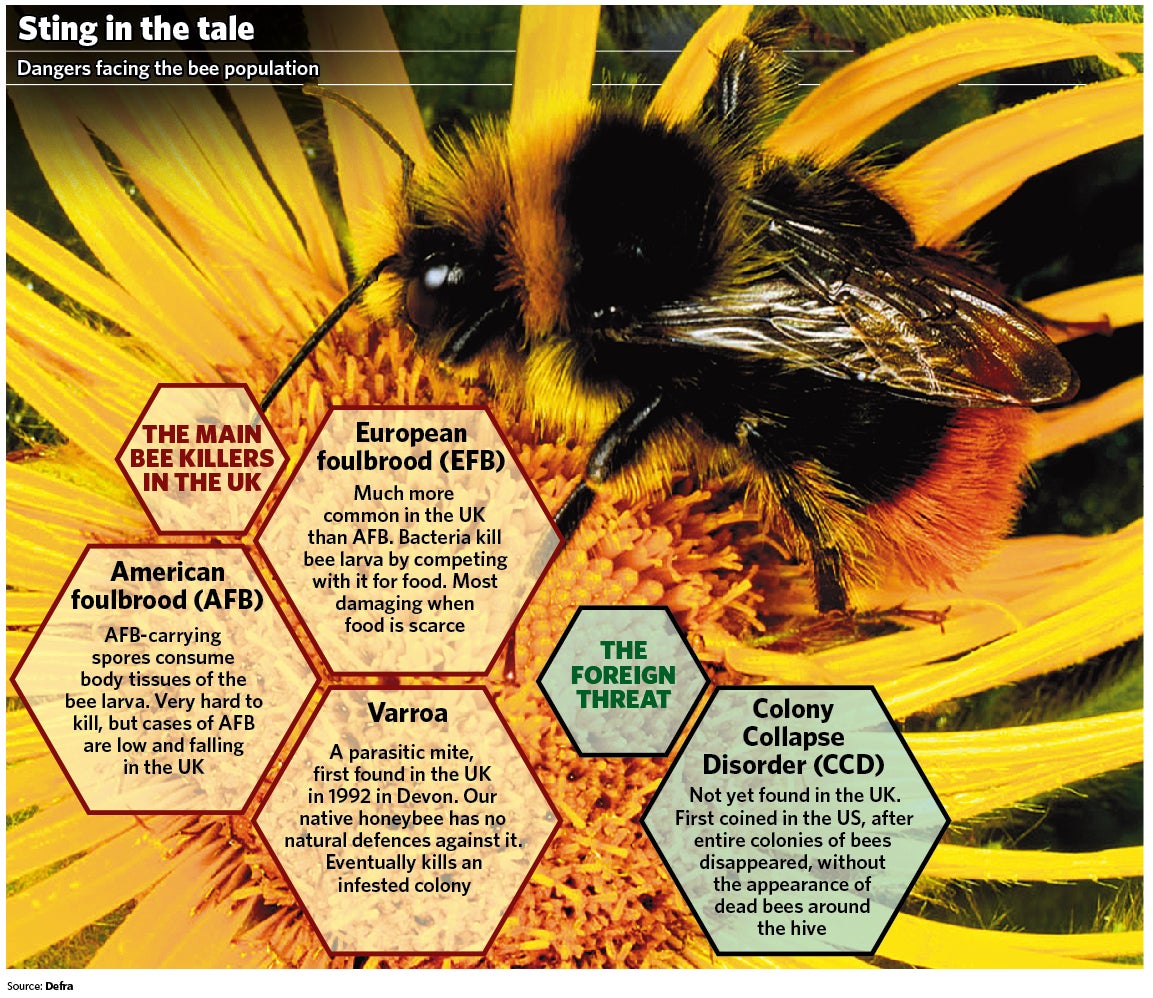
Bee colonies have always been vulnerable to disease because they are densely packed environments through which infections can spread rapidly; a bacterial infection known as foulbrood has been known for more than a century. But in recent years the threats have grown. One of the biggest has been the varroa mite, a tiny insect that feeds off the bodily liquids of bees in the hive, especially in their larval stages. The mite, which carries a damaging virus and can wipe out whole bee colonies, was first detected in the US in 1987 and in Britain in 1992; now it has spread to much of the world. It can be contained with chemicals, but increasingly, the mites are developing resistance to the chemicals used against them.
Other damaging hive invaders from other parts of the globe, which have not yet been seen in Britain but may well be on the way here, driven by climate change, include the small hive beetle, the parasitic brood mite, and the Asian hornet. But the biggest fear of all concerns Colony Collapse Disorder.
What is Colony Collapse Disorder?
Colony Collapse Disorder (CCD) is a recently-observed but little-understood phenomenon in which worker bees from a colony or hive abruptly disappear, and the colony dies. It may be due to stress, or viruses, or a combination of both, or other causes. It began to be noticed in the US in the autumn of 2006 and the spring of 2007, and was thought to be devastating bee colonies in more than 20 states, but enormous uncertainty still surrounds the condition, as hives and colonies can collapse for other reasons, especially during the winter. CCD is thought to have been detected in several countries of continental Europe, but not yet in Britain. Beekeepers are on tenterhooks.
So does this mean that Britain's bee colonies are safe for the moment?
Not according to the British Beekeepers' Association (BBKA), which represents those people in straw hats, veils and gloves. In January the BBKA warned that the threats were so great that if urgent action was not taken, honey bees would disappear completely from Britain by 2018, causing "calamitous" economic and environmental problems. Hence yesterday's lobbying of parliament.
But surely all bees do is make honey?
Far from it. They certainly do make honey, but more importantly, they are an essential agent of pollination for a vast range of plants, many of which are important human foodstuffs. Without the presence of bees, much of agriculture would be impossible, and this is a sobering thought right now, as feeding the world is suddenly becoming more difficult because of rising demand and the transfer of much crop production into biofuels, especially in the US.
Most of the pollination for more than 90 commercial crops grown throughout the United States is provided by Apis mellifera, the honey bee, and the value from the pollination to agricultural output in the country is estimated at $14.6bn (£8bn) annually. In Britain alone, pollination by bees of a suite of just 10 crops, ranging from apples and pears to oilseed rape, was calculated to be worth £165m per annum in 2007.
The BBKA points out that this is £800m-plus over five years – and the research programme they are calling for over the same period would cost a mere one hundredth of that. Yet the Government pleads poverty.
Is the Government doing nothing to safeguard the future of honeybees?
On the contrary. Two weeks ago Lord Rooker, the minister who turned down the BBKA's research programme just before Christmas, outlined a long-term strategy to protect the health of honey bees in England and Wales. Launching a consultation paper, he said: "Honey bees are facing serious threats from a growing number of pests and diseases, and it is vital that we do all we can to respond effectively to these threats, and to sustain honey bees and beekeeping for today and for future generations."
A series of "new or enhanced priority activities" related to disease control or good bee husbandry is proposed, which includes more training for keepers to identify diseases and a campaign to persuade beekeepers to sign up to a national database. One proposal in particular, for volunteer beekeepers to be enlisted in future emergencies to help the national team of bee inspectors track and eradicate new viruses, attracted attention: one commentator called it "a Dad's Army for bees."
Did this not satisfy the beekeepers?
They welcomed it, certainly, but they insist that the research they want is essential. At their lobby of Parliament yesterday, Tim Lovett, the BBKA President, said: "We will keep our bees only if the Government will help us to keep them healthy. Does the Government want the nation to go without honey on their toast, not have home-grown strawberries to go with cream, and even put their own crusade for the public to eat five portions of fresh fruit and vegetables at risk? Food production is now an important issue and bees are central to it."
He added: "We note that the US government immediately invested $80m into research on Colony Collapse Disorder, which has devastated their bee colonies, affecting pollination of the apple orchards, the almond and orange crops. CCD has not yet crossed the Channel from Europe, but we are urging the Government that it needs to be prepared should this happen. The Government spends just £200,000 out of a budget of £1.5 million for bee health on research. Immediate action needs to be taken to avoid this economic and ecological disaster in the making."
So should the Government find £8m for honey bee disease research?
Yes...
* Honey bees are at the basis of much of our agriculture and a quite crucial resource, especially at a time of growing food instability
* The threats faced by honey bees are admitted by the Government to be very serious
* In terms of overall government spending, and considering the nature of the threats, the funding in question is a a drop in the ocean
No...
* The Department for Environment, Food and Rural Affairs (Defra) can't afford it, because of an earlier budget crisis
* Defra is already working on a honey bee health strategy, which should be given the chance to take effect
* There is no certainty that the various threats to the health of honey bees will materialise
Join our commenting forum
Join thought-provoking conversations, follow other Independent readers and see their replies
Comments
Bookmark popover
Removed from bookmarks