The incredible shrinking polar bear
Animals lose weight and size as melting ice limits hunting
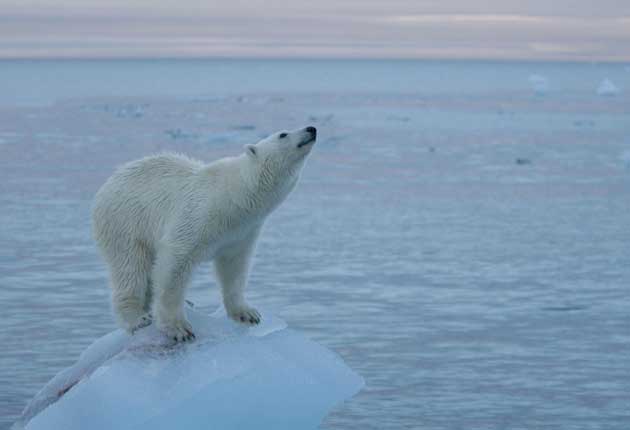
Polar bears are shrinking, along with the ice on which they live – and are turning to cannibalism – as global warming increasingly stops them getting enough to eat.
Scientists say the animals are now only two-thirds as big as they were 30 years ago as melting ice makes it harder for them to catch seals, and that they have begun to hunt each other instead.
The news comes as Arctic nations agreed at a special summit in Norway last week to draw up an action plan to try to save the highly endangered species.
The bears subsist almost entirely on seals, and depend on the polar ice to hunt them. As the seals swim too fast in open water, the bears have to lie in wait for them to surface for air through holes and cracks in the ice. But the best place to do this is near land, as the seals congregate in shallow waters, and every year the ice is receding further out to sea as global warming takes hold.
Even worse, the ice is melting earlier each year – cutting down the amount of seals the bears can catch in the spring, which the bears use as a vital fattening-up time to see them through a long summer fast.
New research presented at last week's summit – the most important meeting on the fate of the polar bear for more than three decades – shows that female bears now weigh an average of 230kg, a full 65kg less than in 1980, and are 220cm long, 35cm less than before.
Their health has suffered as their weight has fallen, impairing their ability to reproduce and have cubs that survive. "The chain of events starts with a drop in body condition that subsequently leads to a drop in reproduction, which leads to a drop in survival," Dr Andrew Derocher, chair of the international Polar Bear Specialist Group, told delegates.
Other scientists report that, in their desperation, the bears are turning on each other. Dr Steven Amstrup, a specialist on the animals at the US Geological Survey, says they are "clearly deliberately hunting other bears, for example by attacking females in their denning areas".
Two years ago a giant US government study predicted that global warming would kill off two-thirds of the world's polar bears by 2050. But this is now thought to be over-optimistic: the melting is accelerating so fast that many scientists believe the Arctic Ocean will be completely ice-free in summer by 2030.
View all comments that have been posted about this article.
Offensive or abusive comments will be removed and your IP logged and may be used to prevent further submission. In submitting a comment to the site, you agree to be bound by the Independent Minds Terms of Service.
- Print Article
- Email Article
-
Click here for copyright permissions
Copyright 2009 Independent News and Media Limited


Reduce your global impact.
Comments
all things eventually come to an end
many animals went extinct before humans and many more will go extinct after us.
Perhaps mans destruction of the earth is in fact a necessary evil something which nature deliberately
programmed us to do. stop holdong onto the [ast and live for today, water will run through your fingers.
The report also shows that COY's (cub of the year) are smaller and that showed in smaller males, but the males were living longer. On table #1 of those captured from 2001-2006, the data is not alarming. In fact it showed an abnormal spike in those captured in 2004 and 2005. Why? Were there more bears?
The report didn't go far enough. Was there a change in the seal population to cause the bears to stray farther. Was there an increase in the population causing an increase in bear territories. It is not uncommon for females to have more that one cub. What if one dies. There is always a dominent sibling. One thing is clear, no one knows the actulal population of the polar bear, it is always estimated. There are too many variables that the study didn't answer.
Not everbody is on board With U.S. alarmists who irresponsibly put the polar bear on the endangered list. This was done based on speculation without solid data. Lets not forget that polar bears are still hunted by the inuit and allowed by the other countries that border the Artic. What if all the ice does melt?
The size of bears may well have shrunk. I don't know. What is widely agreed upon is that the polar bear population has increased significantly since the 1970s. More bears = more competition for food = smaller bears. This would happen with any population.
This isn't merely a plausible hypothesis - it's an unmissable one.
The only way to miss it is to already have made up one's mind that the cause must be something else - in this case global warming.
I don't get it. We recognize bad music. We've all read bad poetry. Bad architecture is everywhere. We know bad fashion when we see it. We recognize bad arguments in a court of law. Shoddy policework? We see that too. Bad business practices? We see plenty of them (too late it would seem when it comes to banking). Why can't people recognize bad science? Because it's staring us in the face with this polar bear foolishness.
As for scientists... I am one (a research based Ph.D.) and I can assure you, scientists are every bit as incompetent at their jobs as the people you meet in EVERY OTHER profession on a daily basis. Competence is a precious commodity.
Is it just that people feel they don't know enough to challenge such foolishness?
If it weren't for 2 dead bears found after a storm (as feature in Al Gore's movie), would we even pay any attention to this non-story.