The swallow that flew to South Africa - and into the record books
It is 100 years since bird-ringing began. Michael McCarthy recalls the historic journey that revolutionised our understanding of winged migration
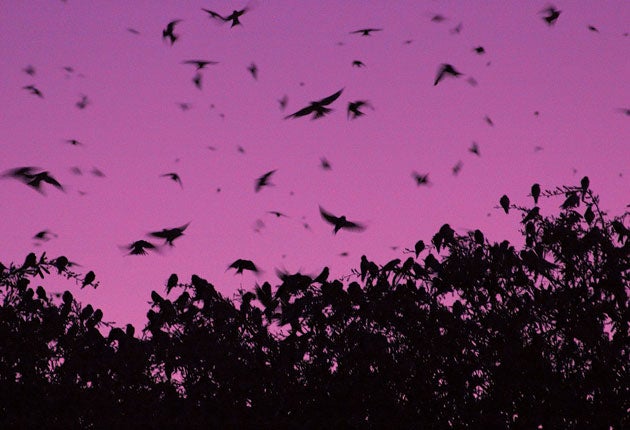
Nobody knew. Nobody dreamed. Nobody even considered the possibility that a bird the size of a penknife might fly 6,000 miles from South Africa to Britain every year, as a matter of course, and then fly back.
At the start of the 20th century, people were just beginning to get an inkling of the wonders of bird migration, but they had little idea of its true scale and extent – until John Masefield's swallow came along.
This was a bird with no name, but it did have a number: B830. For that was the figure on the tiny aluminium ring which Masefield, a 61-year-old provincial solicitor passionate about wildlife, slipped on to the leg of a swallow chick in its nest in the porch of his house in Cheadle, Staffordshire, on 6 May 1911.
Bird-ringing, the fitting of a small metal band to a bird's leg, which if recovered elsewhere reveals the bird's journey, was in its infancy then. In Britain, it was just two years old – and this weekend, in fact, it celebrates its centenary.
In the 100 years since organised ringing began here in May 1909, it has uncovered a wealth of remarkable information about British birds, from the fact that they can journey to the far side of the world, to the fact that they can live to be over 50. But there has been no bigger breakthrough in scientific understanding than that achieved virtually at the start, with the Staffordshire swallow which flew off from Cheadle and ended up somewhere no one remotely expected.
It was known that birds migrated. People had always noticed that about a quarter of our species, ranging from the swallow to the cuckoo, and from the nightingale to the willow warbler, appeared here in the spring, nested and raised their chicks in the summer, and then disappeared in the autumn, when they could be seen flying south. It was assumed that they were going somewhere warmer for the winter, and there was a hazy supposition that they might be heading ultimately for somewhere like Africa. But no one knew for sure until the advent of ringing; and no one had any idea of how far into the African continent they penetrated until news arrived of John Masefield's swallow, 18 months after he ringed it.
It came in a letter to Harry Witherby, a publisher who had founded the journal British Birds, and one of the men who began organised ringing in Britain (Masefield was using rings Witherby supplied).
Dated 27 December 1912, it was sent by Mr C H Ruddock, proprietor of the Grand Hotel, Utrecht, Natal, South Africa. He wrote: "Dear Sir, On December 23, a swallow was caught in the farmhouse of the farm Roodeyand, 18 miles from this town, with a metal label round its leg, with the words Witherby, High Holborn, London, and on the other side B830. The farmer, Mr J Mayer, took the label off and has it in his possession. As I am interested in birds of any sort and the migration of same, I shall be glad to know if you received this letter safely."
At a stroke it was revealed that swallows breeding in the British Isles migrated to winter in South Africa, something which even today we find hard to credit: a bird not much bigger than a matchbox flying 6,000 miles down the whole length of the African continent. Even more remarkable was that it was found so far to the south-east of Africa, for to come in more or less a straight line from Britain meant it would have had to cross the Sahara, something which seemed scarcely conceivable.
Since then ringing, organised in Britain by the British Trust for Ornithology (BTO), with 2,400 enthusiastic and highly trained amateur ringers, has thrown up even greater marvels. It has shown that the Arctic tern, our farthest-travelled bird, goes annually to the Southern Ocean and Australia (a tern ringed in Anglesey in June 1966 was recovered dead six months later in New South Wales, 11,285 miles away) while other British birds travel to the Siberian tundra and Arctic Canada. Ringing has proved how long-lived our birds can be, with the record held by a Manx shearwater, ringed on Bardsey Island in North Wales in 1957, and found again last summer, when it was at least 51; and it allows the measuring of annual changes in birds' survival rates. "In an era of rapid environmental change, ringing is vitally important as a tool to monitor changes in our bird populations, tracking where they go and what they do," said the BTO's Mark Grantham.
But although bigger distances have now been recorded, there have been no bigger revelations from ringing than that provided by the swallow ringed in Staffordshire in that Maytime, 98 years ago. Masefield himself, an upright, civic-minded man (no relation to the John Masefield who was Poet Laureate in the mid-20th century) might have seen that as his crowning achievement as an amateur naturalist, but his life was afterwards overshadowed by the tragedy which befell so many men of his generation: his son Charles, a published poet, was killed in the First World War. Yet his achievement should be remembered: it revealed just how amazing were the journeys undertaken by our migrant birds, tiny creatures making incredible, epic odysseys.
The story of John Masefield's swallow is told in full for the first time in Michael McCarthy's new book Say Goodbye To The Cuckoo, published by John Murray, price £16.99. To order a copy at the special price of £14.99 (free P&P) call Independent Books Direct on 0870 079 8897 or visit www. independentbooksdirect.co.uk
Join our commenting forum
Join thought-provoking conversations, follow other Independent readers and see their replies
Comments