Ranavirus: It's a frog's life
As a new virus cuts a swathe through their numbers, Gillian Orr discovers that we are only starting to unlock the secrets of these alluring amphibians
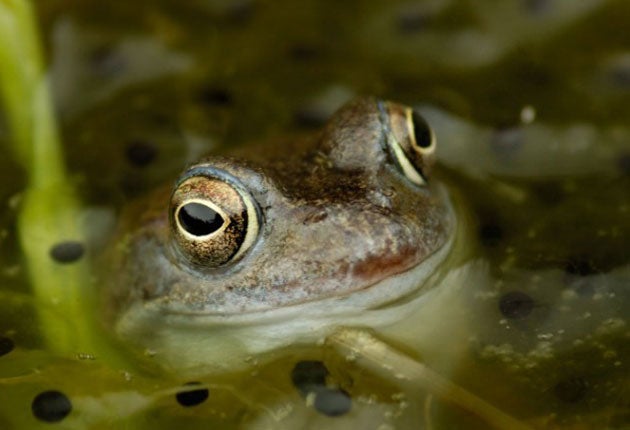
Sad news: last week scientists revealed that the number of common frog populations has fallen by more than 80 per cent because of a virus spreading through the UK. Ranavirus is thought to be new to this country and the symptoms include the haemorrhaging of internal organs and skin ulcerations. This frog plague is a disaster for a species that is as fascinating as it is mysterious.
From more 5,000 known species of frogs, the world's smallest is called Microhyla nepenthicola. The adult males of the amphibians range in size between 10.6mm and 12.8mm, barely bigger than a pea. They were discovered by scientists living in and around carnivorous plants in Borneo earlier this year.
Scientists believe that the largest frog ever was the Beelzebufo ampinga, which lived about 65 million years ago, at the same time as dinosaurs. It was as large as a beach ball and weighed about 10lb. A palaeontologist unearthed the fossils of the frog in Madagascar and it took 15 years and 75 fossils to put together an accurate reconstruction.
Many frogs contain poison and toxins that can be harmful to humans. The most dangerous frog is the phantasmal poison dart frog, found in Ecuador. Although very pretty and only ranging in size between 1-4cm, they have one of the strongest toxins found in frogs.
It's not all bad though: because these frog toxins are extraordinarily diverse, they have raised the interest of biochemists. The alkaloid epibatidine, a painkiller 200 times more potent than morphine, is found in some species of poison dart frogs. Other chemicals isolated from the skin of frogs may offer resistance to HIV infection.
The skin of frogs contains powerful germ-fighting substances because of the hostile environments they exist in. A substance isolated from the skin secretions of the Foothill Yellow-legged Frog (once common in California and Oregon but now facing extinction) looks likely to be able to kill the methicillin-resistant Staphylococcus aureus bacteria, more commonly known as the hospital superbug, MRSA.
Although we tend to associate the eating of frogs with France, frogs are also popular on dinner plates in Asia. According to UN figures, the global trade in frogs has increased in the past 20 years. France and the US are the two largest importers; with France importing between 2,500 and 4,000 tonnes of frog meat each year.
We might enjoy eating frogs but some frogs also enjoy eating each other. The Lechriodus species of frog, which is found in Australia and New Guinea, are commonly known as cannibal frogs, for obvious reasons. It is common for frogs to eat tadpoles as well.
The main reason for frogs to call is to attract a mate and females generally prefer louder calls, because they indicate a bigger, stronger male. Frogs will also use their call to emit a distress signal. Some frog calls are so loud they can be heard a mile away.
The degree to which a frog's toes are webbed depends on their habitat and how much time they spend in water. The African dwarf frog lives nearly all of its life underwater and has fully webbed toes. The Australian green tree frog, which rarely goes near water, has only very slightly webbed toes.
Discovered in 1852 in Ecuador, glass frogs are a family of frogs that are green in colour over most of their bodies but have translucent chests, allowing you to see their internal organs and beating heart. Glass frogs have a unique pigment in their skin that reflects the same infrared radiation as plants, probably to allow them to conceal themselves.
Surely the most famous amphibian in the world is Kermit the Frog, who, in a career spanning 55 years, has starred in dozens of films, television shows, and adverts; received a star on the Hollywood Walk of Fame; accompanied Lady Gaga to the MTV Music Video awards and even addressed the Oxford Union.
Join our commenting forum
Join thought-provoking conversations, follow other Independent readers and see their replies
Comments
Bookmark popover
Removed from bookmarks