The Big Question: Should mothers be offered screening for autism, and what issues would it raise?
Why are we asking this now?
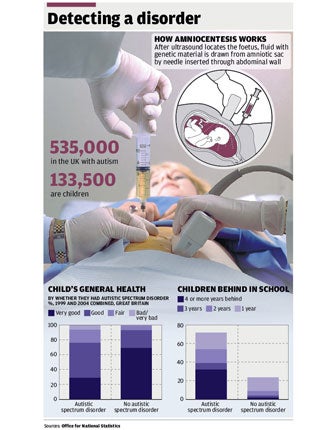
A pre-natal test for autism moved a step closer yesterday with the announcement by scientists at the University of Cambridge that high levels of the male hormone testosterone in the amniotic fluid surrounding the foetus in the womb may serve as an early warning signal of the condition.
Researchers led by Prof Simon Baron-Cohen, the autism expert, say the discovery raises the possibility that an amniocentesis test similar to that performed for Down's syndrome could be offered to mothers in the future.
Does this raise new ethical issues?
Professor Baron-Cohen seems to think so. He called for an ethical debate so that society could decide where it stood on the issue. "Would [a test] be desirable?," he asked. "What would we lose if children with autistic spectrum disorder were eliminated from the population? There is a test for Down's syndrome and that is legal and parents exercise their right to choose termination. But autism is often linked with talent. It is a different kind of condition."
Is Prof Baron-Cohen right?
No. Even if Professor Baron-Cohen's putative test were to be developed – and all that has been demonstrated so far is an association between testosterone levels in the amniotic fluid and autism – it would not be suitable for screening the whole population of pregnant women.
Amniocentesis involves the insertion of a long needle through the abdomen into the womb through which a sample of the fluid surrounding the foetus is extracted for testing. The procedure is not without risk – it carries a one per cent chance of triggering a miscarriage – and can only be justified where the chances of uncovering a birth defect such as Down's syndrome are similarly high.
So who should the testbe offered to?
A small number of selected mothers judged to be at high risk of having an autistic baby based on family history or previous children already born with autism. The test would only be performed by request – it would not be routine. (The difference with Down's is that there is a simple blood test that can be performed that gives an estimate of the risk of the condition, which can then be confirmed by amniocentesis. There is no blood test – existing or proposed – for autism.)
Might the test lead to the elimination of people with autism?
No, because it would not be used to screen the whole population of pregnant women. Screening for Down's is much more widespread, and in 92 per cent of cases diagnosed couples opt for a termination. But that has not led to the elimination of people with Down's syndrome. Although autism runs in families, suggesting a strong genetic influence, it also occurs spontaneously in families, making it impossible to predict. The benefit of a pre-natal test would be to offer to parents who have already experienced the burden of living with an autistic child a chance to have a second or subsequent child unaffected by the condition. For these families it would be a godsend – offering them a choice.
Why is Prof Baron-Cohen worried?
There is a critical difference between autism and Down's syndrome, he says, which is that in some cases autism is linked with genius – displayed in an obsessive interest in mathematics or engineering or music. Newton and Einstein were almost certainly autistic and the idea that people who were not only valuable members of society but also important contributors to its future might have been eliminated before they were born raises uncomfortable questions. Should medicine offer the opportunity to eliminate a foetus who may turn out to be a person of such importance, he asks?
Is this a valid argument?
Many may find the suggestion that some human beings are more valuable than others, and more worthy of being preserved, distasteful. One commentator yesterday suggested it came close to "Nazi-style eugenics". On this argument, all human beings should be valued equally, and they should never be discarded simply because they are difficult, eccentric, don't confirm to "norms", or cause inconvenience to others. That would be to interfere with the natural diversity of the human race.
What do other experts think?
Professor Joan Morris, director of the National Down Syndrome Cytogenetic Register, which records all Down's births, said there was no ethical distinction between testing for Down's or Spina Bifida (already offered in pregnancy) and testing for autism. "There is no new argument here," she said. Testing for each condition raised the same issues over the ethics of selecting foetuses for termination. All three conditions are life limiting (with the exception of severe spina bifida ) rather than life threatening.
Why does autism provoke such strong views?
The condition exerts a grip on the public imagination. In the social world in which we live, the capacity to read situations and respond appropriately is crucial to successful human interaction. Autism disturbs something that is core to our being human. First identified in 1943, autism has attracted increased interest in the past decade. Some suggest this is because, compared with other disorders such as Down's, people with autism look "normal" and are easier to identify with.
Is autism increasing?
Hard to say. With its defining symptom being "an inability to read social situations", it is not simple to diagnose. In people of high intelligence it may go unrecognised for years – even throughout their lives. As understanding has improved the diagnosis has expanded, and experts now refer to "autistic spectrum disorders" including Asperger's syndrome, to include those less severely affected. People with these milder disorders, sometimes described as "mind blindness", are thought to number 500,000. Of these, 100,000 are estimated to be of low IQ and to need support while the remaining 400,000 are of average or high IQ and are mildly affected. The severest kind of autism is thought to affect about 30,000 people in the UK.
Are there wider issues involving embryo screening?
Yes. Routine testing of pregnant women of the sort discussed here only covers a couple of disorders – Down's and spina bifida – and possibly in the future autism. But for a small number of women – those considering IVF – a whole raft of possibilities is opened up, through pre-implantation genetic screening. The first baby to be born in Britain after being screened for BRCA1, the breast cancer gene, was announced last Friday. It is now possible to screen for almost 200 inherited defects, including Huntingdon's disease and cystic fibrosis, by taking a single cell from the developing embryos, testing it in the laboratory, and then replacing those embryos in the womb that have been shown to be free of the defective gene. Opponents argue that this is another step towards eugenics – the selection and disposal of "imperfect humans.
Is it desirable to screen unborn children for autism?
Yes
*Only those at high risk of autism through their family history would be offered the test
*Autism would not be eliminated because the test would not be offered to every pregnant woman
*It does not raise different ethical issues from those raised by testing for Down's syndrome
No
*It could lead to the elimination of some of the greatest minds capable of shaping our future
*A whole range of individuals who add to the diversity of human nature might be lost
*With a large number of people – 500,000 – mildly affected the impact of a test could be huge
Join our commenting forum
Join thought-provoking conversations, follow other Independent readers and see their replies
Comments
Bookmark popover
Removed from bookmarks