The Big Question: Why are teenage pregnancy rates so high, and what can be done about it?
Why are we asking this now?
The case of Alfie Patten, said to have fathered a child at the age of 13 with a girl of 15, has reignited controversies over sex and morality education, with Conservative party leader David Cameron believing the case is evidence that his claim that Britain has become a "broken" society is right.
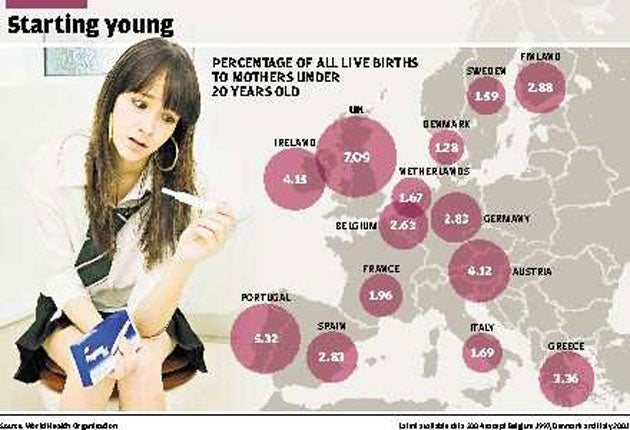
The case comes on top of the fact that statistics show that the UK has the highest percentage of teenage pregnancies in Western Europe – and is second only to the United States, according to figures compiled by the World Health Organisation.
What is the government's policy on sex education in schools?
A government review of how the subject is broached in schools recommends that sex education should be a compulsory part of the national curriculum in primary and secondary schools under a new curriculum to be introduced in September 2010. However, the plan has provoked controversy – particularly among faith-based groups. As a result, a new review led by a respected East London headteacher, Sir Alasdair MacDonald, will look at the question of whether there should be an opt-out clause for parents who do not want their children to take part in the lessons.
Why was this review necessary?
Because statistics – in the form of our teenage pregnancy rates – make it obvious that we have not been successful in delivering this in the past. Currently secondary schools only have to teach the mechanics of sex in biology classes and not in conjunction with relationships and sexual health. Most schools do teach personal, social and health education (PSHE) but it is not compulsory.
A recent survey of pupils showed that four in every 10 had received no sex education at school. Teaching of sex education in the UK also poses particular problems in faith schools. For instance, contraception, abortion and homosexuality are against the teachings of the Catholic faith and there has been some controversy within Catholic schools where diocese have issued edicts barring their schools from allowing pro-choice groups into schools to talk about abortion.
The Government, said Mr Knight, is planning supplementary guidance for faith schools indicating that they must teach all elements of the curriculum alongside Catholic values.
Why do we have the highest teenage pregnancy rate in western Europe?
Some would back David Cameron's "broken Britain" line – arguing that there has been a general reduction of family values with less emphasis on marriage and a growth in single parent families. Others would argue that today's youngsters have been subjected to "sexploitation" – both by the commercial world as witnessed in several reports, most notably the recent inquiry into childhood by the Children's Society which talked of advertisers aiming sexy clothing ads at an increasingly younger age group, and through the internet with a report last week claiming that "tens of thousands" of school and university websites worldwide had become affected by hardcore pornography. Dr Tanya Byron, the TV psychologist who conducted a review of internet use and video games for the Government, recommended that all schools should use an accredited service for their internet provision – which can have blocks put on it to bar hardcore porn from websites used by pupils.
How is the issue tackled in countries with lower teenage pregnancy rates?
The teenage pregnancy rate in Holland is only one-fifth as high as that of the UK – only five births per 1,000 teenagers compared to the UK's 27. Its abortion rate per teenage head of the population is also one of the lowest in Europe. The approach to sex education, though, in a country where pupils are as likely as not to walk through an authorised red-light district on their way to school is very different. Yes, children can discuss sex during their primary school years but it is discussed in an atmosphere of talking about relationships and caring and respect for others.
As Siebe Heutzepeter, headteacher of De Burght school in Amsterdam, puts it: "The English are embarrassed to talk about sex. They are too squeamish. Here adults and children are better educated. It would be unthinkable for a Dutch parent to withdraw their child from sex education. I have only had one Muslim mother who left halfway through a parents' talk on sex." He added: "There is no point in telling children just to say 'no' – this is a liberal country: you need to tell them why they are saying 'no' and when to say 'yes'.
Why is our sex education different?
The curriculum – even that proposed under the review – is more prescriptive. On the face of it, it looks as though it is presenting pupils with a number of facts rather than trying to encourage them to come to a deeper understanding of emotions. For instance, all children from the age of five will learn about body parts and animal reproduction, puberty and intercourse from the age of seven and pregnancy, contraception and safer sex from the age of 11 when they have transferred to secondary school. However, the new curriculum will attempt to stop sex education being consigned to biology lessons ("now we have naming of parts" as it is often caricatured) and ensure that children learn about relationships and the option of abstinence along with the facts of life.
Does that suggest a will to learn from countries like Holland?
In launching the review, Schools Minister Jim Knight was careful to refer to the need for "relationship education". One of the reasons why the subject has been so poorly delivered in the past has been because there are not enough teachers trained to deliver it. In a secondary school, in particular, it would not be a favoured option for most teachers to volunteer to deliver a class on sex education to youngsters approaching or in their teens. The government hopes to rectify this by providing and encouraging more teachers to become dedicated PSHE teachers by 2010.
Are the curriculum reforms likely to work?
That is hard to say. As educationists in Holland put it, it is as much about changing attitudes and culture in the UK as it is about developing lesson plans. Sanderjin van der Doef, an author of a series of books on sex education for use in Holland schools, says: "Here sex is a normal daily part of life, like shopping or football. In England it is a joke or a nudge."
An example of the polarisation of views on Britain's recognition as the teenage pregnancy capital of western Europe can be seen from comments placed on a newspaper website recently asking what age children should be taught the facts of life following the publication of the Government review of the subject.
"I think it is a terrible idea to teach sex education to children aged five. Giving sex lessons to innocent children destroys their childhood," said one contributor. This view was backed up by another who added: "Young uneducated unmarried girls are not having babies because of a lack of sex education." This was counteracted by another contributor who argued: "The Netherlands educates children about sex very early and has the lowest number of teenage pregnancies in Europe." Another added: "Children need facts, not ignorance."
Should the UK learn from other countries?
Yes
*Teenage pregnancy rates in the UK demand that we learn from those with much lower rates
*In the Netherlands, sex education is delivered in the context of learning about relationships not biology
*The UK does not have enough teachers trained in the delivery of the subject to teach it effectively
No
*It is not the business of schools to teach children about sex – it should be left to the parents.
*Lessons abroad touch on topics which would be viewed by some faith groups as inappropriate in class
*Better to educate parents about their responsibilities rather than change the curriculum
Join our commenting forum
Join thought-provoking conversations, follow other Independent readers and see their replies
Comments
Bookmark popover
Removed from bookmarks