English wines: Grape expectations
The perseverance of England's winemakers is starting to pay off. By Aoife O'Riordain
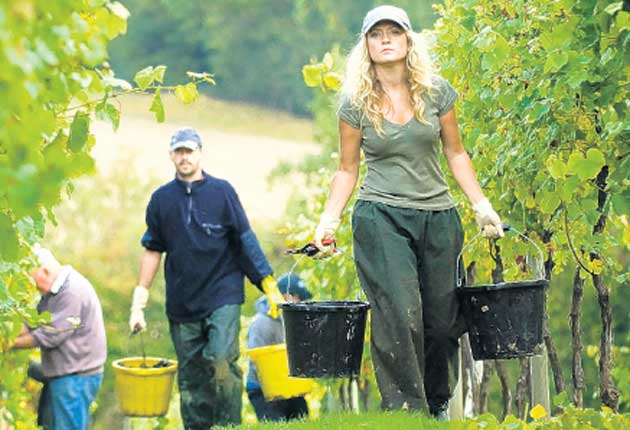
At this time of year, mainland Europe's winemakers are busy harvesting the grapes that will go into this year's vintage. So too have their English counterparts been hard at work bringing in the grapes picked in the vineyards of Kent, Gloucestershire and other parts of the country.
Vineyards have formed part of England's landscape for centuries, but it is only in the past few years that our home-grown wines have begun attracting an increasing following of discerning oenophiles. Since the Romans introduced wine to these shores, it has been produced in small quantities at various points down the centuries, mostly by monasteries or by those wealthy enough to experiment. But in the 1940s all that began to change, when pioneering research and planting by Ray Barrington Brock, Edward Hyams and George Ordish gave rise to renewed enthusiasm for viticulture here. When the first commercial vineyard was planted at Hambledon in Hampshire in the 1950s, it marked a new chapter for the English wine industry.
Fast-forward to the present day and this dedication seems to be paying dividends, with several English wines hitting the headlines. In the past few years, leading vineyards such as Ridgeview, Camel Valley, Chapel Down and Nyetimber have been collecting awards at some of the wine world's most prestigious events. This year, 100 English wines accepted honours at a trio of high-profile ceremonies, The International Wine Challenge, the International Wine and Spirit Competition and the Decanter World Wine Awards.
Compulsory data collection introduced by the Department for Environment, Food and Rural Affairs (Defra) in 1989 is building a better picture of how the domestic wine industry is evolving. The English Wine Producers trade association data for 2008 shows there are now 416 vineyards and 116 wineries with an average annual production of around 2 million bottles. This figure is set to grow, due to a 50 per cent increase in vine planting in the past four years.
The vineyards extend all over southern England to Cornwall in the South-west and as far as York in the north. Parts of the South-east share the same geological strata as classic wine-producing regions such as Chablis and Champagne.
While still white wines are currently the most popular, the greatest growth is in sparkling wines, whose three main grape varieties (pinot noir, pinot meunier and chardonnay) account for the biggest rise in new plantings. This greater understanding of the best grapes for English conditions is only one of the innovations raising standards.
Chapel Down in Kent, the home to the English Wines Group, is one of the most high-profile of English wineries and is the largest producer of sparkling wines. As well as a 25-acre vineyard, Chapel Down has contracts with several vineyards spread across the South-east to supply grapes for its Tenterden winery. Frazer Thompson, the managing director of Chapel Down, is all too aware of the challenges facing English wine. "Transformation in wine takes a long time, but we have been seeing changes over the past three years. The newer wines are much higher quality, the product is winning awards, and people are beginning to think English wine is rather good," he says.
Increased profitability also means that talent can be attracted from overseas. "This harvest, I've got South Africans and Kiwis picking grapes, upping the standards. When they go home, they will leave some of their expertise with the English working alongside them," says Thompson.
While some may feel the relatively high price of English wine compared with foreign imports is too great an act of patriotism, Thompson counters: "Customers are pragmatic when it comes to price. People who drink English wine are attracted to it because it is something different and unique." Undersupply is another contributing factor to our homegrown wines' small 0.14 per cent share of the market.
"We get press coverage and win lots of awards, but there really isn't much English wine available," says Thompson. This is borne out by recent figures from Waitrose, which reported an 18 per cent year-on-year rise in the sales of English wine in 2008. Earlier this year, it became the first retailer of its kind to plant its own vines at its Leckford Farm Estate in Hampshire with a view to selling its first sparkling wine in 2014.
The effect that climate change is having on grape cultivation in England is ambiguous. Many vineyard owners have observed changes from year to year, but in the absence of comprehensive data it remains to be seen what the long-term effects will be. However, a recent Greenpeace study on the effects of climate change on the French wine industry will have many of its winemakers reaching for a glass of their best. The report suggests temperatures in France could increase by between 4C and 6C by 2100, spelling disaster for many of the wine world's most soughtafter marques. It also forecasts the displacement of current vineyard zones by up to 1,000km.
Climate change aside, English winemakers' talent and commitment is beginning to pay off. With a bumper crop predicted for this year's harvest, this could be a vintage year for the English wine industry – something that everyone can raise a glass to.
English Wine Producers www.englishwineproducers.co.uk English Wines Group (01580 763 033; www.englishwinesgroup.co.uk)
'In the wine world, reputation is everything'
Camel Valley is one of the success stories of the English wine industry. In 1989, aged 33, former RAF pilot Bob Lindo and his wife, Annie, started to pursue their dream of winemaking and bought a derelict farm in a picturesque corner of north Cornwall.
The Lindos saw the vine-growing potential in its well-drained south-facing slopes, and took the plunge. "We very much bought the farm with a view to producing wine commercially from the outset; so, if it did not work, we could not eat," says Lindo.
Now with 17 acres under vine at the farm, and a further 30 acres under contract locally, Camel Valley's still and sparkling wines are increasingly sought after. They are being sold by the likes of Waitrose and Fortnum & Mason and served in restaurants including Rick Stein, Hakkasan and Raymond Blanc's Le Manoir aux Quat'Saisons. Several of Camel Valley's vintages have also garnered praise from some highly respected voices in the wine trade. Its 2007 Bacchus vintage was bestowed with a gold medal at the 2009 International Wine Challenge.
Camel Valley Cornwall Brut, an aromatic English-style sparkling wine, was also runner-up to Bollinger champagne in this year's World Sparkling Wine Championships in Italy – an acknowledgment Lindo is particularly proud of. "In the wine world, reputation is everything, so I am thrilled with our achievements", he says.
With his son, Sam, now part of the family business and proving a talented winemaker in his own right, Camel Valley has an increasing number of fans. Many of its popular vintages have already sold out, yet the Lindos remain resolute about the artisan nature of their wines and won't compromise on quality.
"In a good year, we can produce 200,000 bottles, but in a bad year that can be none," says Lindo. "All that time ago, when we started digging holes ourselves to plant the vines, we never dreamed all of this would happen."
Camel Valley (01208 77959; www.camelvalley.com)
Join our commenting forum
Join thought-provoking conversations, follow other Independent readers and see their replies
Comments
Bookmark popover
Removed from bookmarks