Lava bread, anyone? Pompeii snack bar rises from the ashes after 2,000 years
The Roman 'thermopolium' destroyed by Mt Vesuvius in AD79 has been restored. Michael Day reports
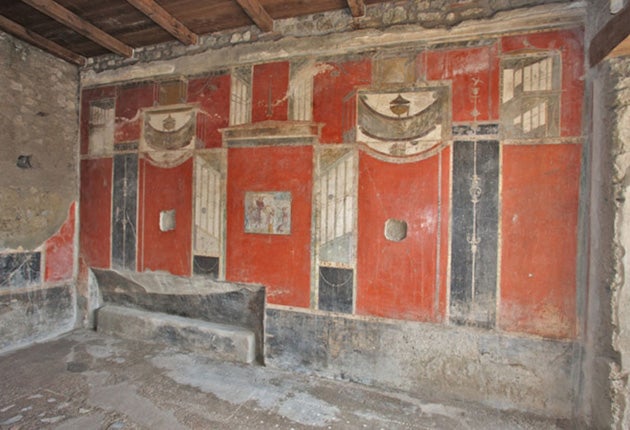
THE LAST patrons who stood at the L-shaped counter of Pompeii's best-known snack bar eating the house-speciality – baked cheese smothered in honey – had to leave in a hurry owing to violent volcanic activity. But after an unforeseen break in business of 1,921 years, the former holiday hotspot of ancient Rome's in-crowd will finally re-open for business tomorrow.
Visitors will be taken on a guided tour of the thermopolium (snack bar), once owned by Vetutius Placidus, and taste some of the food that was popular before the devastating eruption of Mount Vesuvius in AD79 that buried the city under 60 feet of ash and pumice.
As with many high-profile launches, tomorrow sees an advance opening ceremony for 300 special guests, chosen at random for a taste of Roman café society, according to the Italian news agency Ansa. The full opening will take place later.
When Vesuvius erupted for two days, most of its citizens died as an enormous wave of scalding gas and dust tore down the volcano's flanks and enveloped the city.
The thermopolium, one of the best preserved sites in Pompeii, has been closed to the public for years in order to protect it from further damage. But following months of detailed excavation and preservation work, all visitors will soon be able to go inside and get an idea of a typical ancient Roman lunch establishment.
Inside, as in many modern cafés and bars, visitors are greeted with a large, L-shaped, decorated counter where customers stood to enjoy a quick lunch. Cylindrical holes in the bar contained glass dolia, or jars, displaying food.
Archaeologists working at the site also found a jar full of coins, amounting to about two days' income. They speculate that the owner may have left them in a last-ditch attempt to save his wealth as he fled the doomed city. The thermopolium used to opened directly on to a main street, the Via dell'Abbondanza. All sections of Pompeii society would call by for snacks or a light Mediterranean lunch, two millennia before it became à la mode in Britain.
Dr Annamaria Ciarallo, an environmental biologist and researcher at Pompeii,said: "The food then was mainly based on cereals, vegetables, cheese and fish, with just a little meat. It was very healthy – the original Mediterranean diet."
But the sybaritic citizens of Pompeii were able to resist anything but temptation and sweet, calorie-filled desserts were the real stars of the snack bar. Its creations filled with sticky honey and ricotta cheese have direct descendants in the cafés of nearby Naples today. Two of these dishes, mostaccioli and globe, will be offered tomorrow for the visitors as part of a special one-off event marking the restoration of the bar.
Dr Ciarallo said many of the snack bar's customers would have grabbed snacks and light meals as take-aways. "There wasn't a lot of ceremony. Often people, especially the busy ones, would have eaten outside," she added.
For customers who preferred to sit, the thermopolium had a triclinium, or dining area, with couches. It was decorated with a beautiful painting showing the rape of Europa with Jupiter disguised as a bull. An internal garden, or viridarium, housed another seating area, which excavations suggest was once shaded by a pergola covered with grapevines and had flower beds in which herbs used in the kitchen were grown. The house of the owner and his family adjoined the premises.
The larario, or household shrine, is decorated with Corinthian columns. Wall paintings depict the household gods and personal companion spirit, carrying out a sacrifice at an altar. Mercury, the god of commerce, and Dionysius, the god of wine, are also painted on the shrine.
Join our commenting forum
Join thought-provoking conversations, follow other Independent readers and see their replies
Comments