Out with tuna, in with sardines – a recipe for saving the seas
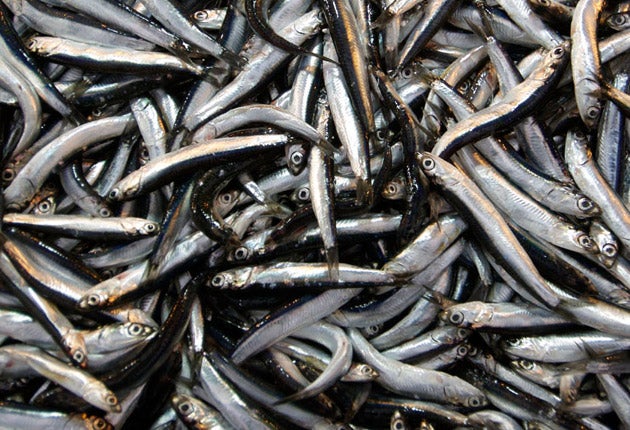
The world's oceans would be a better place for wildlife if people shifted from eating large, predatory fish such as tuna and cod to smaller, "grazing" fish such as anchovies and sardines, a major scientific study has found.
Fish at the top of the marine food chain have been the favourite species for the dining table for decades but overfishing has led to a catastrophic decline, scientists said. The number of predatory fish such as tuna, cod, swordfish and groupers has fallen by two-thirds over the past 100 years; 54 per cent of this decline is thought to have occurred in the past 40 years, they said.
Over the same period, the number of smaller, foraging fish that feed on plankton has doubled because there have been fewer top fish in the oceans to eat them, according to a review of some 200 separate studies of fish populations over the past 120 years.
If consumers could be persuaded to buy more anchovies, sardines, capelin and other smaller fish, this could help rebalance the marine ecosystem, said Professor Villy Christensen of the University of British Columbia in Canada.
"We can still take a few predatory fish if there are too many of them, but we cannot take them all, which is what we are doing by fishing down the food web," Professor Christensen said.
By targeting top predators, humans have unbalanced the ecosystem in favour of smaller, grazing fish that feed on the tiny animal and plant plankton at the lowest "trophic level".
"If you removed the lions in the Serengeti what you'd get is a lot of antelopes," Professor Christensen said.
"Overfishing has absolutely had a 'when the cat's away, the mice will play' effect on our oceans," Professor Christensen said.
Most smaller fish caught are turned into industrial products, such as fishmeal and fertiliser, rather than sold for human consumption, he said. Emphasising their value as a highly nutritious human food could help transform the marine ecosystem, he told the American Association for the Advancement of Science in Washington.
"Currently, forage fish are turned into fishmeal and fish oil used as feeds for the aquaculture industry, which is in turn becoming increasingly reliant on this feed source. If the fishing-down-the-food-web trend continues, our oceans may one day become a 'farm' to produce feeds for the aquaculture industry," he said.
"Fishing through the food web [ie at all trophic levels] is an alternative to fishing down the food web. [But] we are not doing that; we are losing the big predators – we are getting the Serengeti without the lions," he said.
"Society must decide what we want with the ocean. Do we want to turn it into a farm, or have a more natural ecosystem? The problem with turning it into a farm is that we don't control it. We depend on it working as a natural entity so we'll see wild fluctuations if we continue going down that route."
Booms in certain types of smaller foraging fish such as sardines, which feed on the zooplankton, sometimes leads to a catastrophic decline in the smaller animals in the food chain, which feed on the plant plankton, he said.
"If there's not enough zooplankton you get into a situation where there is a green soup and we've seen that a number of times. You get anaerobic conditions. We've seen it for instance in the Black Sea, where it is well documented," Professor Christensen said.
A little fish can go a long way: Mark Hix's sardines with potato and cumin salad
Pilchard and sardine fishing is a part of Cornish heritage and the two names are easily confused. In the UK, sardines are officially classified as small pilchards and sardines used to be called pilchards if they were canned. But Cornish sardines now enjoy protected food status, and the word "sardine" seems more appealing than "pilchard".
Serves 4
8-12 sardines or pilchards, filleted
A little flour for dusting
A little vegetable or corn oil for frying
For the potato salad
3 medium shallots, peeled and chopped
One-third of a tsp ground cumin
1tsp cumin seeds
100ml chicken or vegetable stock
30ml cider or white wine vinegar
400g large new potatoes, peeled cooked and cut into 1cm slices
Salt and freshly ground black pepper
1tbsp parsley, finely chopped
30-40ml olive or rapeseed oil
In a pan, simmer the shallots, ground cumin and seeds, two-thirds of the vegetable stock and the white wine vinegar until almost completely reduced.
Add the sliced potatoes and the rest of the stock, stir well, cover and cook gently over a low heat for another 4-5 minutes, giving an occasional stir. The liquid should have almost disappeared and the potatoes should be falling apart a little. Stir in the olive oil and parsley and replace the lid to keep warm.
Heat a little vegetable oil in preferably a non-stick frying pan, season the sardine fillets and very lightly flour the skin. Fry the fillets for a couple of minutes on the skin side on a medium heat until crisp, then flip them over and finish cooking for 30 seconds or so; then remove from the pan and drain on kitchen paper. To serve, spoon the potato salad to warmed serving plates and arrange the fillets on top.
Join our commenting forum
Join thought-provoking conversations, follow other Independent readers and see their replies
Comments