Chinese chef is first to win Michelin three stars
Once upon a time, every Chinese carried a Little Red Book, which provided a recipe for uniformity, dullness and oppression. Another red book, a Big Red Book – the Michelin Guide – exploded its own reputation for culinary parochialism today and promoted a Chinese chef and a Chinese restaurant into the pantheon of international cuisine for the first time.
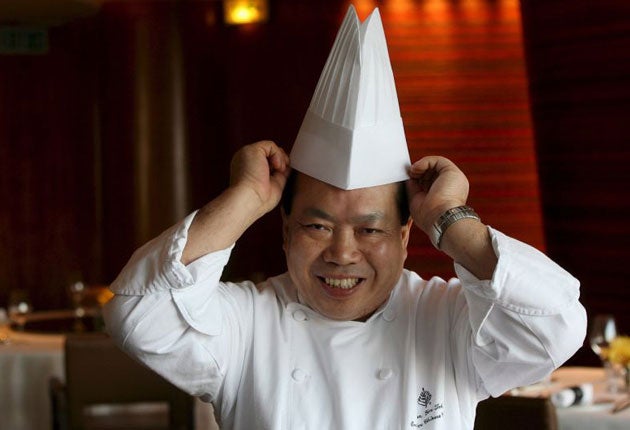
Chan Yan Tak, an unassuming man in his 50s, who worked his way up from the bottom to become the most admired cook in Hong Kong, became the first Chinese chef to be awarded the maximum three stars by the world’s most prestigious restaurant guide. One of his dim sum dishes was once described as “like eating clouds”.
The Lung King Heen, the three-year-old restaurant of the Hong Kong Four Seasons Hotel, was the only eatery in the former British colony to be awarded three stars in Michelin’s inaugural Hong Kong-Macau guide unveiled today. Its executive chef, Mr Chan, who has had no formal training and started as a 13-year-old kitchen boy in a large Hong Kong restaurant, joins such globetrotting culinary aristocrats as Gordon Ramsay, Alain Ducasse, and Joel Robuchon as a three-star Michelin chef.
“We are incredibly excited and we are delighted for the chef, who is a very modest man,” said Nicola Chilton, the public relations director of the Four Seasons, Hong Kong. “Quite apart from the tribute to his work, and the work of everyone here, this amounts to a recognition of Cantonese cooking as an important, international cuisine, on the same rank as French or Spanish or Japanese.”
Only 72 restaurants in the world have three Michelin stars. Of those, 26 are in France.
Jean-Luc Naret, the director of the Michelin guide, said: “We’re very impressed by his cuisine. In order to give him three stars he’s been visited 12 times which means that he has a very, very high consistent, quality level.”
Only one other restaurant in the new Hong-Kong-Macau guide unveiled today was given the maximum three stars, which signifies “worth a special journey”. That was a French restaurant in Macau – the Robuchon à Galera in Macau, run by the French celebrity chef, Joel Robuchon.
The bilingual Chinese and English guide covered more than 30 different types of cuisine – but only half the restaurants listed were Chinese. Of the 12 inspectors used by Michelin, 10 were Europeans and two were Chinese. M. Naret, director of the guide, dismissed suggestions that it gave the new book a bias towards European styles of cooking. “You don’t have to be French to appraise French cuisine and you don’t have to be Chinese to appraise Chinese cuisine,” he said.
Japanese cuisine has long been recognised by the Michelin as equivalent in quality to European styles of cooking (although, whatever Michelin may say, French cuisine is always treated as first among equals by the Big Red Book). Chinese cooking has been relatively neglected – until now.
Although Chinese restaurants in other cities, including Paris, have received one star from Michelin inspectors in the past, Chan Yan Tak is the first Chinese chef anywhere in the world to receive the ultimate gastronomic accolade.
Ms Chilton said the chef had been “overwhelmed and speechless” when the listings were announced. Mr Chan, who speaks no English, went to his restaurant to prepare for “a very special” service of dinner. “He is very hands-on. He likes to be in his kitchen. That’s where he expresses himself best. He doesn’t like talking about his work. He loves cooking,” Ms Chilton said.
Mr Chen began as a kitchen boy at the Dai Sam Yuen, a celebrated Hong Kong restaurant of the 1960s. He worked his way up to be executive chef at Lai Ching Heen, which once came runner-up in the International Herald Tribune’s 10 Best Restaurants in the world. He retired in 2004 to enjoy a “more relaxing life” but was persuaded to become executive chef of Lung King Heen when it opened with the new Four Seasons hotel in 2005. Lung King Heen means “view of the dragon” – a reference to its sweeping views over Hong Kong harbour.
In his comments in the hotel’s publicity material, Mr Chen says that he has tried to give traditional Cantonese cooking – based on seafood, including such exotica as abalone and shark’s fin – a “contemporary approach”. Typical Chinese ingredients are sometimes supplemented by truffles or foie gras.
“The South-eastern influence of the flavour and components of typical and traditional Cantonese cuisine are combined with a novel and creative presentation style,” he says.
Even though the dishes look “tidier” than a traditional Chinese meal, they “reflect the familiarity and variety that guests and locals alike are looking for in authentic Chinese cooking,” he said.
Typical dishes include braised goose liver in abalone sauce and fish maw; wok-fried prawns with dried chilli and shallots; and the Lung King Heen roasted chicken. A light dim sum dish for two might cost HK$68 or £6. A full eight-course, businessman’s lunch is a modest HK$430 or about £38.
In a review in the Independent on Sunday two years ago, Terry Durack declared Lung King Heen to be the “best Chinese restaurant in the world”.
“While imported luxuries such as truffles, wagyu beef and foie gras sit beside local delicacies such as shark’s-fin, bird’s-nest, abalone and double-boiled soups, there are also simpler, more modest dishes, including a short but seductive dim sum list,” he wrote.
“But first things first: a tray of three house-made chilli sauces land on the table. Then a little appetite-teaser of lightly fried scallop sandwiched with fresh pear – a perfect balance of crisp and tender, sweet and savoury.
“I choose three delicacies from the dim sum menu, and find them flawless.A deliciously bright and bouncy steamed lobster and scallop dumpling (£2.20 each); a steamed seafood and scrambled-egg-white dumpling (£1) that is like eating clouds; and a golden sesame ball filled with roast duck and taro (£1) that is a textural treat.”
Join our commenting forum
Join thought-provoking conversations, follow other Independent readers and see their replies
Comments