Food & Drink

Mostly Cloudy with Showers 14° London Hi 14°C / Lo 8°C

Shop salads have more fat than a Big Mac
By Katie Hodge, Press Association

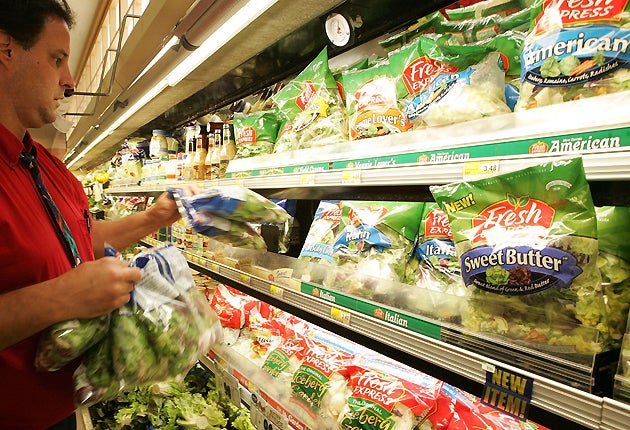
A wide range of salads on sale in a California supermarket

Getty Images

A wide range of salads on sale in a California supermarket

Some supermarket salads contain more fat than a Big Mac and fries, it was revealed today.

According to consumer group Which?, leafy lunches stocked at Morrisons and Asda are among the least healthy options.

The Smedleys Atlantic Prawn Marie Rose Salad, sold at a number of supermarkets including Morrisons, contains 855 calories and 66.3g fat - 70 per cent of the fat a man should eat in a day.

In contrast, a Big Mac and medium portion of fries contains 820 calories and 40g of fat.

Another "unhealthy" pre-packed salad was the Asda Chicken Caesar Pasta Salad which contained 41g of fat - again more than a Big Mac and fries and nearly as much as six Cadbury's Creme eggs.

Almost a quarter of this salad was made up of high-calorie sauce - 13 per cent mayonnaise and 10 per cent Caesar dressing.

Creamy sauces were often the reason why salads were so surprisingly high in calories and fat, the report found.

Mayonnaise dressing was the second highest ingredient in an M&S Pasta with Tomato & Basil Chicken salad which had 760 calories and 46g fat.

Sainsbury's Tomato & Basil Chicken salad was also revealed to be comparatively high in fat.

The report, which highlighted differences in the labelling of salads, said it was sometimes difficult for consumers to identify the fat content of a meal.

Findings showed the Tesco Tuna Layered Salad only listed calories per half pack rather than showing the 550 calories and 41g fat found in a full salad.

Martyn Hocking, of Which?, said: "If you thought your high-street salad was healthy, you could be in for a surprise.

"Which? has found that there were large differences between the amount of fat, saturated fat, salt and calories in pre-packaged salads.

"This latest research backs up what we've been saying for ages - a clear, consistent labelling scheme is important to help people spot how much fat, sugar and salt is in the food they're buying."

But Morrisons termed the report "misleading" and said it misrepresented the company.

A spokesman said: "Morrisons sells around 1.5 million salads each week, and this particular branded line accounts for less than one tenth of one per cent of those sales.

"The comparison is absurd, Which? Is weighing up a mayonnaise based product against a leafy salad. It's not comparing like with like."

A spokesman for Asda added: "We are the only supermarket that gives customers the benefit of traffic light colours, guideline daily amounts, grams of nutrients per portion and the words 'high', 'medium' and 'low' on our products, the very labelling system that Which? is calling for and has recommended by the Food Standards Agency.

"Unlike other retailers, our customers can see at a glance which of our wide range of salads are the healthiest and which are a bit more of an indulgence."

And Sainsbury's insisted it offered "a range of salads" to cater for a broad spectrum of customers.

A spokesman said: "The salad highlighted by Which? is clearly labelled red for fat but is also labelled green for saturates as it contains only 2.1g of saturated fat as a result of the work we have done to reduce saturate levels across all of our own label ranges. It is also labelled green for salt and sugars."

Which? sampled 20 pre-packed salads on the high street to compile its report.

Of these, it found several "healthy options" including Sainsbury's Rainbow Salad which contains soya beans and lentils and Sainsbury's Thai Chicken Noodle is low in fat, salt and sat fat.

Both salads came with dressing in a separate container.

Which? is calling for food companies to adopt one type of label so shoppers can clearly identify levels of fat, sugar and salt.

Post a Comment

View all comments that have been posted about this article.

Offensive or abusive comments will be removed and your IP logged and may be used to prevent further submission. In submitting a comment to the site, you agree to be bound by the Independent Minds Terms of Service.

Comments

QUITE CORRECT.
[info]soaring_eagle1 wrote:
Thursday, 25 June 2009 at 08:15 am (UTC)
What I call a salad is green leaves, tomato, celery radishes, and cucumber without anything else in or on it.

It would also be cheaper to grow or buy your own salad stuff and make your own salads up.

Then just mix it with low fat additions.

People are basically lazy these days and the supermarkets, garages and other outlets have jumped on the so called healthy salad band wagon to 'help them out'.

Another warning 'Which' should have given is many packet salads are laden with bacteria and germs, even the washed ones. If you buy one you must still give it a good wash, Listeria was the main one but people seem to have forgotten this, apparently they can have E Coli, and Salmonella in them as well.


Just grow your own organically is my advice at least you know how it was grown and where it comes from.

[info]everytimeref wrote:
Thursday, 25 June 2009 at 08:26 am (UTC)
A salad without a dressing is rabbit food.
[info]eddieiscool wrote:
Thursday, 25 June 2009 at 09:56 am (UTC)
Surely it's obvious that anything laden with mayonnaise is bad for you! It's full of fat! And really, if people want to gorge themselves on fatty foods, then let them! Anyone silly enough to think mayonnaise on a salad is healthy deserves all they get (probably heart disease and an early death).
Common sense needed
[info]thestupidtimes wrote:
Thursday, 25 June 2009 at 12:01 pm (UTC)
As usual, if people actually look at the food they are eating and read the packet, they will soon find out what is in it. I hope this doesn't encourage overweight people to think that the health food police have it wrong. A Big Mac and chips has very little nutritional value. A salad with fatty dressing will still have lots of goodness. Here's a light way to look at it: http://thestupidtimes.blogspot.com/2009/06/just-eat-big-macs-say-health-experts.html
Salad Fat
[info]sandn09 wrote:
Friday, 26 June 2009 at 06:34 am (UTC)
In view of their health hazards why are hydrogenated (long-shelf-life) fats not banned in the UK as they are in anumber of other countries.d fats
Re: Salad Fat
[info]tommytcg wrote:
Friday, 26 June 2009 at 06:59 am (UTC)
and why do writers still harp on fat and calories, when these have no meaning in human physiology for body-fat gain. In the Krebs cycle, it is the sugars that are converted to fat. Sugars come from sugar, fruit, starchy veg. grains, milk etc. If they worry about arterial diseassr, then they base their ideas on a wrongly concluded study in 1954. Well documented is that neither dietary cholesterol nor elevated blood cholesterol cause heart disease/stroke. (Statins are a 24 bilion $ fraud) Look at the studies on homo-cysteine, lipo-proein alpha and tri-glycerides, the first two vitamin deficiency conditions, the last from too much carbs, mainly sugar, and alcohol. News in, slightly different subject. http://www.naturalnews.com/026503_pandemic_swine_flu_bioterrorism.html
[info]parodyofvirtue wrote:
Friday, 26 June 2009 at 07:33 am (UTC)
who cares if it's got calories in it, at least you'll go some way toward your five a day (which you wont find in a Big Mac).
Mayonnaise is sold like peanut and not the cream that fattens you. We have these as the fine grease
[info]famulla wrote:
Friday, 26 June 2009 at 07:43 am (UTC)
Mayonnaise is sold like peanut and not the cream that fattens you. We have these as the fine grease white that is tasty but little do we realise that these are very fattening. The worst in the cream forms
I thank you
Firozali A Mulla
salads
[info]ezras_cat wrote:
Tuesday, 7 July 2009 at 02:13 pm (UTC)
Well how stupid do you have to be to realise that a sauce is more than likely going to be high in fat/calories? A salad - greens, tomatoes and other crunchy stuff - is not full of calories.

Tuck into our A-to-Z of recipes

Article Archive

Day In a Page

Sun | Mon | Tue | Wed | Thu | Fri | Sat

Select date