Long term review: the new MacBook Air
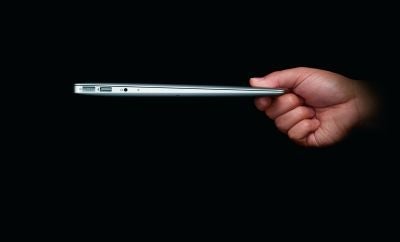
Size isn’t everything, we know. But size and style combined? Well, maybe.
In the last couple of years, almost every computer company from Acer to Zoostorm has been making netbooks, the low-cost, lightweight, small-screened laptops which have proved tremendously popular. Since they often cost under £200, their appeal is easy to understand, despite their limitations. People were prepared to live with keyboards which are almost always cramped and uncomfortable, to put up with trackpads that are nearly unusable, to deal with heavily constrained battery life.
Factors like being cheap, light and easy to plop into a small bag outweighed these concerns. But while high-end companies like HP, Toshiba and Sony joined the netbook gold rush, one company held back: Apple.
Steve Jobs was forthright in this year’s unveiling of the iPad, saying that netbooks “are not better than laptops at anything, they’re just cheaper.” And the iPad, it seems has been cutting into netbook sales, even though the limited connectivity and closed system of the iPad means it’s not direct competition.
The company already had a superb lightweight machine in its range, the 13-inch-screened MacBook Air. But for portability, design and capability, it took until now for the real answer to the netbook to appear.
Now it has: a smaller screened MacBook Air. It has an 11-inch display which is significantly diddier than its earlier model but still helpfully bigger than practically any netbook – these mostly max out at 10 inches. Like the previous one, it has tapering edges that make its narrow profile even slimmer. In terms of portability it’s flatter than the competition.
Apple loves its aluminium and the “unibody” design means the base of the MacBook Air is hewn from one lump of metal. In turn this means the aluminium offers light weight and strength. Not to mention great stylishness.
Details are important. Try this test to understand the company’s obsession with industrial design. Next time you have a lightweight laptop to hand, put it on the desk with the opening towards you. Then lift the lid with your thumb. Chances are, the base of the laptop will tip up, too: you’ll need to steady the keyboard part of the chassis with your other hand. With every MacBook, including this new lightweight tiddler, the machine is so finely balanced that the base will stay put as you flip the lid. It’s a small thing but once you’ve noticed it, you wonder why everyone doesn’t take care of it.
Although the MacBook Air only has an 11-inch screen, it’s a high-resolution 1,366x768 pixel display, which looks great. The connectivity has been improved – there are now two USB slots where the original MacBook Air had only one. Mind you, most rival laptops manage three USB connectors. And there’s another disappointment: still no dedicated Ethernet port, so you need an optional extra adaptor.
One of the main standouts on this machine is the keyboard. Despite the small screen, the keyboard is near-identical to the one on the MacBook Pro 15-inch model, one of the most comfortable keyboards anywhere. The keyboard here is exactly as wide as the bigger machine’s, with good-sized, widely spaced keys (save for the smaller function keys in the top row). A large glass pad replaces the small trackpad found on most netbooks. It’s highly usable, responds to multi-touch gestures and even clicks when you press it. Together, the keyboard and trackpad set the MacBook Air apart.
Even so, we haven’t got to the real reason the new model stands out. That’s flash. Not flash as in showy and eye-catching, though that applies too, but in the sense of the kind of storage it uses. Instead of a regular hard drive, the MacBook Air has no-moving-parts flash memory. This is the kind of solid-state storage you’ll find in a mobile phone or iPad. It’s compact, reliable and, above all, fast. At around twice the speed of a hard drive, it makes the MacBook Air quick and responsive.
Just as the iPad stays in a standby state most of the time rather than being switched off – you won’t actually power it down except because of aeroplane regulations at wheels-up – so this laptop goes to sleep after a few minutes and wakes fast, too. This instant-on capability is one of the most appealing features here and for some people may make the cheaper iPad less attractive.
What’s more, you can leave the machine in this slumbering state and the battery, Apple claims, will keep it ticking over for up to 30 days.
Of course, actually using the thing will drain the battery more quickly, but it will last for up to five hours between charges. Some netbooks manage more than this, but far from all.
So is it really the future for laptops? Well, it’s a heck of a lot pricier, though at £849 there’s a lot of bang for your buck and it’s hard to see how it could have been made for much less with this build quality. The processor speeds aren’t as great as some laptops, though you’re rarely kept waiting. The keyboard isn’t backlit (unlike on most other Apple laptops), which is a shame. Then there’s that limited connectivity, mentioned above, and the fact that if you want a slot to read a camera SD memory card – common on Windows PCs – you’ll need the larger 13-inch-screen model. And some will feel the 2GB of RAM just isn’t enough. Despite these faults, the MacBook Air is still irresistible.
It’s been a busy year for Apple, with a glossy new iPhone that has sold massively, despite an initial flurry of concern about the antenna. And the iPad, arguably the most innovative consumer electronics device from any company in years, has been hugely popular. The MacBook Air, though, thanks to its being brilliantly portable and devastatingly appealing, may lay claim to being Apple’s best product release this year.
Join our commenting forum
Join thought-provoking conversations, follow other Independent readers and see their replies
Comments