Speed reading: Breaking the read limit
Wasting time savouring books rather than just absorbing the facts? The web could help boost your speed. John Walsh reports
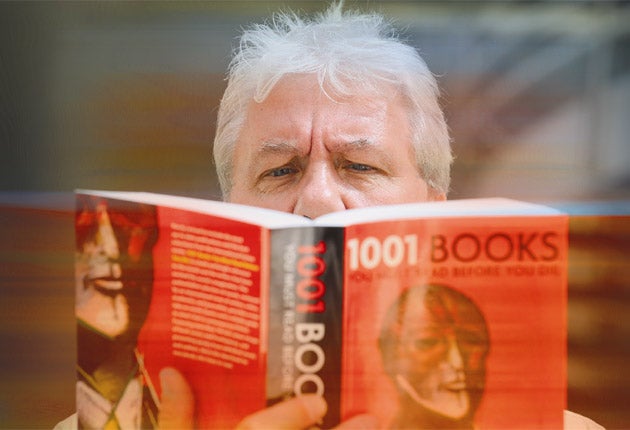
I once worked on the books pages of a newspaper with a woman who took a course in speed-reading. She needed it, she said: so many books came past her desk every week and she needed to have an opinion about them all.
"Why not," I asked, "leave it to the reviewers to have opinions about them?"
"But how," she said, "can I decide which books are worth sending for review, unless I've read them myself?"
I couldn't argue with this, but I was suspicious of speed-reading. There's a natural rhythm to reading words on a page, and doing it unnaturally fast is like watching Casablanca on fast-forward, or listening to Pachabel's Canon in that awful, frantic double-speed version. "This speed- reading course," I said. "How does it work?"
She explained. "Open the book at a double-page spread. Make a fist with your right hand and unfurl the index and little fingers to form a pair of horns. Lay your horned fist on the left page and draw it slowly downwards, so that the extended fingers constitute a moving margin, and concentrate your gaze on the middle of the page. Repeat with the right-hand page, turn over and repeat ad infinitum."
I hadn't realised it would be so ... physical. "I can read twice as fast like this," she said. "It's marvellous for novels, because you can digest the plot quickly, and go back to reread any good passages. It's less good with non-fiction because there are so many facts. And it's completely hopeless," she concluded, "with poetry."
The idea of speed-reading a Keats ode or a Blake lyric seemed so farcical that it killed the subject for me. But speed-reading has become a hot topic. Several websites assure viewers that they hold the key to mastering an exhaustive 50-page report in seconds, or cutting your homework time by half. Check them out and you discover there's a world of bad habits out there. Did you realise that you probably "subvocalise" while reading? That is, a little voice in your head imagines the sound of the words being read. It's comforting for the brain, but it slows down understanding. In its extreme form, it's called "reading with your lips moving".
Also to be avoided is "backtracing," or reading the same bits over and over again, a sign that either a) you are savouring the cadences of the prose, or b) you are falling asleep. And you may have trouble with "chunking" – seizing blocks of words and reading them in chunks too large to comprehend without going back to the beginning (you dolt).
Some sites feature just one man and a very small theory. One "professor" advocates using a bookstand, to avoid the uncomfortable ordeal of reading a book flat on a table. He confidently predicts it will improve your reading speed by 30 per cent and radicalise your homework regimen. Another chap called Kris Madden, in a patterned sweater clearly bought by his mum, urges you to increase your words-per-minute rate from 250 words to 1,000 by cutting out all subvocalisation and not letting the brain produce its little pictures. You can achieve this, he maintains, by saying a sequence of words or letters aloud while reading. He demonstrates this theory by reading sentences while intoning "A-E-I-O-U" over and over. "Right now I'm reading at a rate of 1,200 words per minute," he says proudly. "That means I could finish The Catcher in the Rye in about 10 minutes." But who on earth would want to do that? And how can you understand what you're reading when you're trying to remember to say "A-E-I-O-U"?
The phrase "speed reading" was coined in the late 1950s by a schoolteacher called Evelyn Wood. She spent a lot of time wondering why some people read much more quickly than others, and tried to train herself to improve her speed. One day, she flung a book to the floor in frustration and, while smoothing the pages down, realised that the motion of her hand sweeping across the page drew her eyes to the words with more attention than usual. She developed a simple technique of using the hand to gradually reveal the contents of a page and called it "the Wood Method." It was renamed Reading Dynamics in 1958, when she began to talk about speed-reading.
In the 1960s, her 12-week reading courses were promoted in 150 Evelyn Wood Centres in the US, claiming to improve reading rates by a factor of 10. Most couldn't live up to this promise and the centres gradually disappeared. But it's extraordinary to find, half a century later, the same, slightly babyish approach to reading is being recommended on websites. Call up Videojug.com/film/how-to-speed-read and you'll be told to read while running your index finger under the words, and urged to cut out "backtracing" by sliding a piece of paper down the page you're scanning.
Inevitably, technology is now employed to improve reading and comprehension – or "visual processing" as it's increasingly called. A device called a tachistoscope (used in wartime to help identify enemy aircraft) is employed in a few websites to flash a number of words on your screen at a variety of speeds. The newest version is Spreeder, where you can organise a free trial (spreeder.com) in a matter of seconds. You cut and paste the document you want to speed-read into the on-screen window, adjust the settings (300 words per minute? 400? 800? And how many words can you read at a time?) and press Go. Instantly the document becomes a flashing sequence of words – one, two, three or ten at a time – no sooner flashed up than replaced by the next.
The effect is amazingly jerky, like a lexical strobe-light. No matter how smoothly or simply written the text, it comes at you like a series of little blows to the eye, bang, bang, bang. And if you're reading at a rate of, say, five words at a time, the ends and beginnings of sentences become chopped together in a way that virtually guarantees incomprehension.
A slightly more user-friendly version can be found on zapreader.com, where a two-minute tutorial (featuring the softest and most emollient teaching voice you've ever heard) talks you through the controls. But it has the same jerky quality, as if you're standing in front of a very small blizzard aimed at your eyes. And of course, neither site teaches you anything about how to read a book faster, only how to read a document – and by the time you've pasted it into the system, you could have snail-read it twice over.
Of course it's frustrating when you need to read a book fast, and are thwarted by the speed restriction built into your head (mine's been a pathetic 40 pages-an-hour for as long as I can remember). But artificial attempts to gee-up your reading and understanding seem doomed to remain in the realm of Ms Evelyn Wood wiping the pages with her hand. I'm now deep in Sarah Waters' subtle 500-page ghost story, The Little Stranger. The idea of reading it at high speed, and losing the savour of Ms Waters' calm descriptive prose, is frankly idiotic. There's a pleasure in reading sentences at a patient rhythm, having them build into satisfying paragraphs and richly rewarding chapters – a pleasure that can't and shouldn't be rushed. One thinks of Woody Allen's celebrated line: "I took a speed-reading course and read War and Peace in 20 minutes. It involves Russia."
Join our commenting forum
Join thought-provoking conversations, follow other Independent readers and see their replies
Comments
Bookmark popover
Removed from bookmarks