WWW: World Without Wikipedia
Is life better when the biggest-ever (but not necessarily most accurate) encyclopaedia is out of the picture? On its day of blackout, Tim Walker searches for answers – even in books
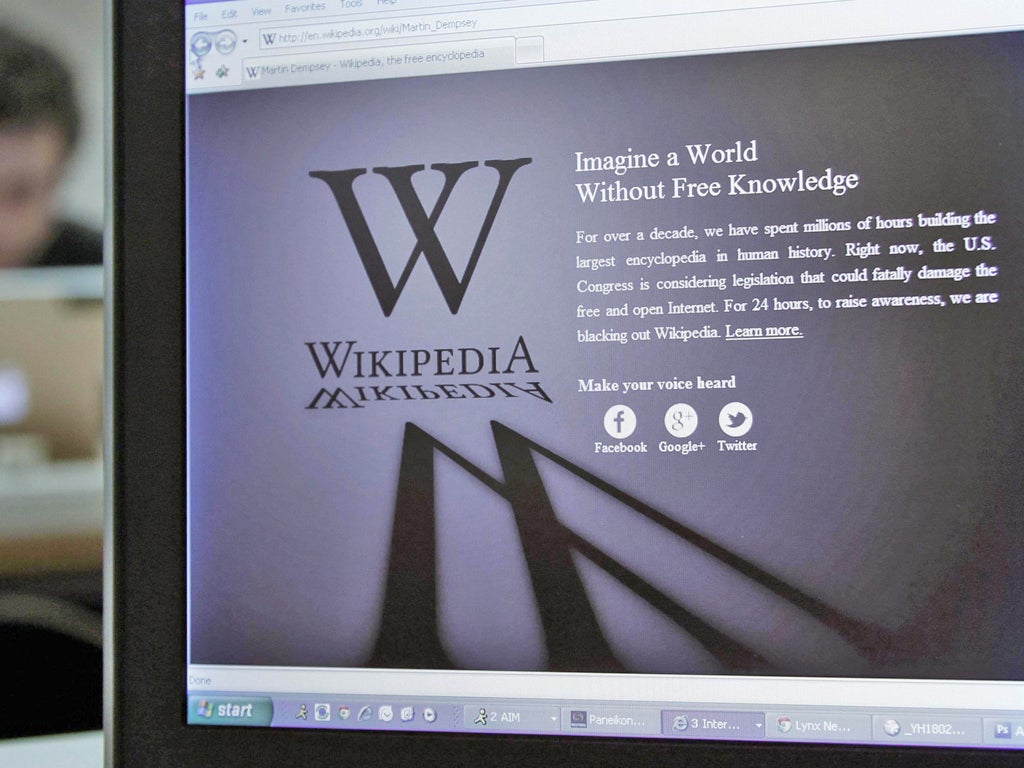
If you were researching your history coursework yesterday, or, say, writing a newspaper article about Wikipedia, then you will have found yourself at a loss. Instead of the largest encyclopaedia in human history, visitors to Wikipedia.org were greeted with a black page, and a doomy invitation to "imagine a world without free knowledge".
For 24 hours, the website had gone dark, in protest at the proposed Stop Online Piracy Act, or Sopa, which is being considered by the US Congress.
Wikipedia believes the law, which would stop search engines linking to websites that facilitate illegal downloading, "could fatally damage the free and open internet" by promoting censorship. Tweeting in advance of the blackout, the site's founder, Jimmy Wales, made a less hyperbolic suggestion: "Student warning!" he wrote, "Do your homework early."
Of course, as a serious journalist, I would never normally use Wikipedia as a serious research tool. Well, I wouldn't only use Wikipedia. But in this case, it would undoubtedly have provided a semi-accurate and well-sourced set of facts about its own history and a decent explanation of Sopa. Without it, I was forced to turn for facts to a series of more obscure websites and – would you believe it – printed books.
Given that the offices of The Independent have had access to the internet for some time now, I can reveal that all the physical encyclopaedias in the building date back to before the Obama presidency. So how would I fare when I tried to complete the everyday tasks for which I normally turn to the world's favourite crowd-sourced reference tool?
I can't have been alone, for example, in using Wikipedia to remind myself of the plotlines to the original Sherlock Holmes stories, during the BBC's recent run of Sherlock. Of what was Conan Doyle's Moriarty a professor, precisely? What led Holmes and his nemesis to the top of the Riechenbach Falls in The Final Problem, and how exactly did he explain his return from almost certain death to Dr Watson three years later?
Wikipedia is an invaluable source of information for television viewers. How could anybody have understood Lost without it? As it turns out, the best way to refresh my memory of The Final Problem, using the "free knowledge" of the web, was to read it in full at the free e-book site, Project Gutenberg. This kept me occupied for most of the morning. Naturally, I spent my lunchbreak setting a pub quiz, for which Wikipedia would have been a trove of useless trivia. What was the UK's No 1 single when the Berlin Wall came down? Which is the best-selling work of fiction of all time? And what's the capital of Burkina Faso? Before I resorted to cribbing questions from repeats of QI on Dave, I consulted Wolfram Alpha, a "computational knowledge engine" that answers questions directly, rather than offering a set of relevant pages like Google. It's good on geography: Burkina Faso's capital is Ouagadougou, Wolfram assures me, and its population is 1.5 million. But Wolfram is weak on literature, and fails to name Dickens' A Tale of Two Cities (though it does offer a useful list of words that rhyme with "fiction", in case I'm writing a poem). And it is incomprehensible on music, so a bit of wild Googling is required to find that Lisa Stansfield topped the charts in November 1989, with "All Around the World".
Meanwhile, if I'm having an intellectual round for dinner, I tend to use Wikipedia to brush up on their specialism beforehand; the site has very useful potted guides to the likes of Existentialism, Modernism and Marxism. The only solution I could think of yesterday was to visit Wikipedia's French language site, and use Google Translate to filter its summary of "Existentialisme" back into English. I got: "Existentialism is a philosophical and literary, which postulates that human beings form the essence of his life by his own actions, as opposed to the idea that they are predetermined by him any theological doctrines, philosophical or moral." Good enough for dinner conversation?
Lord Bell and his Wiki-war
The controversial lobbying firm Bell Pottinger asked the founder of Wikipedia to advise its staff on ethical internet editing.
Lord Bell, the head of Chime Communications which owns Bell Pottinger, invited Jimmy Wales to speak to around 50 senior staff in the wake of an investigation by The Bureau of Investigative Journalism for The Independent, which revealed the company was secretly altering Wikipedia pages on behalf of its clients.
Mr Wales admitted that the Wikipedia rules about paid-for advocates editing the site were "a bit mushy" and should be tightened up. But he insisted PR professionals should always be transparent about their identity and client when editing pages.
According to the magazine PR Week, Lord Bell replied: "We don't become criminals because we are paid. We've done nothing wrong."
Mr Wales responded: "I'm uncomfortable when you say you have not done anything wrong."
Oliver Wright
Join our commenting forum
Join thought-provoking conversations, follow other Independent readers and see their replies
Comments
Bookmark popover
Removed from bookmarks