Dementia: A small taste of hell on earth
Dementia affects hundreds of thousands of people in the UK, yet few know how it feels. A new awareness course aims to help us to find out
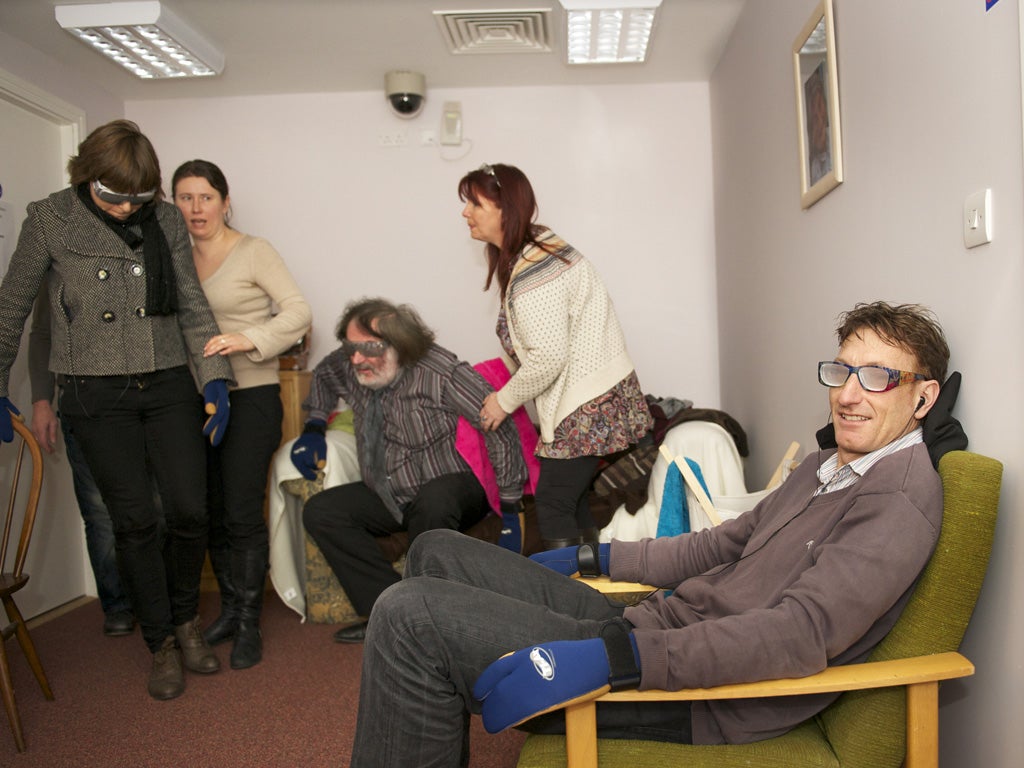
I have been led into a room. It is unlike any I have been in before and I'm not at all sure of its topography.In one corner a television is blaring very loudly. There are other people milling around but I have absolutely no idea what they are doing. Cups and plates are clanking together nightmarishly and the sound is reverberating through my skull along with the disembodied voices that seem to be bellowing at me from the pit of hell.
I could not swear to it but there could be lights flashing somewhere, perhaps a strobe.
All is confusion. Every few minutes I am approached by someone who I can only assume has some kind of authority although it is a struggle to understand what they want. I find myself trying – and failing – to bundle some socks, pour a cup of tea and thread a belt through of a pair of trousers. The smallest task is almost beyond me.
I wish they would just go away because I'm not sure if I'm going to fall over or start crying.
My main aim is to get to the chair in the opposite end of the room and sit down. When I eventually get there I cling to the arms for dear life.
It may sound like some kind of 1960s CIA drug experiment but what I am being subjected to is a dementia awareness journey created by the social enterprise charity PSS. Based at Liverpool Hope University, which is in the process of raising funds to establish itself as an £8m national centre of excellence in applied research into supporting the growing UK population with dementia, the journey aims to give an insight for carers and professionals into what it is like to suffer from the disease.
The condition, which remains untreatable and ultimately fatal, is widely acknowledged to be the great health challenge of the 21st century but research and investment into dementia lags far behind its future impact on our society. Public understanding remains even further adrift.
Pam Stopforth, PSS's dementia development co-ordinator, says undertaking the journey can prove a sobering experience for some, especially those who have cared for a loved one with the condition. Emotions often run high and tears are not unknown although the end result is always regarded as positive – even among those who cannot endure it. As a precaution, counsellors are on hand to help those that undergo the experience.
"No one has ever regretted taking it," explains Stopforth. "We have had some very powerful feedback. One carer said: 'I feel like I have walked a short way in my mum's shoes.' People have come out saying how sorry they are that they haven't been more patient," she adds.
There is clearly an element of guesswork in recreating the symptoms of a complex brain disease – effectively an umbrella term for more than 100 conditions – already diagnosed in 750,000 Britons. But Stopforth is confident that the simulation gets somewhere close to mirroring what it must be like.
And I can assure you it is not nice – even for 10 minutes.
Achieving the extraordinarily disconcerting effects is a surprisingly low-tech affair. A pair of distorting glasses throws you off balance while headphones pump confusing sounds into your ears. Neoprene mittens limit physical dexterity akin to the way sufferers – the majority of whom are over 80 – might also have to put up with arthritis and rheumatism. To add to the uncomfortable mix, popcorn kernels are poured into your shoes to make walking difficult, although thankfully I am spared this extra indignity.
But what really makes the experience believable and so powerful is the PSS staff who stand in as uncaring carers. They talk over you – swapping stories from their weekend drinking exploits – harry, insult and generally treat you with the kind of disdain that elderly people grow sadly all too used to. As you are shuffled from place to place you feel little more than an inconvenience. It is both a humiliating and infuriating experience.
Stopforth, a former social worker, says it is desperately important to remember that everyone with the condition is an individual. "When you have met one person with dementia – you have met just one person. Although the symptoms are often the same it will affect every person differently based on that person's life experience. Some go into it and are relatively unfazed. Others become very frustrated," she adds.
Dementia has found itself back in the news in recent weeks. The newly released Margaret Thatcher biopic The Iron Lady depicts the former Prime Minister in the grip of the disease that is now believed to have also affected her predecessor Harold Wilson while he was still at No 10. United States President Ronald Reagan was also diagnosed with the condition after leaving the Oval Office and lived with Alzheimer's – the most common form of dementia – for a decade before his death in 2004.
But despite such high-profile and powerful victims there remains a deep stigma over the condition and lack of funding for both drug therapy research and social care provision continues. Jess Smith, of the Alzheimer's Society, says more action is urgently needed. "There are surprisingly few drugs and that is something that needs to be addressed," she says. "People only get worse and they need more support and they need more care. It is not just the medical side of being given treatment, it is the care aspect as well. It is not just the person with dementia it is the whole family that is affected. The person they know and love will change."
Dementia sufferers endure a variety of symptoms depending on the type they have and stage they are at. In the early phase many people can cope quite well – covering up their problem by writing lists and keeping diaries to mask forgetfulness. Some estimates suggest as many as six out of ten sufferers go undiagnosed.
But short-term memory loss can make it almost impossible for sufferers to carry out everyday tasks such as making a cup of tea or going to the shops. Long-term memory is often left intact. Sufferers are also struck by mood changes which can leave them angry or frightened while also experiencing communication problems causing frustration.
Perhaps unsurprisingly, dementia is now the most feared condition among the over 55s and second only to cancer among the younger generation. However, research has suggested that carers and families tend to underestimate the quality of the lives of those with the disease.
Meanwhile, the condition appears to be affecting people at a younger age. A recent study carried out among British civil servants suggested the first signs of failing cognitive powers – often linked to future onset dementia – now occur from the age of 45 rather than 60. So while dementia primarily affects people above 65, more than 16,000 Britons below retirement age have the disease.
Although newspapers might like to fill their pages with miracle "cures" and preventions – everything from coffee to shopping – there is no magic bullet. No one really knows what causes it. There may be a genetic disposition to some forms of the disease and research suggests that healthy lifestyles, reducing alcohol, taking exercise and eating a balanced diet may play a part in staving it off. One in three stroke victims is known to develop the condition
However, it remains essentially a lottery of long living. Around one in 20 men and women aged between 70 and 80 is affected while a fifth of 80-year-olds of both sexes suffer from it. Ever-growing longevity means it is estimated that by 2051, there will be more than 1.7 million diagnosed cases.
Drug therapies can only inhibit the symptoms. The four drugs currently being prescribed are effective for just nine months, while sufferers live with the condition for an average of four and a half years. Clinical trials are expected to start on three new drugs soon.
In 2007 dementia patients cost the NHS £17.03bn. This is expected to rise to £50bn by 2038. This means developing new and more creative ways of caring – not just for dementia sufferers but also their loved ones – is vital, explains Stopforth. "The main problem faced by carers is isolation. They don't know who to see to get help and it can be very difficult to say, my partner or my mum has dementia."
Later this year, she will be taking the dementia journey to the Museum of Liverpool for the public to try as part of the city's decade of health and wellbeing. It is her ambition that one day everyone in Britain will go though it.
Join our commenting forum
Join thought-provoking conversations, follow other Independent readers and see their replies
Comments