Homeopathy: Curing with kindness
Numerous studies have shown that homeopathic remedies don't work. Why, then, do millions of patients swear that they do? The answer, says Professor Edzard Ernst, should be a lesson to all doctors
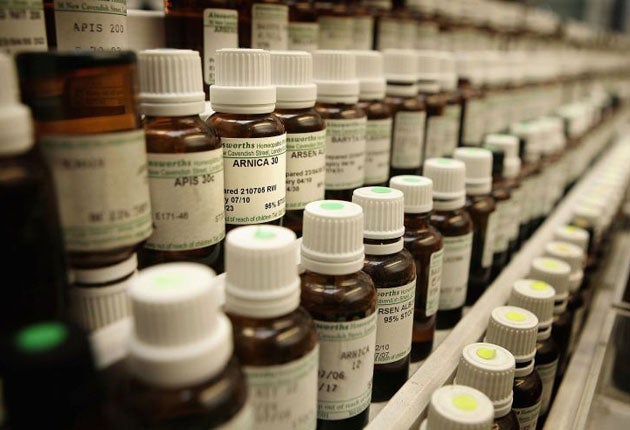
The British Medical Association recently called homeopathy "witchcraft", and a parliamentary committee recommended stopping all NHS funding for it. Yet many people, not least members of the Royal Family, swear by it.
So, what are the facts? Why is there still so much uncertainty? And why are emotions flying so high? British homeopaths are this week celebrating their annual Homeopathy Awareness Week – a good occasion to try and find some answers.
Homeopathy was developed almost single-handedly by a German physician, Samuel Hahnemann. About 200 years ago he found that when, as a healthy person, he took the anti-malaria drug quinine, he experienced some of the symptoms associated with malaria. He eventually concluded that "like cures like": any substance that provokes a symptom in a healthy person can be used to treat that same symptom when it occurs in a patient. You cut an onion and your eyes start watering; so a homeopathic preparation made from onions can be used to cure hay fever, a condition characterised by watering eyes.
But homeopaths do not use simple extracts of onions or other substances. Hahnemann also believed he had found that diluting an extract repeatedly in a special way – homeopaths call this "potentisation" – would make the remedy not less but more powerful. How on earth can this possibly work? Therefore, homeopathic remedies are so diluted that typically they no longer contain a single molecule of the onion. The theory of the "memory of water" provides the answer, according to homeopaths. It postulates that, during the dilution process, some mystical "energy" is transferred from the onion to the water. And that "energy" then triggers a healing response in our body.
This is all wishful thinking and romantic fantasy, scientists insist. The war of words is as old as homeopathy itself, but somehow misses the most important point. If homeopathic remedies make patients healthy, the debate is academic.
The proof of the pudding is in the eating. So do homeopathic remedies really have any effect on patients? To find out, we need clinical trials. Today we have about 150 clinical trials of homeopathy. Typically they test the effectiveness of homeopathy by treating one group of patients with homeopathy, while a comparable, second group receives placebos, i.e. sugar pills that only look like the real thing.
These trials have generated vastly different results: some suggest homeopathy works, others fail to do so. It can thus be tempting to cherry-pick and select those data that suit our arguments. This sort of thing has fuelled more and more emotional debates. But that approach is, of course, fundamentally misguided. To get to the truth, we must firstly avoid cherry-picking and look at the totality of the studies, and secondly we have to consider the issue of their reliability. Some trials are biased, but others are not. If we do all this systematically, we are bound to arrive at rather sobering conclusions.
Many researchers across the world have reviewed the evidence and concluded that homeopathic remedies are pure placebos. Five years ago, The Lancet even announced "The Death of Homeopathy". But homeo- pathy did not die. In fact, it continues to thrive and now boasts many supporters, who say, "We are not stupid, we have experienced benefits and therefore know it works."
Homeopaths ignite the debate further by claiming that the clinical trials are artificial, inadequate research tools. They show us "real-life" studies where patients are monitored over time but are not compared to a placebo group. These observations invariably demonstrate impressive success rates after homeopathic treatments. So, we seem to be confronted with a perplexing contradiction: homeopathic remedies are placebos with no specific effects, but in "real life" they seem to work.
The solution to the conundrum is quite simple, however: the remedy does nothing and the homeopath does everything.
If you see a homeopath, you are typically asked many very detailed questions. The homeopath is interested, empathetic and you feel warmly understood. The whole encounter lasts for about an hour, and at the end you receive a prescription. The remedy is a placebo but, never mind, the consultation and the expectations it raises have important effects. This is true particularly if you are suffering from conditions such as insomnia, depression or eczema that respond well to this type of reassuring "mini-psychotherapy". No contradiction at all then. But one nagging question does remain. Does it matter what helps the patient? If it is a placebo so be it, some would say. Regardless of the negative scientific verdict, homeopathy is good for you. What really counts is that it works. Essentially this line of argument implies that, regardless of the negative scientific verdict, homeopathy is good for you.
For a whole host of reasons, I disagree with this line of argument. Honesty is one of them. If the remedy is a placebo, we cannot truthfully pretend it isn't. Such lies may be benign, but they are also unethical.
And it is essential to realise that we don't need a placebo to generate placebo-effects. If a doctor prescribes for patients suffering from insomnia, depression, eczema etc a treatment that works beyond a placebo and, if this is done in a kind and empathetic way with time and understanding, the patient will profit from the specific effects of the prescription and also the non-specific effects of the encounter, which we often call placebo-effects.
Good medicine should always employ specific therapeutic effects (which homeopathic remedies do not possess), as well as the non-specific effects of the therapeutic encounter, i.e. time, understanding, empathy and human warmth, which homeopaths have lots of. Using only one or the other is quite simply not good medicine.
So, when we celebrate Homeopathy Awareness Week, we should honour Samuel Hahnemann – not for inventing homeopathy but for reminding us how important those non-specific elements of the therapeutic encounter really are.
Professor Edzard Ernst is the professor of complementary medicine at Peninsula Medical School, University of Exeter
Join our commenting forum
Join thought-provoking conversations, follow other Independent readers and see their replies
Comments
Bookmark popover
Removed from bookmarks