My girls won't have the cancer jab
The new cervical cancer vaccine offers few benefits, says Jerome Burne, father of two daughters. Which makes the risks even more alarming
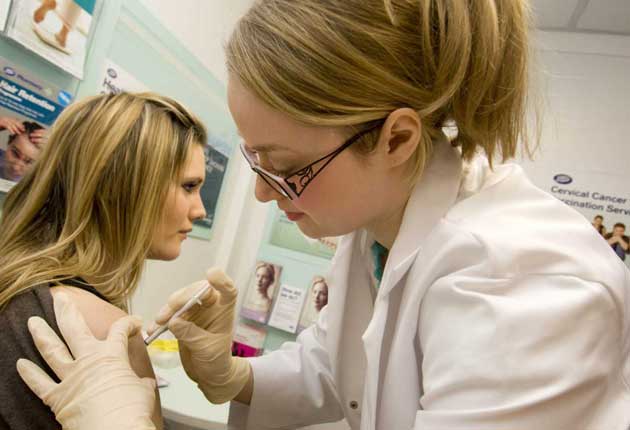
Much as I love my two gorgeous daughters – aged 13 and 17 – and wish to protect them from all harm, I will not be consenting to them having the HPV vaccine against cervical cancer.
It's a public health initiative that is unnecessary, reckless and ridiculously expensive. Worse, serious doubts about its wisdom have not been properly presented to the public. Instead, children and parents have been bombarded with publicity – "a totally life-saving, revolutionary vaccine" – while the media have largely parroted official assertions that it is "safe, proven and effective", all of which are unfounded.
The outline of the project is pretty familiar. This term, "the biggest public health programme ever" began to vaccinate all 12- and 13-year-olds against the human papilloma virus (HPV): this involves three separate injections over several months. Later on, 16- to 18-year-olds will be inoculated as part of a catch-up programme. By July 2011, more than two million girls will have been offered the vaccine which, it is claimed, will protect them against the two strains of HPV – numbers 16 and 18 – responsible for 70 per cent of all cervical cancers.
At the moment, 3,000 women develop cervical cancer every year and just under 1,000 die from it. Government and drug-company press releases claim that the programme will eventually cut these deaths by about 400 a year. What's not to like?
To begin with, it is a fabulously expensive way to deal with a problem which, although horrible for anyone who develops it, is hardly a major health risk. Figures haven't been widely publicised, but one quoted cost is £100m a year, which works out at £250,000 per life saved. Would this pass the NICE criteria for expensive cancer drugs? We already have a very effective screening programme that has brought deaths from cervical cancer down from 11 per 100,000 in 1950 to 3.4 in 2004, and the numbers are expected to continue falling.
However, the vaccination could actually reverse that. Women still have to be screened because, even when the whole programme is up and running, the number who develop precancerous cells is expected to drop by, at best, 50 per cent. At the moment, the biggest risk factor for cervical cancer is never having been screened; half of those with the disease haven't. The fear is that the programme may reduce screening attendance as vaccinated women assume they are safe.
But these are arguments about the HPV vaccine as a public policy. What really matters to me and every parent is: what risk does it expose my children to? As we've seen that the chance that any individual girl will benefit is tiny, I want the risk of any adverse reaction to be even tinier.
Public discussion of risks in the UK gives little hint of possible dangers. (The figures that follow all relate to a brand called Gardasil being used in America. This was to have been the UK choice until one called Cervarix was chosen because it was cheaper. We are told that otherwise they are equivalent.)
We plan to vaccinate 600,000 12- and 13-year-olds a year, on the basis of trials involving fewer than 1,200 girls under 16 that lasted less than two years. More than 20,000 women aged 16 to 26 were also involved in trials. Side effects included birth defects and juvenile arthritis. Only a few; but what happens when millions get the vaccine? Could certain genotypes be particularly vulnerable? No one knows. In fact, I'm asked to enter my children into a vast experiment.
Already, patterns of side effects are emerging. A body called Justice Watch has been prising figures for adverse reactions to Gardasil from the US authorities. Last October, the total was around 3,500; by this July, the figure had risen to 8,864, including 18 deaths and 140 "serious" reports.
There's plenty of disagreement over what the cases show. Authorities say they aren't necessarily connected to the vaccine. Two of the most worrying reactions have been blood clots – what might that be doing if you are one of the older girls on the pill? – and 38 reports of an autoimmune disorder called Guillain-Barré syndrome that can cause paralysis.
It's obvious that we need more information, which is why the US Food and Drug Administration called for studies to investigate these possible risks. But the results won't be in for a decade in some cases. The quickest trial they asked for was one involving 44,000 vaccinated girls who are being followed for six months to pick up signs of any immediate or medium-term problems such as autoimmune disorders or rheumatism. The results will be out in September next year. Meanwhile, UK experts confidently declare that there are no dangers; if so, why run this and the other studies?
But the uncertainty over side effects isn't all that's unknown. A key factor in the success of any vaccine is the length of time it confers protection. If it is too short – say, less than 10 years – too many booster shots will be needed. How long will protection last? No one knows; so far, it's lasted just over six years.
Then there is the reaction of the 15 other HPV strains, which account for 30 per cent of the cancers; will that change as the two most infectious ones are blocked? Could it allow them to become more infectious? A recent paper in the New England Journal of Medicine explored the possibility. Will it happen? No one knows.
And on top of all that, we don't actually know that the vaccine will prevent cancer. We know it confers resistance to the virus strains most likely to cause cancer, but since the cancers don't usually appear until a woman is in her late forties, definitive proof will be some time coming.
So this great public-health initiative looks more like a hugely unstable edifice of wildly optimistic assumptions piled on top of one another. If just one or two prove way out, it could all come crashing down. It's one lottery I won't buy a ticket for.
HPV infects the majority of women, maybe as many as 80 per cent, by the age of 50 but it very, very rarely causes a problem. I believe that my girls will be a lot safer relying on healthy immune systems that haven't been challenged by too many vaccinations and on regular, cheap, simple and safe smear tests.
Join our commenting forum
Join thought-provoking conversations, follow other Independent readers and see their replies
Comments