Organic milk: Pint of the right stuff
Campaigners say swapping regular milk for organic could transform Britain's wildlife. But can pesticide-free dairy farming offer the huge benefits its advocates claim?
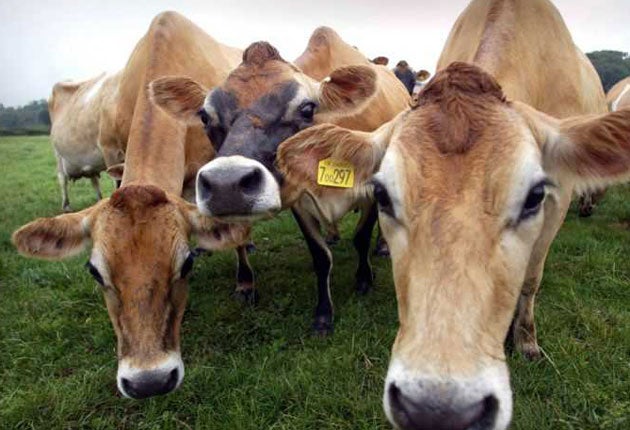
When you hear see word "organic", do you struggle to stifle a yawn? Do you automatically think of sandal-wearing Morris dancers from Dorset? "Maybe we've got food labelling wrong," says Kate Humble, the Springwatch presenter. "Perhaps if we had a 'wildlife-unfriendly' label for milk from intensively-farmed cows, people would think harder about food choices."
On behalf of the Organic Milk Cooperative, Humble is urging milk drinkers to break the habits of a lifetime and go organic. "As a nation we are often guilty of shopping on autopilot," she says. "We don't often relate the process of milk production with the pints we put in the supermarket trolley." Maybe we should develop a kind of check-out conscience and think about the larks and buttercups before the bar coder starts to ping. If just 5 per cent of us switched to buying organic milk, says Humble, it would turn 52,000 acres – an area the size of Greater Birmingham – into organic land. For an extra pound a week we would get healthier milk, happier cows, more wildlife and a prettier countryside. Not a bad deal.
Organic farming means producing food without the benefit of artificial chemicals – the factory-processed fertilisers, pesticides and antibiotics on which most conventional farms rely. The movement took off in the 1990s on the back of a greater public awareness of environmental concerns, and was helped on the way by food health scares such as BSE. Today about 743,000 hectares, representing 4.3 per cent of agricultural land in Britain, is farmed organically. The industry is still expanding, albeit slowly. Organic farmland has increased by 9 per cent on last year.
Of course the business of any working farm, organic or not, is growing food, not accommodating wildlife. You can farm with nature without necessarily having much nature to show for it. Nonetheless Pensthorpe in Norfolk, where some of this year's Springwatch programmes will be filmed, is a pretty convincing argument for wildlife-friendly farming. "It's a perfect place," says Humble, "a kind of nature reserve that earns its keep." Between the fields that supply grain for Jordans Cereals, there are well-managed hedges, plenty of trees and broad field margins. "It's a microcosm of Britain's wildlife all in one spot," she adds.
Children on "hedgerow safaris" can see frogs and toads, rabbits, find nut shells variously chewed by voles and wood mice, and hear the music of songbirds that has been lost from all too many farms. It is the kind of place where, if you are lucky, you can catch the cows making a humming noise that sounds like contentment.
Fast forward to the other big news from the dairying world, the "super scary dairy" at Nocton in Lincolnshire. Three farmers have submitted a joint application to build Britain's biggest dairy farm, described as "a flagship for the next generation of the UK dairy industry". Situated on the super-fertile arable plains of Lincolnshire it will house 8,100 dairy cows producing a staggering quarter million litres of milk every day. The animals will live inside colossal modern sheds with state-of-the-art technology to speed the milk on its way to market.
It does not sound like much fun for the cows. The life of a factory animal is, as far as humanly possible, a denial of nature: no hedges and trees, no fresh grass, no lazy hours spent chewing the cud among the daisies. But take a closer look. The animals, says Nocton Dairies, will be fed on lucerne and crop by-products from surrounding farms. Their waste will be processed through an "anaerobic digester" that eliminates environmentally-harmful slurry, turning it into biofuel – and enough of it to power not only the farm but 2,000 nearby homes. There will be a resident vet, and, when not on milking duty, the animals will be released into paddocks to graze, at least in dry weather.
We might as well be realistic and admit that this kind of big-bucks techno-farming is closer to the reality of farming today than the Darling Buds of May haze of Pensthorpe. There was a time when most of our milk came from small dairy farms, especially in the West Country. But today more than 60 per cent comes from big farms holding more than 150 cows. It costs much less to transfer 50,000l of milk to the tanker than 500. And whether it comes from a family farm or Cow City, Lincs, the milk, they say, all tastes exactly the same. Concentrating production into high-intensity huge units like Nocton could, some say, free up land that could be managed in a more environmentally friendly way. Neil Darwent, writing in Farming Today, calculates that if all dairy cows in England and Wales were run in similar "herds" of 8,000, we would need only232 farms, instead of around 11,500 at present. It would be tough luck for the small farmer of course, but the industrial system could, after all, be adapted to produce overall gains for wildlife and biodiversity.
There is also debate about whether organic farms really are richer in wildlife than conventional farms. A government-funded study of 180 organic farms in 2005 found that they were. On average they support nearly twice as many species of wild flowers, a third as many bats, and significantly more spiders (but only 5 per cent more species of wild birds). On organic dairy farms the fields were smaller and bordered by thick hedges and trees. Increased biodiversity was, in the words of this report, "a happy by-product" providing "very large benefits right across the species spectrum".
But another government report published two years earlier nevertheless claimed that there was "insufficient evidence" that organic farming benefited wildlife. While admitting that organic farms tended to have fewer "ecological side-effects", it noted that their carbon footprint was higher, and that they can impose greater environmental burdens than conventional farms. The report singled out organic milk in particular as requiring more land and generating a greater amount of greenhouse gases. In other words, continued the report, organic farming was less energy efficient and, perhaps surprisingly, more polluting. In launching the report, David Miliband suggested that organic food was really only a "lifestyle choice" for the consumer, with no built-in environmental gain. This represented something of a U-turn for the minister who had said of the earlier report that organic farming was definitely "better for biodiversity than intensive farming".
Some informed commentators smelt a rat. In concentrating its fire on energy efficiencies, the Defra report left out important environmental issues, said the Soil Association, an enthusiastic promoter of the organic system. Firstly it paid little heed to animal welfare issues. It did not attempt to cost out the simple pleasure of a more attractive farm landscape.
Nor, crucially, did it talk about the soil. What really matters, says the Association, is what is going on beneath our feet. Its own study, made in 2009, found that the soil on organic farms is a more effective carbon sink, and that it is less likely to be blown or washed away by wind and rain. Furthermore, it was more efficient at nutrient recycling. Chemical farming kills off some of the natural biodiversity of soil, notably soil fungi which are known to be sensitive to nitrogen-based fertiliser. But Defra, for whatever reason, seems reluctant to commission research in this area. We count skylarks as an indicator of "environmental health", but no one is counting the earthworms.
Defra and David Miliband may see organic farming as no more than a fashionable bubble, a "lifestyle choice". Its advocates see it as a great deal more, as an umbilical link between us and the land, between a healthy natural environment and a technological substitute. We are the consumers and the choice is ours. Buying organic milk, says Kate Humble, is one of the easiest and cheapest ways of supporting farming with nature. "You will know it comes from well-managed farms, and you are doing something actively to protect and conserve the British countryside – and what an effortless way to do it."
"If I had to say which was telling the truth about society", said Sir Kenneth Clark, "a speech by the housing minister or the actual buildings, I should believe the buildings." So, perhaps, with organic farms. If it was a choice between a 500-page government report and the bees that hum over the wild flowers at Pensthorpe, I would believe the bees.
Join our commenting forum
Join thought-provoking conversations, follow other Independent readers and see their replies
Comments