Romania's orphanages: Locking the past away
Twenty years ago, Romania's orphanages caused outrage around the world. What's happened since is a remarkable success story
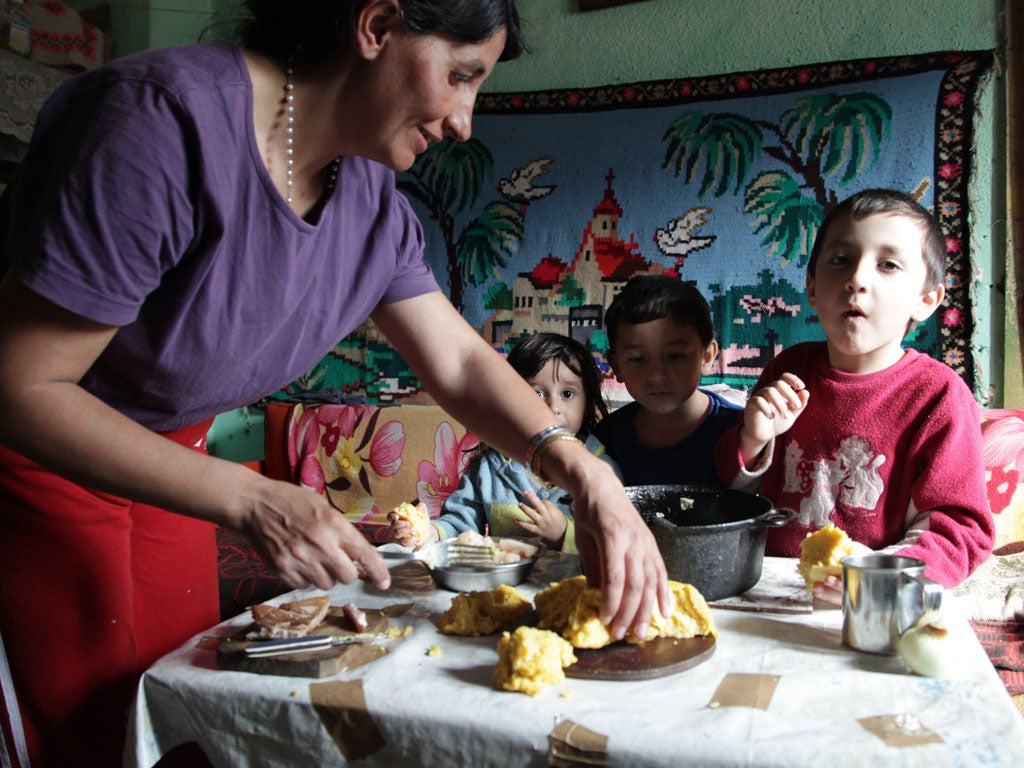
It was in 1992, at the beginning of the Bosnian war, that the Commander of the British UN contingent, Mark Cook, came across a bombed-out orphanage in Croatia. He found the surviving orphans and, appalled at their plight, gave his word that he would rebuild their home. He left the army, raised £1 million, rebuilt the orphanage and that was how the charity Hope and Homes for Children came into being in 1994.
It's not surprising that the sight of these orphans had such a profound and life-changing effect on Cook. Every so often a film-maker will get behind the orphanage scenes in China, or an Eastern bloc country, and as a result we all scream with outrage and pity to see the conditions they live in. Only last week, on Channel Five, there was a heart-rending documentary, The Lost Orphan: Mirela's Story, in which Natalie Pinkham, who'd worked in an orphanage some 12 years ago, returned to Romania to find out what had happened to one of her favourite children. It wasn't a happy outcome. Mirela, apparently a perfectly normal, lively baby at two years old, had been so institutionalised in the intervening years that she had changed into a jerking, needy child, still in nappies at 13, who could barely walk or speak, now destined for a lifetime in horrendous adult institutions for the disabled.
I myself visited, with Hope and Homes for Children, orphanages in Albania and Romania in 2005 and, even though I have an upper lip made of concrete, cannot speak of the scenes I saw without starting to break down.
So what is happening to these institutions now? Are they still continuing to thrive?
No. It seems that something is being done. At the beginning of its existence, and naturally enough, Hope and Homes for Children started by renovating existing orphanages and building new ones in which these wretched children were rehoused. Comfortable orphanages, with toys, gardens and more carers. But in 1996 it became suddenly clear that what these children wanted was not nicer orphanages. What they want more than anything else is the love of a family. Children need one-to-one love, proper relationships and attachments – relationships that they can never find in orphanages, where attachment to an individual child is actively discouraged. And from that realisation onwards, the charity's policy changed.
In 1998, when Hope and Homes for Children first went to Romania and were confronted with 60 babies rocking in their own excreta, instead of building a nicer institution they bought six homes, put 10 children in each and started, in partnership with the Romanian government, a programme of de-institutionalisation.
The tragic thing is that most of these children aren't actually orphans. They do have families of their own, but families that were unable, for various reasons, to look after them. They gave the children to orphanages with the mistaken idea that there they might have a better life. And why did they produce these children if they were unable to look after them? It all goes back to Ceausescu's appalling population expansion policies. He banned contraception and abortion and installed "sex police" to examine each woman of childbearing age every three months to make sure she hadn't had an abortion. As a result, families were forced to have far too many children, and the orphanage business boomed. And the current Romanian government has been left with this hideous legacy.
It's not that easy to close down institutions swiftly and there's no quick fix if you want to make things better in the long term. It's partly because the staff in these institutions don't want to be made redundant – orphanages really are an industry in some countries, embedded in the culture. It is also extremely hard to rebuild relationships between children and their own or new families and carry out the sensitive process of reintegration. "And also we realised you can't close an orphanage without putting in place a model that transforms childcare from an institutionalised system to a family-based one," says Mark Cook. And this takes time.
But the model has been accepted by the Romanian government and recognised by Unicef and the World Health Organisation as best practice. It has been so successful that it's now being used in other countries that have far too many orphanages, like Ukraine, Bulgaria, Belarus, Moldova, Bosnia, Rwanda and Sudan, where Hope and Homes for Children is also working to reform childcare systems. Many of the children are being returned successfully to their own families; others are being adopted, fostered or cared for in small family homes within their own countries.
Hope and Homes for Children, in close partnership with Absolute Return for Kids (Ark), has enabled Romania to lead the field in the orphanage-closing business. They have a training centre there, and have had parties come from across CEE countries and Sudan to see how they are doing it.
When Hope and Homes for Children started work in Romania there were more than 100,000 children in orphanages. Now there are only 6,500 and the plan is to take every single child out of the orphanages and close them all down by 2020. After that, no Romanian child will ever be put into an institution again.
FROM NEGLECT TO CARE
Bulging institutions
After the fall of Ceaucescu in 1989 the overcrowded Romanian orphanages became notorious for their inhumane conditions. Of the estimated 100,000 children living in them, many were there as a result of Ceaucescu's outlawing of abortion and contraception and were not orphans.
Reduced numbers
In the last 15 years the number of children living in orphanages has dropped dramatically to 6,607 and out of 600 orphanages only 170 remain. The charity Hope and Homes for Children hopes to have moved all remaining children out of orphanages by 2020.
Closure and care
Hope and Homes for Children has also been involved in the closure of more than 44 orphanages and has placed almost 4,500 children into alternative care.
Specialist guidance
Alongside their work with orphanages, the charity has published specialist childcare manuals and monitors the standard of care in over 90 specialist childcare services.
Miranda Kiek
Join our commenting forum
Join thought-provoking conversations, follow other Independent readers and see their replies
Comments