Soya: good or bad for you?
Soya can help prevent cancer – yet some research suggests it actually raises the risk. So should we be eating it or not? By Helen Brown
There was an awkward pause on the phone the day before my last dinner party. A friend called to check details of my promised Chinese extravaganza. "Because the thing is," she mumbled, "we're trying for a baby and I read that tofu can lower men's sperm counts. So would you mind keeping it off the menu, just to be on the safe side?" This was news to me. I'd come to think of tofu – of all soy products – as health-boosting "superfoods". Weren't they meant to lower cholesterol, help with menopausal symptoms and help us resist all sorts of cancer? "Oh no," said another guest the following evening. "I heard that soy causes cancer and alzheimer's as well as interfering with fertility."
Our confusion is understandable. Over the past decade a range of scientific studies conducted around the world have concluded that these tasty little East Asian beans (and the many products derived from them) might help prevent or cause all manner of life-threatening or undesirable conditions. So last year's "lowered sperm count" story (based on a study of the diets of 99 men by the Harvard School of Public Health) have just been counterbalanced by the results of research conducted by scientists from the Vanderbilt University school of medicine in Nashville, Tennessee, who studied the diets and health of 68,412 women aged 40-70 in Shanghai and found that those in the top third of soy food intake reduced their risk of bowel cancer by 30 per cent. Separate research from Taiwan last month also suggested that soy supplements could be used to ease menopausal symptoms instead of hormone replacement therapy, which has been linked to cancer.
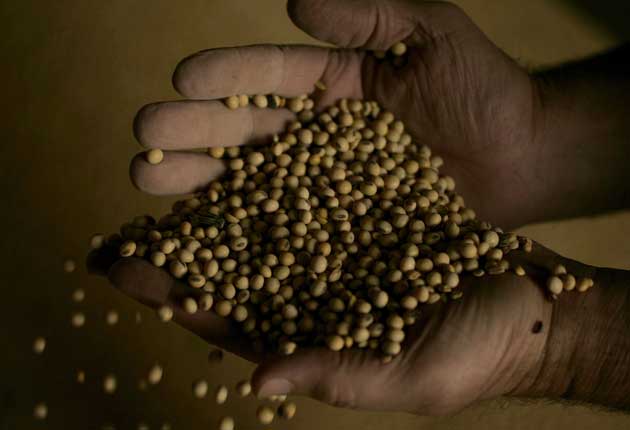
Soy is believed to have an impact on many diseases because it contains isoflavones – phytoestrogens or plant hormones – which appear to act as a much milder form of the primary female sex hormone, oestrogen. And this is where things get tricky, as many human cancers – such as breast cancer – have been linked to high levels of oestrogen, but many scientists also believe that by binding to oestrogen receptors and blocking access from the stronger oestrogens, isoflavones can reduce the risk of hormonal cancers.
Yinka Ebo, health information officer at Cancer Research UK, stresses that "most of the limited and inconsistent research on soy to date has been done in a petri dish, by extracting the isoflavones. They've been isolating and examining the effects of one chemical, whereas the human body's reaction to whole soya products involves a far more complex mix of chemicals."
Most of the human studies to date (like the latest bowel cancer study) have involved Asian populations with different lifestyles, diets, genetic make-up and ability to metabolise soy and phytoestrogens (which they traditionally eat in far greater quantities than the average Westerner). Based on a 2000 adult survey, the mean population consumption of soya products in the UK is about 3g/day. And the Food Standards Agency believes that consumption of soy at this level is unlikely to have any health benefits or risks. So should we be eating more of it?
When it comes to fertility issues, Dr Allan Pacey, senior lecturer in andrology at The University of Sheffield, says that the plant hormones "may affect the initial development of the testicles if a pregnant woman eats lots of soya products. Adult sperm counts are largely determined by how big the testicles get at puberty, which is controlled by their cellular structure, laid down in the foetus. There is evidence to suggest that if a male fetus is exposed to compounds mimicking oestrogen, they may have a less well developed reproductive system that could lead to a variety of conditions, including, when they become adult, a risk of infertility. Therefore, pregnant women should try to reduce their exposure to all oestrogenic compounds, including soya. That said, I am unaware of any increased risk of infertility in adult men in areas of the world where soya is a bigger part of the diet. This may never have been studied, or it may be that genetic factors mean it is not a problem."
But the Food Standards Agency advises that pregnant women don't need to avoid soya products if they're eaten as part of a healthy balanced diet. And in their 2003 report on Phytoestrogens and Health, the Committee on Toxicity of Chemicals in Food, Consumer Products and the Environment (COT) considered that animal and human studies on soy-based infant formulae did not provide definitive evidence that soy-based infant formulae can adversely affect the health of infants. However the findings provided evidence of potential risks. Consequently, the Department of Health advises that soya-based formula should only be given on the advice of a GP.
Soya-based formulas are most likely to be used by vegan women. Dr Justine Butler, senior health campaigner for the Vegetarian and Vegan Foundation, is one of the few scientists to have made a complete study of all the health risks and benefits of soy. She believes the Department of Health's "highly cautious approach is based largely on unfounded anecdotal evidence and animal-based experiments". And many animals react differently to soy than we do – it appears to have proved fatal for a few parrots, for example. Dr Butler stresses that "millions of infants have been raised on soya formulas in the UK and US, many of whom are now well into their late 30s and early 40s."
Dr Butler is keen to emphasise that soy is a good source of protein, containing the eight essential amino acids which the human body needs. She says: "Soya milk and other soya products provide a rich source of polyunsaturated fatty acids (including the 'good' omega-3 fats) and are free of cholesterol. Soya products provide an excellent source of disease-busting antioxidants, B vitamins (including folate) and iron. "
"If my research flagged up any areas of potential – and I stress 'potential' – risk," says Dr Butler, "it would be for post-menopausal women with oestrogen-dependent breast cancer and possibly people with hypothyroidism, as a limited number of studies have suggested that isoflavones may affect thyroid function by lowering free concentrations of thyroxine." In addition to their concerns over soy formula-fed babies, these are the other two groups considered to be at potential risk by the COT report, too. Meanwhile, the Food Standards Agency is commissioning a research project to consider potential adverse effects of phytoestrogens in men with low testosterone levels. But for the rest of us, according to most experts, it seems that so long as it's eaten in moderation and as part of a healthy balanced diet, soy can remain on the menu.
Join our commenting forum
Join thought-provoking conversations, follow other Independent readers and see their replies
Comments