Sport relief: The soccer team for schizophrenics
A football team for schizophrenics started out as a daring experiment. Now there are 50 across Italy – because therapeutic soccer really works, writes Sean Thomas

Sign up to our free Living Well email for advice on living a happier, healthier and longer life
Live your life healthier and happier with our free weekly Living Well newsletter
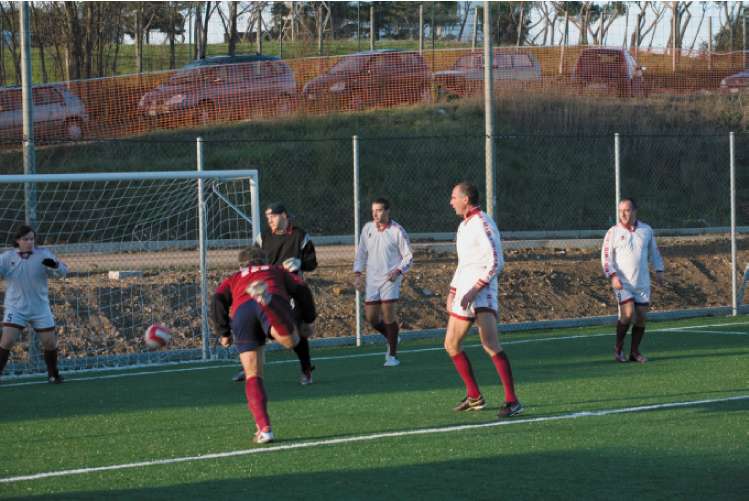
If you drove past on the autostrada, and briefly looked down at this little football game, in the Bufalotta suburb of Rome, you might not notice it being any different from a normal match. It's when you get down on the touchlines and have a good look that you see that there is something strange. Many of the players, for instance, have a peculiar stiffness in their movements. One or two are grimacing and mumbling. Meanwhile, the goalkeeper is crawling across the penalty area for no apparent reason.
Only then do you guess the truth: that half these players are schizophrenics. Because this is the Gabbiano club, a side conceived and brought together by a psychiatrist, as a startling and successful form of psychiatric therapy.
Mauro Raffaelli is the man responsible for the original concept behind Gabbiano. Taking a breather from the game – he likes to play alongside his patients – he comes over to tell the story. "The notion of football therapy first struck me 14 years ago, when I was in a Roman hospital. I was treating one of the patients you can see out there – Alessandro. I was injecting his legs, and I realised they were notably muscly, like an athlete. So I asked him if he had ever played sport, and he said yes: football." This revelation gave Mauro the crucial insight that he could reconnect the patients with their happy and healthy childhoods, by getting them to kick a ball around, and even play proper matches.
In its early days, the football therapy encountered real opposition – and not just on the pitch. Managers of sports grounds didn't want "crazies" in their changing rooms. Some claimed the patients might attack bystanders. The psychologists persuaded the powers-that-be that such fears were baseless. Since then, the concept has blossomed. Now there are 50 teams of psychiatric patients in championships and tournaments right across Italy. And the reason everyone has changed their attitude is quite simple: therapeutic football seems to work.
Mauro points at Alessandro again: "Before we got him into soccer, Sandro was truly sick. He was suffering wild hallucinations, and hearing many voices. But most of these symptoms have been ameliorated."
Before the second half, Mauro calls over some other patients. We meet Luca Denei, an ex-security guard. Ten years ago, he tells us, he was virtually catatonic from severe depression. Now he's married, has four daughters, and he's just started a course at Rome University.
Naturally, football is not a total cure. Another player, 41-year-old Benedetto Quirino, attests to this. He comes from a wealthy and cultured background, he speaks very good English, and was himself, ironically, a psychology graduate. He believes he has greatly benefited from Raffaelli's revolutionary therapy, but he remains very disturbed. Benedetto tries to tell us about his condition. But his attention wanders off. Then he appears to hear voices in his head. Tics agitate his intelligent face. You can see the anxiety under the smile. It is heart-wrenching.
Benedetto wanders over to the dugout, muttering away. But when he gets back into the game the transformation is evident. Suddenly he is not a "lunatic", he is just running around like anyone else: calling for the ball, whacking a tasty volley at goal.
Another puffing doctor joins us. Santo Rullo works in Villa Letizia, a therapeutic residential community on the outskirts of the Italian capital; along with Mauro, Santo was one of the creators of football therapy. He elaborates on the curative process: "A football team is a social group, each individual has a role, everyone has a social place; rules and relationships are all-important. So when an isolated and excluded person joins a team, it teaches them to live in, and with, the larger community."
He wipes his face. Then he adds: "Another great advantage of soccer therapy is that the players increase their endorphin levels – the happy hormone that makes you feel good after exercise. Many disabling mental conditions, like depression, are linked with reduced endorphins."
The game has ended. The reds have won, despite a spirited fight-back from the whites. For the after-match celebrations, we all repair to a nearby, slightly run-down part of Rome: the port area where Alessandro Faraoni grew up. We join Sandro and his mum in their small but cosy apartment. As Sandro showers, his mum tells her son's story. Sandro was a perfectly ordinary, rather handsome young Italian man. He was working as a bodyguard for the Italian president. But the stress of carrying a gun, and worrying about assassination attempts, catalysed a latent psychosis in Alessandro. Sandro says: "I like to think that my mum was my first medication. I guess football was my second. Football worked for me because it helped me escape the prison of madness... The weird thing is, the opposite team became the voices in my head, they embodied the voices, and that helped me. It made them real. And then I could cope."
Subscribe to Independent Premium to bookmark this article
Want to bookmark your favourite articles and stories to read or reference later? Start your Independent Premium subscription today.
Join our commenting forum
Join thought-provoking conversations, follow other Independent readers and see their replies