3-D mammograms offer new breast cancer screening option

Sign up to our free Living Well email for advice on living a happier, healthier and longer life
Live your life healthier and happier with our free weekly Living Well newsletter
Mammograms have entered a new dimension, literally. At some screening centers, women are now being offered a 3-D technology that costs more and involves more radiation but may provide a better look.
The Food and Drug Administration approved the 3-D mammography device in 2011, and the technique is becoming more common.
Radiologists who use 3-D, also known as tomosynthesis, say its drawbacks are worth the greater accuracy. By itself, 3-D mammography delivers about the same amount of radiation as standard digital 2-D mammograms. But when the FDA approved the new device, it said 3-D could be used only as an add-on to standard mammograms, essentially doubling the low radiation dose. The FDA made 3-D an add-on only because there is not enough information yet about whether 3-D screenings detect cancers as well as 2-D mammograms do. Therefore, 2-D remains the standard of care and provides unique benefits for clinicians, such as familiarity and the ability to compare images from previous years.
"The 3-D image doesn't replace the standard 2-D mammogram," says Julianne Greenberg, a radiologist at Washington Radiology Associates, which has begun telling women who come in for their standard 2-D screening that they can add a 3-D mammogram to it for $50. "Three-D is added value to an already existing, really good technology."
In a conventional mammogram, the breasts are compressed and X-rayed four times: side to side and top to bottom, for both the left and the right breast. To take the 3-D images, an arm of the machine sweeps in an arc around the breast during each of the four compressions, taking anywhere from 20 to 60 pictures to produce a 3-D rendering of the breast. These images look almost like holograms; radiologists can spin and flip them around on a computer screen, searching for cancer in the tissue and lymph nodes.
When looking at a 2-D and a 3-D image of a breast together, radiologists showed a 7 percent improvement in their ability to distinguish between cancerous and non-cancerous cases, according to two studies that the FDA considered during its approval process.
More accurate detection reduces the rate of false positives. In the United States, about 10 percent of women who have a screening mammogram will be called back for additional imaging, such as a sonogram or more mammography, according to the FDA. The vast majority of those women do not have breast cancer (about four cases of breast cancer are found for every 1,000 women who are screened, Greenberg says), but they have to cope with the fear and anxiety of having abnormal mammograms and perhaps undergoing more invasive testing.
"It's terrifying for a patient," Greenberg says. "It's anxiety-producing. It's inconvenient. It's additional radiation exposure. It's potential for a biopsy for something that really is benign."
Washington Radiology Associates began offering tomosynthesis in August 2011. Close to half of patients have been choosing to spend the extra $50, Greenberg says, which insurance does not cover. Aetna, for example, considers tomosynthesis "experimental and investigational because of insufficient evidence of its effectiveness."
Greenberg says that by using the combined 2-D and 3-D pictures, WRA has seen a 20 percent decrease in recall rates and a 31 percent increase in cancer detection over 2-D alone.
"It has been really helpful in detecting really small breast cancers and decreasing recall rates in all patients, whether they have dense breasts or fatty breasts or in between, whether they're 75 or 40 years old," Greenberg says.
In addition to a lack of information about whether 3-D alone would be as good as 2-D alone, there are no data yet to show which subgroups of women - stratified by age, breast size or density, cancer history - might benefit the most from tomosynthesis.
This concerns Carol H. Lee, chair of the American College of Radiology's breast imaging communications committee, who says that "the jury's still out" on whether it's worth exposing women to more radiation in order to decrease the recall rate for a few of them.
"We have a tendency in this country to adopt new modalities before they're fully validated because they're something new and we like to think they're an advance," says Lee, a radiologist at Memorial Sloan-Kettering Cancer Center in New York. She does not use tomosynthesis.
Robert Ochs, a physicist who served as the lead reviewer for the FDA panel that approved the 3-D machine, said that even a double dose of radiation is still very little. A 2-D/3-D combination of mammograms produces about a tenth of that from a CT scan of the chest, or 160 times the "negligible" amount in a dental X-ray, according to the American College of Radiology.
"The potential immediate benefit for cancer detection greatly outweighed the potential for cancer from the radiation that would occur many, many years down the road," Ochs says.
Having a 2-D/3-D screening every year is estimated to increase a woman's lifetime cancer risk by less than 1 percent compared with the risk from 2-D exams alone, according to Ochs. The National Cancer Institute recommends that women age 40 and older have a mammogram every one to two years. The U.S. Preventive Services Task Force (USPSTF), an independent, government-appointed panel that makes recommendations to policymakers, doctors and others, in 2009 recommended that women wait until age 50 years to start routine mammography.
Lillie Shockney, the administrative director of the Johns Hopkins Breast Center and a breast cancer survivor, said she receives about 1,400 emails a week about breast cancer on the center's website, and probably two of those are queries about tomosynthesis.
"Usually what they're asking is if [3-D mammograms] squeeze the breasts as tight," Shockney says. "That's not a good reason to select it."(It would also be a disappointment, since anyone opting for 3-D still must get the 2-D squeeze anyway.)
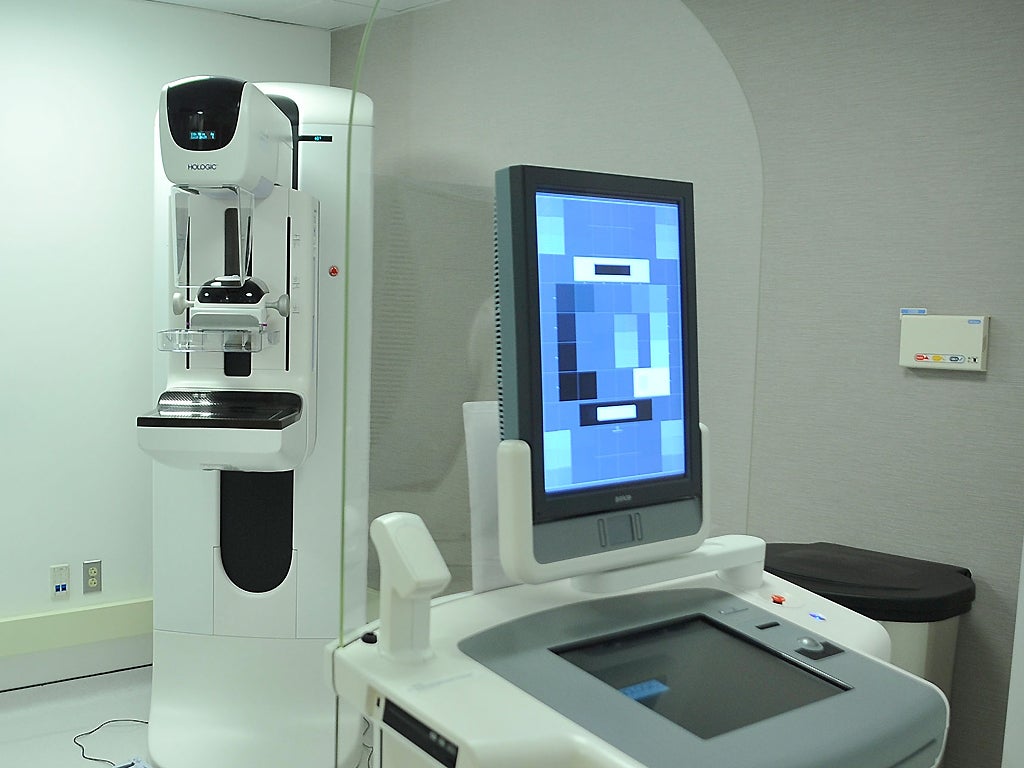
The Hopkins Breast Center doesn't yet have a 3-D unit, but it does have a room reserved for it, Shockney says. The machine, called the Selenia Dimensions 3-D system, is marketed by Hologic and was developed at Massachusetts General Hospital in Boston.
Shockney says that the most important thing for women is not whether they opt for 3-D, but that they get a screening in the first place. "We have the ability to save their life and save their breasts when we catch things early."
Subscribe to Independent Premium to bookmark this article
Want to bookmark your favourite articles and stories to read or reference later? Start your Independent Premium subscription today.
Join our commenting forum
Join thought-provoking conversations, follow other Independent readers and see their replies