A diagnosis of the NHS – by its patients
Health service scores strongly for cleanliness but badly for mixed-sex wards, reports Jeremy Laurance

Sign up to our free Living Well email for advice on living a happier, healthier and longer life
Live your life healthier and happier with our free weekly Living Well newsletter
A snapshot of the NHS seen through patients' eyes, published today, shows that despite record investment over the past decade, problems persist with mixed-sex wards, hospital food and answering call buttons.
The National Inpatient Survey, by the Care Quality Commission (CQC), the health and social care inspectorate, is one of the largest of its kind, covering 72,000 patients who spent at least one night in hospital in 2008.
More patients rate their wards as clean and say doctors and nurses are washing their hands. But on giving help with eating, involving patients in decisions and communicating with GPs, they are falling short.
Cynthia Bower, chief executive of the CQC, said: "It's great to see patients noticing improvements in cleanliness and handwashing. There are now real signs that the NHS is beginning to get to grips with infection control. Rates of MRSA and C. Difficile are now falling. However, patients are clearly highlighting some persistent problems, such as help with eating and involvement in decisions. It is a great shame the NHS has not got a stronger grip on these issues."
The Patients Association ridiculed the survey for giving Mid Staffordshire NHS Trust an average rating, including two out of three for its A&E department, after an inquiry by the Healthcare Commission (the CQC's forerunner) in March uncovered "appalling" emergency care which may have led to hundreds of deaths. "What is this survey if it cannot pick up on poor care?" said Katherine Murphy, the association's director.
Cleanliness
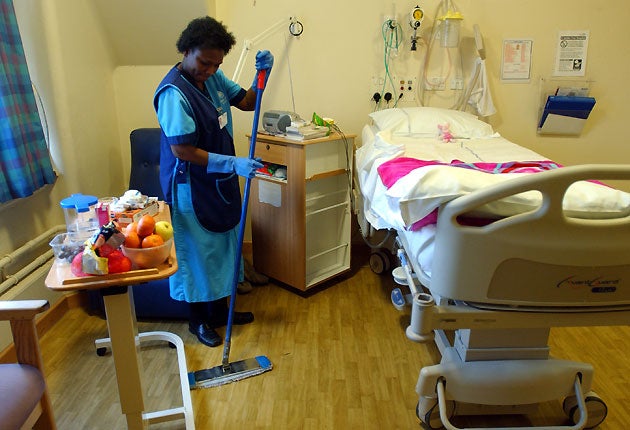
In 2008, 95 per cent of patients said their room or ward was "very clean" or "fairly clean". Among the worst performers was Hillingdon Hospital, Middlesex, where 12 per cent of patients said their room or ward was "not very clean" or "not at all clean".
Washing hands
Almost three-quarters (74 per cent) of patients said doctors always cleaned their hands between touching patients, up from 67 per cent in 2005. But doctors still trail nurses – 76 per cent said nurses always cleaned their hands.
Quality of food
More than half of patients (58 per cent) rated the food as "good" or "very good". However 14 per cent said it was "poor". Among the worst trusts was Queen Elizabeth Hospital, Woolwich, where 29 per cent rated the food as "poor".
Help with eating
This remains a major problem in NHS care. About 30 per cent of patients need help with eating but 18 per cent of those say they did not get it.
Mixed-sex wards
One in 10 patients with a planned admission said they had to share a sleeping area with the opposite sex. Among emergency patients, 29 per cent shared. This showed no significant improvement on 2007. The Tories said Labour's record on mixed-sex wards was a "series of broken promises".
Answering call buttons
There was no improvement here compared with 2007 – 17 per cent said the bell was usually answered right away but 15 per cent said it took longer than five minutes. Two per cent complained that it was not answered at all.
Overall care
Patients are growing more positive about the NHS – gradually. In 2008, 93 per cent rated their care as "excellent", "very good" or "good", up from 92 per cent in 2007.
Those who rated their care as "excellent" increased from 38 per cent in 2002 to 43 per cent in 2008, a period that has seen an extra £45bn ploughed into the service.
Patients' survey: The best hospital for...
Clean Rooms Queen Victoria NHS Trust, East Grinstead, Sussex: 87 per cent of patients said the rooms were "very clean".
Quality of food Robert Jones and Agnes Hunt hospital, Shropshire: 84 per cent said food was "very good".
Mixed-sex wards Harrogate NHS Trust: Only 4 per cent said they had to share with the opposite sex.
Answering call buttons Liverpool Heart and Chest NHS Trust: 35 per cent said calls answered right away.
Overall care Christie Hospital NHS Trust, Manchester: 68 per cent said care was "excellent".
Subscribe to Independent Premium to bookmark this article
Want to bookmark your favourite articles and stories to read or reference later? Start your Independent Premium subscription today.
Join our commenting forum
Join thought-provoking conversations, follow other Independent readers and see their replies