Are we losing the war on cancer?
100 of the world's experts convened at the weekend to take stock of our progress – and the diagnosis is gloomy. Steve Connor reports
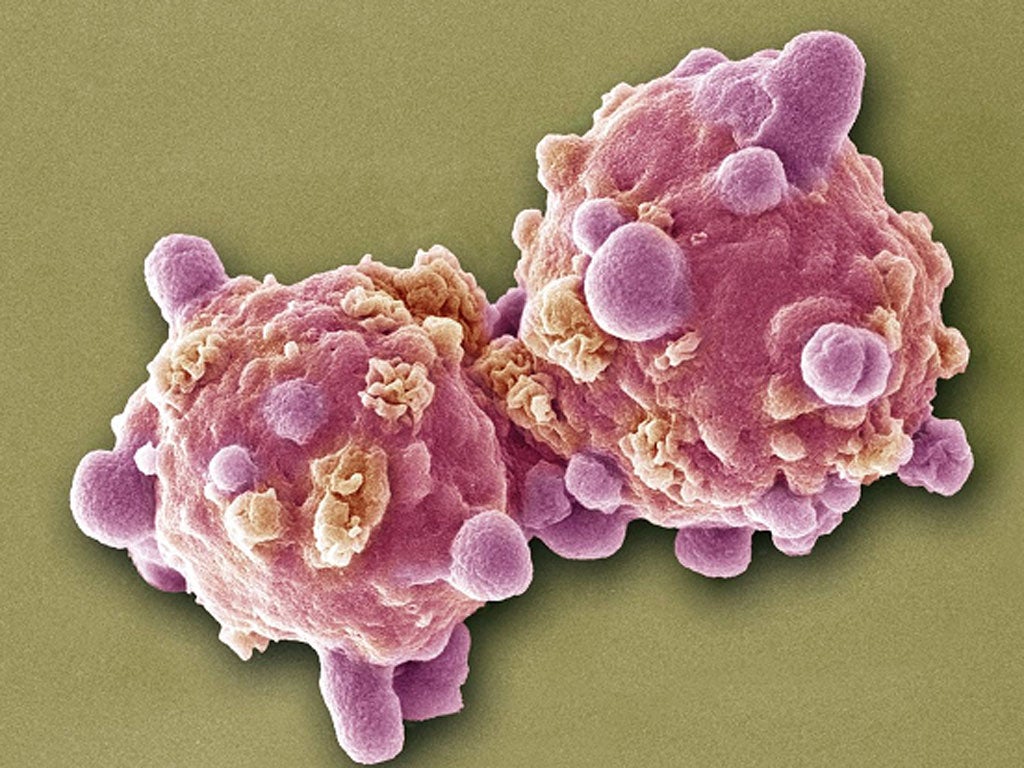
They came from around the world to discuss one question: Are we winning the war on cancer? A few thought we were, some said we weren't, and most believed that war was the wrong metaphor for the struggle against a complex set of diseases that will affect one person in three at some time in their lives.
A hundred of the world's leading cancer specialists descended on Lugano in Switzerland last weekend to formulate a 10-point action plan to finish off what President Richard Nixon started on 23 December 1971, when he signed the US National Cancer Act. Although the Act does not use the phrase "war on cancer", this was how it was widely received at the time.
Most Americans thought a cure for cancer would be discovered within five years – emulating the technological success of landing a man on the Moon. But more than 40 years later, few experts talk of a single cure for the 200 known types of cancer. The optimism of the early 1970s has given way to the dogged determinism of a cancer community under siege from the growing global epidemic.
"Curing cancer is certainly more complicated than landing on the Moon," said Peter Krammer of the German Cancer Research Centre in Heidelberg, one of the experts who attended the World Oncology Forum.
People need to realise that there are two types of war on cancer – one focused on a cure for patients and the other based on the elimination of the disease, said Umberto Veronesi, a veteran oncologist and a former Italian health minister.
"In 40 years, we've nearly doubled the curability rates for cancer and in another 40 years it is reasonable to assume that we'll get near total curability," Dr Veronesi told the forum. "But the second goal of eliminating cancer from the population is a Utopian dream because the incidence of cancer is increasing not decreasing. We can cure a patient but as soon as we cure one patient, another patient arrives."
Some cancers today are indeed curable compared with 40 years ago – provided, of course, that they are detected early enough. For instance, some types of testicular cancer that are 100 per cent curable today were invariably fatal half a century ago.
Many kinds of cancer are now treatable, and survival rates across almost the entire spectrum have improved dramatically. But cancer is still a leading cause of disease worldwide, accounting for around 13 per cent of all deaths in 2008. As the developing world becomes richer, those countries are also being affected by the cancers of the westernised world, which are dominated by the health impacts of smoking. If recent trends continue, according to the WHO, the global burden of cancer will increase to 22 million new cases each year by 2030 – a 75 per cent increase compared with 2008.
"We don't talk about the war on cancer because it's almost cliched. But perhaps it's time to revive it and look at it again," said Douglas Hanahan, director of the Swiss Institute for Experimental Cancer Research in Lausanne. We are winning some battles in the war, but most of the time we are losing them, essentially because cancer is a disease of extraordinary complexity, he told the meeting.
In 1998, following a front-page story in the New York Times about the success of drugs targeting the growth of blood vessels to a tumour, there was widespread hope that a cure for cancer may have finally arrived, he said. The optimism was soon dashed, however, when it was realised that these angiostatins worked only for a while and cost far too much for widespread deployment. The same story of shattered hopes emerged in more recent times with a new generation of "targeted" drugs designed to work against tumours with a certain genetic make-up. One such drug, BRAF inhibitors, produced near-miraculous results in initial trials, with tumours visibly receding within weeks of treatment. However, six months later, the tumours returned with a vengence with evolution of resistant cancer cells, Dr Hanahan said.
A possible solution to the problem of cancer resistance is the use of one or more drugs or treatments in combination. This anti-resistance strategy of combination therapy works well against the rapidly evolving Aids virus. However, many combination drugs are expensive – hardly affordable when taken alone, let alone when taken together. On top of that, drug companies sometimes appear reluctant to cooperate with competitors holding patents on the other half of the combination therapy.
Even when drugs are cheap, as they are when "off patent", Dr Hanahan said, the pharmaceuticals industry sees little financial incentive if clinical trials involve drugs not covered by many years of patent protection.
The disease: in numbers
75 per cent: Estimated increase in cancer cases between 2008 and 2030
22m: New cases of cancer each year by 2030
22 per cent: Proportion of cancer deaths worldwide caused by smoking
12.7m: New cases of cancer worldwide in 2008
One half: Proportion of smokers who will die from tobacco-induced cancer
7.6m: Deaths from cancer in 2008
30m: New smokers a year in world
Join our commenting forum
Join thought-provoking conversations, follow other Independent readers and see their replies
Comments