Blood test offers hope to cancer sufferers

DNA analysis will enable doctors to pinpoint whether treatment is working
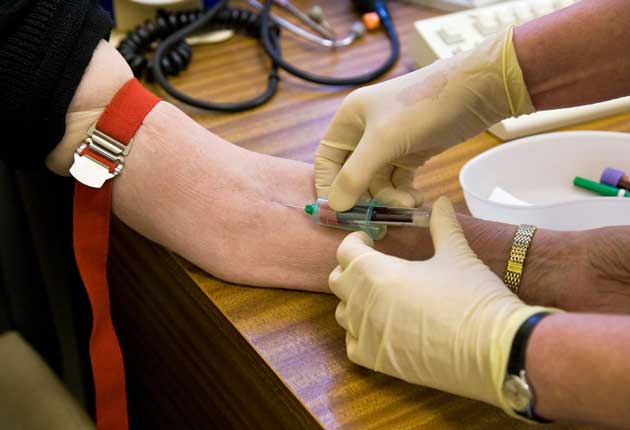
Doctors may soon be able to tell whether cancer has been successfully eliminated from the body using a sensitive blood test that could dramatically change the way they are able to monitor the recovery of their patients.

The blood test, which detects the presence of the smallest amounts of defective DNA shed by cancerous cells, can show how well cancer patients are responding to successive courses of treatment.

Cancer treatment is difficult to monitor at present and usually involves cumbersome and expensive hospital scanners. A blood test that can check different stages of remission will be an invaluable tool in determining whether treatment has worked, scientists said.

Each test is tailor-made for an individual patient and works by identifying gross changes to the patient's DNA that occur during cancer. This "personalised" test distinguishes between a patient's healthy DNA and that which has changed as a result of a cancerous growth, giving scientists a way of seeing if a treatment is succeeding. The researchers predict that the test could soon be used routinely in the battle against the killer disease.

Although such "personalised medicine" based on sequencing a person's unique genome is still expensive – about £3,500 – the scientists believe the test will eventually become no more expensive, but much more effective, than current methods of monitoring cancer treatment.

"Eventually, we believe this type of approach could be used to detect recurrent cancers before they are found by conventional imaging methods, like CT scans," said Luis Diaz, assistant professor of oncology at Johns Hopkins Kimmel Cancer Centre in Baltimore.

Victor Velculescu, another Johns Hopkins scientist involved in the study, presented yesterday at the American Association for the Advancement of Science in San Diego, said: "There is currently no test for cancer patients that provides personalised biomarkers for clinical management of disease, and we feel that this is an important step in bringing new genome sequencing technologies to personalised patient care."

The technique, called personalised analysis of rearranged ends (Pare), differs from previous investigations of the genomes of cancer cells by looking at gross rearrangements of whole chunks of DNA rather than individual mutations in the "letters" of the genome.

Bert Vogelstein, of the Howard Hughes Medical Institute in Baltimore, said: "These alterations, like the reordering of chapters of a book, are easier to identify and detect in the blood than single-letter [genome] changes."

The scientists tested the Pare technique on six sets of cancerous and normal tissue samples taken from four patients with colorectal cancer and two with breast cancer. They found between four and 15 DNA rearrangements in each of the six samples.

The researchers were able to show how levels of the cancer-linked DNA in the blood fell after the initial surgery to remove the tumour, and subsequent bouts of radiation treatments, chemotherapy and secondary surgery.

Rebecca Leary, a member of the research team, said the aim was to develop a highly sensitive method of detecting any residual cancer that may be left after a course of treatment.

"As Pare becomes affordable, it will [help] physicians to tailor patient care and may become a useful supplement to traditional monitoring by imaging or other approaches," Dr Leary said.

Peter Johnson, Cancer Research UK's chief clinician, said: "The detection of DNA changes, unique to individual cancers, has proved a powerful tool in guiding the treatment of leukaemia. If this can be done for other types of cancer, like bowel, breast and prostate, it will help us bring new treatments to patients better and faster than ever."

Independent Comment
blog comments powered by Disqus
News in pictures
World news in pictures
Life & Style blogs

Wandsworth tops aspiring young professionals hotspot list

Other popular areas include Didsbury, Clifton in Bristol, central Cambridge and West Bridgford

Christian GPs and the morning after pill: Much needed clarification

Doctors are allowed to have personal beliefs, just as long as these beliefs do not interfere with th...

Justin Webb on the medical advances in tackling heart disease

BBC journalist Justin Webb talks about his experiences of the advances in preventing heart attacks a...


ES Rentals

    Independent Dating
    and  

    By clicking 'Search' you
    are agreeing to our
    Terms of Use.

    iJobs Job Widget
    iJobs General

    Science Teacher

    £21000 - £36000 per annum: Randstad Education Crawley: We are currently recrui...

    Food Technology Teacher

    £21000 - £36000 per annum: Randstad Education Crawley: We are currently recrui...

    2nd in Charge of English (with Media Studies)

    £21000 - £36000 per annum: Randstad Education Crawley: We are recruiting for a...

    2nd In Charge of English/Head of Department

    £21000 - £35000 per annum: Randstad Education Crawley: Qualified English Teach...

    Day In a Page

    'There is a battle going on inside us that is never discussed'

    Masculinity in crisis?

    'There is a battle going on inside us that is never discussed'
    Have US shock jocks gone too far?

    Have US shock jocks gone too far?

    An incendiary remark from Rush Limbaugh may be the beginning of the end for outspoken right-wing US broadcasters
    The ‘Beverly Hills’ of Surrey pays more income tax than big cities of the North

    The ‘Beverly Hills’ of Surrey

    Elmbridge pays more income tax than big cities of the North
    Heavenly Bodies

    Heavenly Bodies

    Michael Landy's artistic marriage made in heaven... and hell
    'He will always be a friend': Jackie Stewart backs Polanski

    'He will always be a friend'

    Jackie Stewart backs Roman Polanski
    The price of pacifism: Refusing to go to war is finally being recognised as a brave act

    The price of pacifism

    From the Second World War refusenik to the 19-year-old Israeli, Holly Williams talks to five people who risked shame and suffering to take a stand as conscientious objector.
    'It was mass hysteria': Jason Isaacs on groupies, theatre bores and snogging James Bond

    Jason Isaacs: Groupies, theatre bores and James Bond

    To millions, Jason Isaacs is one of Harry Potter's arch enemies – but his wife prefers him as a Scottish TV detective.
    Notes from a small island: Is Sealand an independent 'micronation' or an illegal fortress?

    Sealand: 'Micronation' or illegal fortress?

    Thomas Hodgkinson spent a week at the tiny platform off the Suffolk coast to find out.
    Not a bad bone: Mark Hix cooks with cutlets and ribs

    Mark Hix cooks with cutlets and ribs

    If you ignore cutlets and ribs, you'll risk missing out on some delicious and easy meals, says our chef.
    The experts' guide to summer: From getting fit for the beach to recreating that Olympic buzz

    The experts' guide to summer

    From getting fit for the beach to recreating that Olympic buzz
    Sex, drugs and fast cars: The legend of James Hunt has set Hollywood hearts racing

    Legend of James Hunt has set Hollywood hearts racing

    Early glimpses of Ron Howard's film Rush suggest it will portray Hunt as a high-living lothario, with an insatiable appetite for partying.
    Macklemore: 'I don't have moderation when using drugs and alcohol. It was hurting my life'

    Macklemore: 'I don't have moderation'

    The next Vanilla Ice or the next Eminem? Macklemore doesn't have a record contract – but he does have the UK's biggest-selling single of the year.
    Don't be shy: Bill Granger's Sri Lankan recipes

    Don't be shy: Bill Granger's Sri Lankan recipes

    Sri Lankan cuisine is light, sunny, wonderfully spiced – and so easy to cook from scratch. Just as soon as you've broken into the coconut, that is.
    Sir James Dyson’s latest project: Cleaning up hospitals

    Sir James Dyson’s latest project: Cleaning up hospitals

    Doctors are hailing the revamp of a Bath neonatal unit, where babies sleep more and feed better, as the model for patient care
    One man returns to Argentina's town that drowned

    One man returns to Argentina's town that drowned

    Epecuen was submerged under 10 metres of water in 1985. Now the floods have gone – and 83-year-old Pablo Novak has moved back in