Breast cancer could be curbed by preventive drug treatment
The soaring rate of breast cancer in Britain could be curbed if drugs to prevent the disease were offered to women in the same way that statins to lower cholesterol are offered to people at risk of heart disease, a panel of experts has concluded.
One in 10 women in the highest risk band would benefit, they said. Trials of newer drugs currently under way could eventually see preventive treatment offered to as many as half of all post-menopausal women.
The 12 international experts met in Switzerland last year to review the latest evidence and have published their conclusions in a consensus statement in Lancet Oncology today.
They draw a parallel with statins for the prevention of heart disease which have been in widespread use for more than a decade and are taken by millions. But the use of drugs to prevent cancer is in its infancy and is still unfamiliar.
"The idea of preventing cancer with drugs seems quite alien," said Professor Jack Cuzick, the chairman of the expert panel and Cancer Research UK epidemiologist at Queen Mary, University of London. "But if someone came to a clinic with high cholesterol and was told 'Come back in a year and we will check you again' you would think that was mad. Yet that is what we do with cancer."
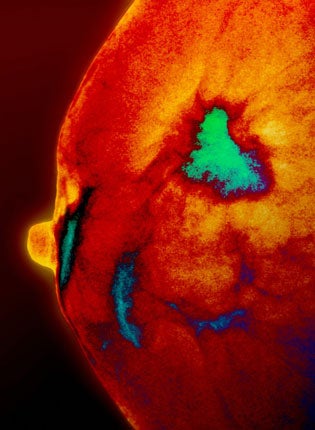
The equivalent of cholesterol levels in cancer is the density of the breast tissue, as seen on a mammogram. Women with dense breasts have a four times greater chance of developing cancer than those with the least dense breasts.
One in 10 women has dense breasts, defined as those where more than 75 per cent of the mammogram shows up as opaque white fibrous tissue, and should be offered drug treatment, the experts say.
Breast density offers a simple measure of risk for women in the same way that blood cholesterol levels provide a measure of heart disease risk.
Once started on preventive drugs, a reduction in breast density can be used to measure their effectiveness in the same way as a fall in cholesterol indicates a response to statins.
Breast cancer is rising rapidly with almost 48,000 new cases a year, an 80 per cent increase in 30 years. The rise is being driven by lifestyle changes that alter the levels of female hormones including later childbirth, smaller families, shorter breast feeding, growing obesity, increased alcohol intake and lower exercise.
Until now, prevention efforts have focused on encouraging women to exercise more, eat less and cut down on alcohol. But unlike heart disease, preventive drug therapy has not been emphasised.
The main drug recommended is tamoxifen which shows a 40 per cent reduction in risk when taken for five years but has side effects including blood clots and a small extra risk of endometrial (womb) cancer. But a trial of a newer class of drugs – aromatase inhibitors – is under way and may show an even bigger reduction in breast cancer risk.
"We are hopeful we will see on the order of a 70 per cent reduction. It is generally better tolerated. You don't get the blood clots or the endometrial cancer. But it does cause bone thinning in some women so that has to be monitored. It is only suitable for post-menopausal women but it might be suitable for half of them," Professor Cuzick said.
How easy is it to get the drugs?
Women hoping to obtain the drugs face a difficulty. The main drug recommended – tamoxifen – is only licensed in Europe as a treatment for breast cancer, not as a preventative. It is "off patent" and its original manufacturer has not applied to extend its licence to include prevention, which is holding back its use. It can only be prescribed "off label", where the doctor carries the risk.
Professor Jack Cuzick, chairman of the expert panel and Cancer Research UK epidemiologist at Queen Mary, University of London, said: "This is an enormous problem. Tamoxifen is not licensed for prevention, but all the experts believe it should be. Only the manufacturer can apply and, because it has gone off-patent, it does not want to bear the cost. There is no mechanism for getting it licensed. It is a crazy situation."
Tamoxifen has been shown in trials to reduce the risk of breast cancer by 40 per cent when taken for five years. But it has side effects, including an increased risk of blood clots, and a small increase in endometrial cancer of the womb. Raloxifene is also recommended – it has fewer side effects but less benefit. Tamoxifen was licensed for prevention in the US before the patent ran out.
Join our commenting forum
Join thought-provoking conversations, follow other Independent readers and see their replies
Comments