Breast cancer screening blamed for 'false alarms'
Thousands of women undergoing unnecessary treatment, researchers say
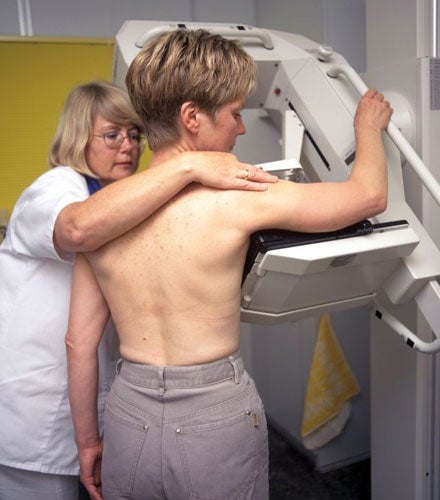
One in three breast cancer cases diagnosed in routine public screening programmes is harmless and would not have caused problems if it had gone undetected, researchers say.
The revelation re-opens the debate about screening, which helps some women but harms others. Doctors say thousands of women undergo unnecessary treatment, including mastectomies, to investigate and treat disease that would have been better left alone.
Peter Gotzsche, director of the Nordic Cochrane Centre in Copenhagen and a critic of screening programmes, joined forces with the researcher Karsten Jorgensen to compare breast cancer trends before and after screening was introduced in the UK, Canada, Australia, Sweden and Norway. They found that the level of over-diagnosis was comparable in all five countries.
As it is not possible to distinguish lethal from harmless cancers, all detected cancers are treated.
It is known that a type of early breast cancer often detected in screening, ductal carcinoma in situ, can resolve itself without treatment but the latest study says this also applies to other cases of invasive breast cancer. The authors, whose findings are published in the British Medical Journal, say many experts find this "difficult to accept".
Screening for cancer detects the disease earlier, when it is easier to treat. The NHS Cancer Screening Service estimates that breast cancer screening saves 1,400 lives every year, one for every eight women diagnosed.
But the researchers say that for each woman who is saved by screening, up to 10 will be overdiagnosed and have unnecessary treatment and up to 500 will have at least one false alarm, half of whom will have a biopsy (removal of a sample of breast tissue).
Gilbert Welch, a professor of medicine at the Dartmouth Institute for Health Policy in the US, says in an editorial published with the research: "The question is no longer whether, but how often, overdiagnosis occurs.
"Mammography is one of medicine's close calls – a delicate balance between benefits and harms. Mammography undoubtedly helps some women but hurts others. No right answer exists, instead it is a personal choice."
In the NHS, women between the ages of 50 and 72 are invited for breast screening every three years. The age range is to be extended to 47-73 by 2012. Figures for 2006-07 show screening detected almost 13,500 cancers.
Some doctors argue that the money spent on the breast screening programme – about £40m a year – would save more lives if it were used to provide more treatment.
The Cancer Screening Service is revising its screening advisory leaflet. A spokeswoman said the new version should be available later this year.
Dr Sarah Cant, from Breakthrough Breast Cancer, said she hoped that the research would not discourage women from attending screening: "Based on all the current evidence, we believe the benefits of detecting breast cancer early still outweigh the risks."
500
Women will have a false alarm for every one saved by breast cancer screening.
Join our commenting forum
Join thought-provoking conversations, follow other Independent readers and see their replies
Comments