Down's syndrome: parents think again
More babies are being born with Down's syndrome than at any time since screening began. Jerome Taylor discovers why
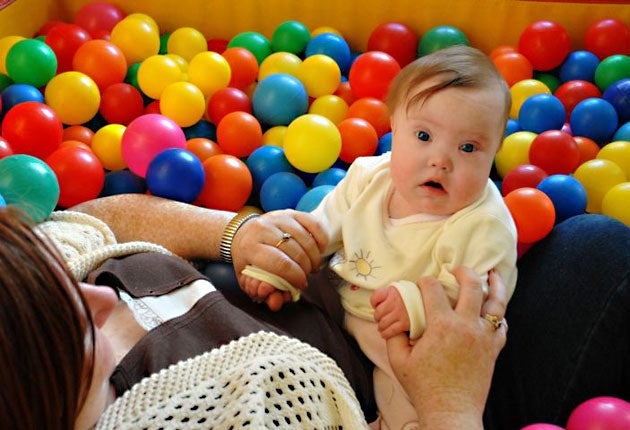
Parents appear to be more willing to bring a child with Down's syndrome into the world because British society has become increasingly accepting of the genetic abnormality which affects one in every 1,000 babies.
After the widespread introduction in 1989 of pre-natal screening to "tackle" Down's syndrome, the number of babies born with the genetic abnormality fell from 717 a year to 594 at the start of this decade. Armed with the knowledge that their baby would suffer from Down's, caused by the presence of an extra chromosome, an increasing numbers of parents chose to have an abortion.
But that trend has been reversed: the number of children being born with Down's syndrome in Britain has reached a high of 749 – the equivalent of two births every day.
And a survey timed to coincide with the release of figures from the National Down Syndrome Cytogenetic Register finds parents more accepting of the possibility that their child might have Down's. The Down's Syndrome Association, in conjunction with the BBC, questioned 1,000 of its members to find out why parents where increasingly likely to push on with a pregnancy where the child had Down's syndrome.
Previous consensus had attributed the rise to the fact that women are increasingly having babies at a later age, which increases the risk of Down's, but the latest survey suggests there are other reasons at play.
The results of the survey showed that, although a third of respondents said religious or pro-life leanings meant they were against the idea of abortion, many parents also felt that Britain had become a much better place to bring up a child with Down's syndrome.
A quarter of the parents said that they already knew people with Down's syndrome or other disabilities and that had influenced their decision to continue with the pregnancy. Thirty-five per cent said they felt that life and society had improved for people with Down's syndrome, while almost half had not believed they would eventually have a child with Down's syndrome, and so had continued with the pregnancy.
"We are all very surprised by this," said Carol Boys, chief executive of the Down's Syndrome Association. "When I and others had our babies it was a very different world – those with Down's syndrome were treated very differently. Now there is much greater inclusion and acceptance, with mainstream education having a huge role. We think this plays a part in the decisions parents make – there's even been a baby with Down's syndrome on EastEnders."
Most recently, awareness of Down's syndrome has been boosted by the defeated American vice-presidential candidate Sarah Palin, who was photographed throughout the presidential campaign feeding her youngest son Trig, who has Down's syndrome. The Independent columnist Dominic Lawson, whose daughter has Down's, said yesterday: "There is a greater understanding than there used to be about Down's syndrome and I think people are a little less scared than they used to be. I also think younger generations of parents are much less keen on the idea of abortion for eugenic reasons.
"While people might understand a parent saying they are too young to have a child it's becoming much less acceptable for mothers who might be having a baby later in life to say 'I want a child but not this one'."
The full report of the Down's Syndrome Association's findings will be featured in a documentary, Born With Down's, to be broadcast on BBC Radio 4 tonight at 8pm.
'There is so much out there for our daughter'
Frances Dine, 39, lives with her husband Paul, 35, in Leeds. She has a 15-year-old daughter, Holly, from a previous marriage and a five-month-old girl with Down's syndrome, Erin.
"We knew there was a good chance Erin might have Down's syndrome but we weren't totally sure because we decided not to opt for the invasive placental test, as there is a risk of miscarriage. I think Paul probably thought about the implications of having a child with Down's more than me but we knew we'd love our child regardless.
"Babies with Down's syndrome can have a great quality of life. At the back of our minds we did keep alive the possibility that she might not have Down's syndrome but we knew that we would be able to cope if she did – there is so much out there for her. Schools are integrated and there are even actors with Down's syndrome. There's a worker at our local supermarket who has Down's syndrome and we think it doesn't need to hold you back.
"It has been hard and at times we've wondered whether we did the right thing, but it is getting easier and we love her to bits. When you have a child you know what to expect. When you have a baby with Down's syndrome you don't – it's a new world. But we are glad to see other parents think it needn't be the grim news it once was."
Join our commenting forum
Join thought-provoking conversations, follow other Independent readers and see their replies
Comments