East German nudists let it all hang out, 20 years on
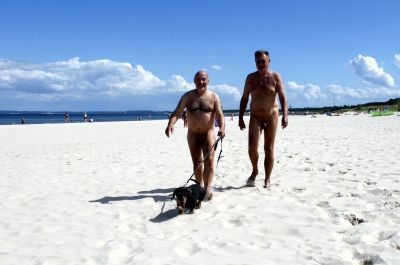
"It has nothing to do with sex," insisted Udo Schumacher, 64, as he stood, stark naked, on a beautiful but bracing beach in Prerow in what was once communist East Germany.
"If you go in and experience how lovely it is to swim with a naked body, and come out without wet trunks on, you feel healthy. And if you can get over the fact that you are naked, it is great," he told AFP back in August.
"Freikoerperkultur" ("Free body culture"), or "FKK" for short, was hugely popular in the otherwise highly restrictive German Democratic Republic (GDR), much more so than in West Germany.
And 20 years after the fall of the Berlin Wall this November 9, the habit is still going strong, and has even attracted a loyal band of followers from what was West Germany to the beaches of the east.
With life so tightly controlled in other ways -- no freedom of speech, little freedom to travel, the Stasi secret police spying on citizens -- FKK was a rare liberty that people made full use of in the GDR.
"It was one of the few liberties," said Schumacher, who is from Dortmund in the west. "I get the feeling that people in the GDR said to the authorities, 'Don't take this away from us as well'."
Nowhere was this more evident than here in Prerow, a picturesque seaside town 300 kilometres (190 miles) north of Berlin, with its long, pristine beaches, sand dunes and crystal-clear, if chilly, water.
Here in GDR times, 2,500 border guards, 70 watch towers, searchlights, barbed wire, boats and radar all made sure no one escaped by sea to West Germany or to Denmark, Doris Pegel, 53, curator of the local museum, told AFP.
Sailing and even surfing were off limits. But one thing people were allowed to do in the shadow of Prerow's watchtowers, and on other beaches and lakes around the communist country, was to indulge in FKK.
And indulge they did, in huge numbers, as people flocked to the seaside in summer and gave FKK a try. In Prerow, for example, nudists created one of the GDR's first nudist campsites, where demand for pitches was massive.
-- No sex please, we're comrades --
-----------------------------------
When the GDR was still young, however, the Politburo saw FKK as a hangover from the Nazis and as dangerous petty bourgeois degeneracy, Josie McLellan, a modern history lecturer at Britain's University of Bristol who has researched the phenomenon, told AFP.
Such suspicions were not helped by events in Prerow, where nudists gathered on the beach and the sand dunes at night, daubing body parts with toothpaste and wearing African-style headgear for debauched "Cameroon Parties."
With the ministry of the interior calling nudism a threat to the "natural and healthy feelings of our working people", the authorities tried to stamp out FKK in the 1950s.
But many nudists were also party members, policeman and even judges, who protested that "doing FKK" and being a good communist were not mutually exclusive, and that nudism was non-sexual.
"Here, the woman is not an object of desire, she is a comrade, there is no bikini to excite you," McLellan cites one contributor to an illuminating 1966 survey of nudists as saying.
A widespread campaign of popular resistance soon made the authorities relent, and by the 1960s and 1970s onwards FKK was almost a national pastime that was even encouraged by the regime.
It became much more popular than in both Western Europe and in the rest of the Eastern Bloc, with the possible exception of the beaches of Croatia in the former Yugoslavia.
This was because although nudism was tolerated, belonging to any kind of nudist organisation was banned. Such logic made FKK more popular since people could just give it a try, without having to join a club first.
As one joke put it: "What do you call a gathering of two or more GDR citizens? An illegal meeting. Or a nudist beach."
-- GDR is dead, long live FKK --
--------------------------------
When the Berlin Wall fell in 1989, Doris Pegel was in West Germany, and remembers phoning home in Prerow and being told that, along with everywhere else in the GDR, there were joyous scenes.
"I was told, 'They're surfing on the beach in Prerow'," Pegel told AFP.
But of the many things to flood eastwards after German unification in 1990, one of the less welcome was a certain prudishness towards nudism on the part of the curious new "Wessi" ("Westerner") tourists.
The result was an effort to regulate the hobby more, and to demarcate beaches and lakes into FKK and clothed areas.
A look around in Prerow today shows that although the GDR is long dead, the old spirit of FKK has survived.
"Here it's all very mixed because people don't have a problem with it. It's supposed to be separated but nobody really minds," 66-year-old nudist Inge told AFP on Prerow beach.
A naked Werner Tallen, a 60-year-old lawyer, meanwhile insisted with a smile that he travelled the 825 kilometres (510 miles) from his home in Munich "because of the Baltic, not because of FKK."
Join our commenting forum
Join thought-provoking conversations, follow other Independent readers and see their replies
Comments